
100 Years of Ol Chiki Script by Pandit Raghunath Murmu
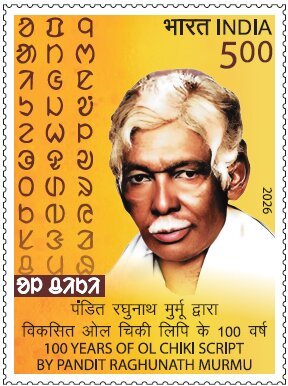
Technical Data
| Date of Issue | February 16, 2026 |
|---|---|
| Denomination | Rs. 5 |
| Quantity | 202,800 |
| Printer | Security Printing Press, Hyderabad |
| Printing Process | Wet Offset |
| Colors | Multicolor |
| Credit (Designed By) | Ms. Nenu Gupta |
| Catalog Codes |
Colnect codes IN 2026.02.16-01 |
| Themes | Famous people | Letters (Alphabet) | Linguists | Literary People (Poets and Writers) |
A Century of Santali Linguistic and Cultural Renaissance
The Ol Chiki script, developed in 1925 by Raghunath Murmu, stands as a landmark achievement in India’s tradition of indigenous linguistic innovation. Designed specifically for the Santali language, Ol Chiki provided a scientific, structured, and phonetic writing system that gave Santali its own independent identity.
The year marks the centenary of the Ol Chiki script—celebrating 100 years of linguistic empowerment, cultural revival, and intellectual self-expression.
The Vision of Pandit Raghunath Murmu
Born on 5 May 1905 in Dandbose village of Mayurbhanj (present-day Odisha), Raghunath Murmu recognized the urgent need for a dedicated script for Santali—one of India’s largest tribal languages. At the time, Santali was primarily transmitted through oral traditions and written using Bengali, Odia, or Roman scripts, none of which fully captured its phonetic structure.
Motivated by this gap, he devised the Ol Chiki script in 1925. Revered as Guru Gomke (Great Teacher), Murmu not only created the script but also authored plays, songs, textbooks, and teaching materials in Ol Chiki to promote literacy and cultural awareness among the Santali community.
He passed away on 1 February 1982, leaving behind a transformative legacy that continues to inspire generations.
Recognition and Growth of Ol Chiki
The Ol Chiki script was formally presented at the Mayurbhanj State Exhibition in 1939, marking a significant milestone in its recognition and acceptance.
From the mid-twentieth century onward, Ol Chiki emerged as a powerful medium for:
- Literary creation
- Educational advancement
- Cultural documentation
- Community empowerment
Writers, teachers, and cultural activists embraced the script as a symbol of dignity, modernization, and self-respect. It enabled the publication of novels, poetry, grammar books, children’s literature, magazines, and theatrical works. It also strengthened efforts to document Santali folklore and oral traditions.
Constitutional Recognition of Santali Language
The sustained development of Ol Chiki contributed significantly to the historic inclusion of the Santali language in the Eighth Schedule of the Constitution of India through the 92nd Constitutional (Amendment) Act, 2003.
This recognition formally acknowledged Santali as one of India’s scheduled languages, reinforcing the importance of linguistic diversity in the nation’s democratic framework.
Cultural and Regional Impact
Today, the Ol Chiki script is widely used across Jharkhand, Odisha, West Bengal, Assam, and other regions with significant Santali-speaking populations.
Beyond its linguistic function, Ol Chiki serves as:
- A symbol of cultural identity
- A medium of education and research
- A presence in public signage and institutional emblems
- A vibrant element of festivals and community life
The script continues to strengthen cultural confidence and preserve indigenous knowledge systems.
Commemorative Postage Stamp on the Centenary of Ol Chiki Script
To honour 100 years of the Ol Chiki script and its visionary creator, India Post has issued a Commemorative Postage Stamp on the Centenary of Ol Chiki Script.
This commemorative stamp celebrates:
- The linguistic innovation of Raghunath Murmu
- The cultural renaissance of the Santali community
- India’s commitment to linguistic diversity
- The preservation of inclusive cultural heritage
Through this philatelic tribute, the Department of Posts recognizes Ol Chiki as a distinctive and enduring symbol of India’s rich multilingual identity.
Conclusion
The Ol Chiki script is more than a writing system—it is a movement of cultural awakening and self-expression. For a century, it has empowered Santali speakers with literacy, pride, and recognition.
As the nation celebrates its centenary, Ol Chiki stands as a powerful reminder of India’s dedication to preserving and promoting its diverse linguistic traditions.
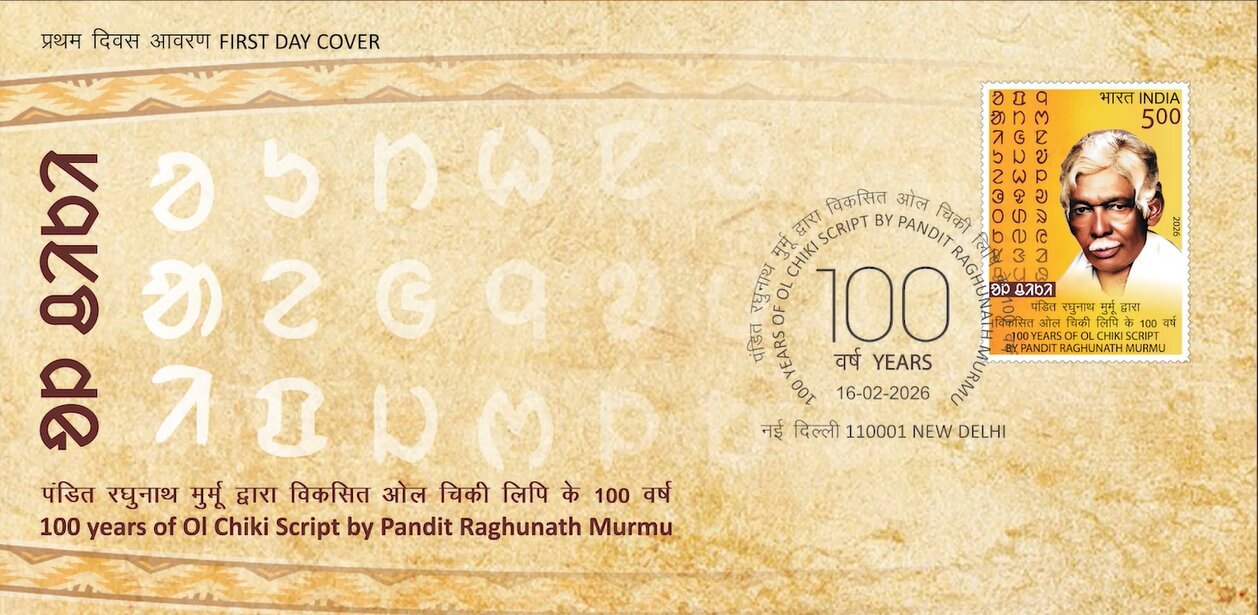
First Day Cover
Leave a Comment
You must be logged in to post a comment.