
Padampat Singhania (1905-1979)
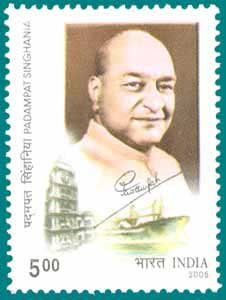
Technical Data
| Date of Issue | February 3, 2005 |
|---|---|
| Denomination | Rs. 5 |
| Quantity | 600,000 |
| Perforation | comb 13½ |
| Printer | Security Printing Press, Nashik |
| Watermark | No Watermark |
| Colors | Multicolor |
| Catalog Codes |
Michel IN 2074 Stamp Number IN 2097 Yvert et Tellier IN 1839 Stanley Gibbons IN 2256 WADP Numbering System - WNS IN005.05 |
| Themes | Anniversaries and Jubilees | Famous people | Men |
Visionary Industrialist and Nation Builder
Padampat Singhania was a pioneering entrepreneur, nationalist, and philanthropist who played a crucial role in shaping India’s industrial growth. As the head of the J.K. Organization, he believed that true national freedom could only be achieved through industrial self-reliance and economic strength.
Early Life and Background
Padampat Singhania was born on 3 February 1905 to Kamalapat Singhania and Ram Pyari. Though he did not receive formal schooling, he gained practical knowledge and business skills through real-life experiences, which later helped him become one of India’s leading industrialists.
From a very young age, Singhania displayed exceptional maturity and business insight. At just 16 years old, he began taking significant responsibilities in the J.K. Cotton Spinning and Weaving Mills, established in the spirit of the Swadeshi Movement. After the death of his father, he successfully managed and expanded the family business.
Role in India’s Freedom Movement
Padampat Singhania was deeply influenced by nationalist ideals. During the Quit India Movement, he supported the freedom struggle by providing financial assistance to prominent leaders, including Madan Mohan Malviya and Balkrishna Sharma.
Although he was awarded Knighthood by the British Government in 1943, he continued to support the Swadeshi cause and the independence movement through generous contributions and discreet assistance.
Contribution to the Constitution of India
Padampat Singhania also played a significant role in India’s constitutional history. He served as a member of the Constituent Assembly of India and was among the signatories to the Constitution of India.
Expansion of the J.K. Industrial Empire
After India gained independence, Singhania expanded the J.K. industrial group into a diversified conglomerate. Under his leadership, the organization grew to include over 70 industrial units in India and abroad.
The group’s business activities covered a wide range of sectors, including:
- Cotton textiles
- Rayon and nylon
- Iron and steel
- Cement manufacturing
- Shipping
- Air transportation
His visionary leadership helped strengthen India’s industrial base during the crucial years of nation-building.
Social Service and Philanthropy
Padampat Singhania believed strongly in social reform and humanitarian service. Inspired by the teachings of the Bhagavad Gita, he actively supported initiatives aimed at social and religious reform.
He established several educational, medical, and religious institutions to benefit society. His contributions to public welfare also included founding the Merchants’ Chamber of Uttar Pradesh to promote commerce and industry.
In recognition of his contributions to society and industry, the University of Kanpur awarded him the honorary degree of Doctor of Letters (D.Litt.) in 1969.
Public Life and Legacy
Apart from his industrial achievements, Padampat Singhania also served as a member of the Legislative Assembly and remained active in public affairs. Known for his simplicity and commitment to the welfare of society, he dedicated his life to the service of the nation and its people.
Padampat Singhania passed away on 18 November 1979, leaving behind a legacy of entrepreneurship, nationalism, and philanthropy.
Commemorative Postage Stamp
To honor his remarkable contributions to India’s industrial growth and national development, India Post issued a commemorative postage stamp dedicated to Padampat Singhania, celebrating his spirit of nationalism, enterprise, and service to society.