
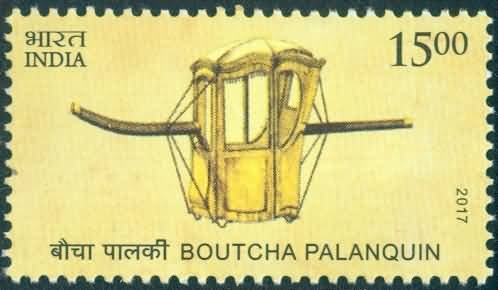
Boutcha Palanquin
Technical Data
| Date of Issue | March 25, 2017 |
|---|---|
| Denomination | Rs. 15 |
| Quantity | 3,000 |
| Perforation | 13 |
| Printer | India Security Press, Nashik |
| Printing Process | Wet Offset |
| Watermark | No Watermark |
| Colors | Multicolor |
| Credit (Designed By) | Sh. Brahm Prakash |
| Catalog Codes |
Michel IN 3129 Yvert et Tellier IN 2820 Stanley Gibbons IN 3283 |
| Themes | Transport |
Among the traditional varieties of palanquins illustrated in the Commemorative Postage Stamp Series on Indian Transport, the Boutcha Palanquin represents a distinctive and culturally significant model. It reflects the diversity in design and craftsmanship that characterized India’s early modes of human-borne transport.
Design and Features
The Boutcha Palanquin was typically more enclosed and compact in structure compared to simpler open models like the Chowpaul. Carefully crafted from wood, it generally featured:
- A fully or semi-enclosed cabin
- Curved or decorative roof structure
- Side panels or curtains for privacy
- Long carrying poles fixed lengthwise
The enclosed design provided greater comfort and privacy to the occupant, especially during long journeys or ceremonial occasions. It was usually carried by four or more bearers, depending on its size and weight.
Social and Cultural Importance
The Boutcha Palanquin was often associated with:
- Noble families and respected members of society
- Traditional wedding ceremonies
- Religious and festive processions
Its refined structure and ornamental detailing reflected status and prestige. Like other palanquins, it was not merely a mode of transport but also a symbol of dignity and social identity.
Historical Context
Palanquins have been mentioned in ancient Indian texts, including the Ramayana, indicating their long-standing presence in Indian civilization. During medieval times, they were widely used by royalty, landlords, and women of noble households.
With the introduction of rickshaws in the late 19th century and the expansion of mechanized transport systems, the everyday use of palanquins gradually declined. Today, models like the Boutcha survive primarily in ceremonial contexts and as heritage artifacts.
Philatelic Significance
The commemorative postage stamp depicting the Boutcha Palanquin forms part of the 20-stamp Indian Transport series issued in five miniature sheets. The stamp beautifully captures the elegance and historical value of this traditional conveyance.
For philatelists and history enthusiasts, the Boutcha Palanquin stamp stands as a tribute to India’s rich transport heritage and the craftsmanship that defined early mobility in the country.
Leave a Comment
You must be logged in to post a comment.