
Long Palanquin
Technical Data
| Date of Issue | March 25, 2017 |
|---|---|
| Denomination | Rs. 5 |
| Quantity | 3,000 |
| Perforation | 13 |
| Printer | India Security Press, Nashik |
| Printing Process | Wet Offset |
| Watermark | No Watermark |
| Colors | Multicolor |
| Credit (Designed By) | Sh. Brahm Prakash |
| Catalog Codes |
Michel IN 3127 Yvert et Tellier IN 2818 Stanley Gibbons IN 3281 |
| Themes | Transport |
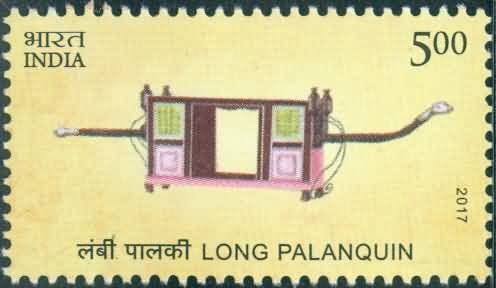
The Long Palanquin represents one of the extended forms of traditional Indian palanquins depicted in the Commemorative Postage Stamp Series on Indian Transport issued by the Department of Posts. As mobility evolved through centuries, variations in palanquin design emerged to suit different needs, and the Long Palanquin stands out for its size, capacity, and ceremonial importance.
Design and Construction
As the name suggests, the Long Palanquin was larger and more elongated than standard palkis. Crafted primarily from sturdy wood, it generally featured:
- An extended rectangular cabin
- A covered or semi-enclosed structure
- Decorative panels or curtains
- A long, strong pole system for support
Due to its length and weight, it was typically carried by six or more bearers, ensuring balance and stability during movement. The design allowed greater comfort and sometimes accommodated more elaborate interior arrangements.
Usage and Social Significance
The Long Palanquin was often associated with:
- Royal and aristocratic travel
- Important ceremonial processions
- Traditional wedding occasions
- Travel over relatively longer distances
Its impressive size and decorative craftsmanship reflected prestige and authority. In earlier times, when organized road networks were limited, such human-borne conveyances provided a dignified and practical means of travel for elite sections of society.
Historical Context
Palanquins have been referenced in ancient Indian literature, including epics such as the Ramayana, demonstrating their long-standing use in Indian civilization. Over time, various regional styles evolved, including compact, enclosed, and elongated versions like the Long Palanquin.
With the advent of rickshaws in the late 19th century and the rapid spread of mechanized transport in the 20th century, palanquins gradually disappeared from daily life. Today, they remain primarily as ceremonial artifacts and cultural symbols.
Philatelic Significance
The commemorative postage stamp featuring the Long Palanquin forms part of the complete set of 20 commemorative stamps on Indian Transport, issued in five miniature sheets. The stamp beautifully captures the grandeur and traditional craftsmanship of this extended palanquin model.
For philatelists and history enthusiasts, the Long Palanquin stamp preserves an important chapter in India’s transport heritage — a reminder of the early systems of mobility that laid the foundation for the nation’s journey toward modern transportation.
Leave a Comment
You must be logged in to post a comment.