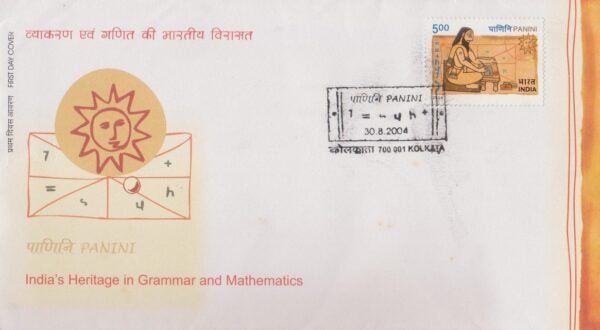
Panini

Technical Data
| Date of Issue | August 30, 2004 |
|---|---|
| Denomination | Rs. 5 |
| Quantity | 400,000 |
| Perforation | comb 13½ |
| Printer | Security Printing Press, Nashik |
| Printing Process | Wet Offset |
| Watermark | No Watermark |
| Colors | Multicolor |
| Credit (Designed By) | Shri Kamleshwar Singh Smt. Alka Sharma |
| Catalog Codes |
Michel IN 2042 Stamp Number IN 2074 Yvert et Tellier IN 1807 Stanley Gibbons IN 2220 WADP Numbering System - WNS IN028.04 |
| Themes | Famous people | Languages | Literary People (Poets and Writers) | Men |
The Great Grammarian and Pioneer of Linguistic Science
Panini is regarded as one of the greatest grammarians in human history. His groundbreaking work on the structure of the Sanskrit revolutionized linguistic analysis and significantly influenced the study of language, mathematics, and even modern computer science. India’s rich intellectual tradition—from the era of the Indus Valley Civilization through the Vedic Period, the Maurya Empire, and the Gupta Empire—created an environment where scholars like Panini could flourish and make monumental contributions to knowledge.
Early Life
Panini was born in Shalatula, a town near Taxila, situated on the Indus River in what is now Pakistan. Scholars place his birth sometime between the 7th and 4th centuries BCE, though it is commonly believed that he was born around 520 BCE and died around 460 BCE.
His parents, Pani and Dakshi, introduced him to the worship of Shiva. According to tradition, the structure of grammar was revealed to Panini through the mystical sounds of Shiva’s drum, which became known as the Shiva Sutras, the foundational sound patterns used in his grammatical system.
The Perfection of Sanskrit Grammar
The word Sanskrit means “perfect” or “refined,” and it was regarded as the sacred language of ancient India. Panini’s work provided an extraordinarily systematic and scientific explanation of the structure of this language. His analysis demonstrated how an infinite number of sentences could be generated from a finite set of grammatical rules—an idea that strongly resembles principles in modern linguistics.
Panini’s grammar carefully examined the phonetics, phonology, and morphology of Sanskrit. His approach categorized linguistic elements based on patterns and similarities and formulated precise rules to describe them. Notably, his work introduced concepts equivalent to phonemes and morphemes, which remain central to modern linguistic theory. Rather than prescribing how language should be used, Panini described how people actually spoke and wrote.
The Major Components of Panini’s Grammar
Panini’s grammatical system consists of four major components:
- Ashtadhyayi – Panini’s principal work consisting of eight chapters divided into smaller sections. It contains about 4,000 concise rules (sutras) that systematically describe Sanskrit grammar.
- Shiva Sutras – A classification of phonological sounds that allows grammatical rules to describe sound patterns efficiently.
- Dhatupatha – A comprehensive list of nearly 2,000 verbal roots, organized with markers indicating grammatical and syntactical properties.
- Ganapatha – Lists of lexical groups that follow particular grammatical rules.
Individually these components may appear complex, but together they form a highly integrated and logically structured grammatical system.
Influence on Mathematics and Computer Science
Panini’s work has often been compared with the geometric system of Euclid because of its logical structure and precision. In his book The Crest of the Peacock, mathematician George Gheverghese Joseph suggested that the algebraic nature of Indian mathematics was influenced by the structure of Sanskrit grammar.
The rule-based system created by Panini is remarkably similar to modern formal language theory used in computer science. His grammar uses advanced concepts such as recursion, transformations, and meta-rules, making it comparable in logical power to a Turing machine. Because of this, many scholars consider Panini a forerunner of computational linguistics and even refer to him as a pioneer of concepts that later influenced computer programming languages.
Legacy
More than 2,500 years after his time, Panini’s work continues to influence linguistics, philosophy, mathematics, and computer science. His grammar remains one of the most sophisticated analyses of language ever produced.
Recognizing the immense intellectual legacy of this ancient scholar, the India Post issued a commemorative postage stamp in honour of Panini, celebrating him as one of the greatest minds in the history of human knowledge.
First Day Cover