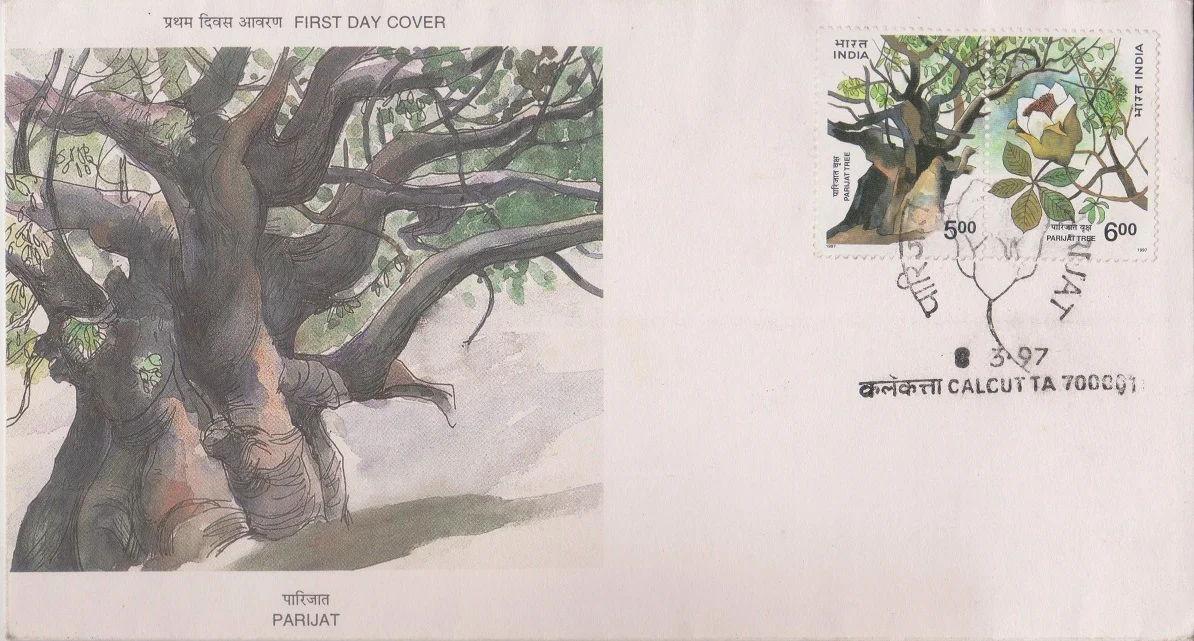
Parijat Flower

Technical Data
| Date of Issue | March 8, 1997 |
|---|---|
| Denomination | Rs. 6 |
| Quantity | 700,000 |
| Perforation | comb 13 x 13½ |
| Printer | Calcutta Security Printers Ltd |
| Printing Process | Offset Lithography |
| Watermark | No Watermark |
| Colors | Multicolor |
| Credit (Designed By) | R. N. Pasricha |
| Catalog Codes |
Michel IN 1542 Stamp Number IN 1600 Yvert et Tellier IN 1312 Stanley Gibbons IN 1706 |
| Themes | Flowers | Plants (Flora) | Trees |
Introduction
The Parijat flower is one of the most beautiful and fragrant flowers in India. It is associated with divinity and is highly valued in Indian culture and tradition. The flower has also been mentioned in the poems of Rabindranath Tagore, showing its literary significance.
Other Names
The Parijat flower is known by several names:
- Har Singar
- Sephali
- Sephalika
- Night Jasmine
Physical Features
The Parijat flower is admired for its delicate appearance and sweet fragrance.
- It blossoms only in the evening hours.
- The flowers fall off by the next morning.
- The stem of the flower is saffron-orange in colour.
- The petals are white and soft.
- The flowers are highly fragrant.
- Flowering season is from August to October.
Distribution
Parijat flowers are commonly found in many parts of India, especially in the outer Himalayan regions up to 1400 metres. They grow in:
- Jammu and Kashmir
- Nepal
- Assam
- West Bengal
- Tripura
- Central India up to the Godavari region
It is also found in Thailand, Indonesia, and Pakistan.
Medicinal Uses
The Parijat flower is not only decorative but also useful in traditional medicine.
- The flowers act as an appetiser.
- They help soothe the stomach.
- They are used in herbal remedies for health benefits.
Cultural Importance
Because of its divine association and unique blooming habit, the Parijat flower is often used in worship, gardens, and cultural traditions.
Conclusion
The Parijat flower is a symbol of purity, beauty, and fragrance. Its white petals, saffron stem, pleasant scent, and medicinal value make it one of the most cherished flowers in Indian heritage.
First Day Cover