
Pingali Venkaiah
Technical Data
| Date of Issue | August 12, 2009 |
|---|---|
| Denomination | Rs. 5 |
| Quantity | 400,000 |
| Perforation | 13 |
| Printer | India Security Press, Nasik |
| Printing Process | Photo Gravure |
| Watermark | No Watermark |
| Colors | Multicolor |
| Credit (Designed By) | Sh. Sankha Samanta |
| Catalog Codes |
Michel IN 2397 Stamp Number IN 2337 Stanley Gibbons IN 2616 WADP Numbering System - WNS IN050.2009 |
| Themes | Commemoration | Famous people | Flags | Freedom Fighters | Men |
Architect of India’s Tricolour
Shri Pingali Venkaiah, the revered designer of the Indian National Flag, was born on 2nd August 1878 at Bhatlapenumarru in Divi Taluk, Krishna District, Andhra Pradesh, to Shri Pingali Hanumantha Rayudu and Smt. Venkataratnamma. His life was a remarkable blend of patriotism, scholarship, and innovation that ultimately gave India its most cherished national symbol.
Early Life and Education
Pingali Venkaiah received his primary education in his village and completed high school at Hindu High School, Machilipatnam. Inspired by patriotic fervour, he left for Bombay (Mumbai) at the age of 19 and joined the Army. After training, he was posted to Africa, where he participated in the Boer War (1899–1902).
During his stay in Africa, he met Mahatma Gandhi and was deeply influenced by his ideology and vision for India.
Service and Social Commitment
After returning to India, Venkaiah worked briefly as a Railway Guard. When Madras (Chennai) was struck by a devastating plague epidemic, he resigned from his job and trained as a Work Inspector. He then served as a Plague Disease Eradication Inspector, dedicating himself to public welfare during a critical time.
Scholar and Agricultural Innovator
Pingali Venkaiah was a versatile genius with diverse interests. He studied diamonds, geology, agriculture, and languages, mastering Japanese, Urdu, and Sanskrit. In 1904, inspired by Japan’s victory over Russia, he learned Japanese out of admiration for the nation’s resilience.
During the Khadi Movement initiated by Mahatma Gandhi, he imported Cambodian cotton seeds from America and successfully developed a hybrid variety suited to Indian conditions. His remarkable achievement earned him the title “Patti (Cotton) Venkaiah.” In recognition of his agricultural contributions, he was granted honorary membership in the Royal Agricultural Society of London.
Quest for a National Flag
In 1906, Venkaiah attended the 22nd Session of the Indian National Congress at Calcutta (Kolkata), presided over by Dadabhai Naoroji. Disturbed by the hoisting of the British Union Jack at the Congress session, he resolved to design a flag that would symbolize India’s identity and aspirations.
In 1916, he published a book titled A National Flag for India, presenting 30 different flag designs. His dedication to this cause earned him respect within the Congress circles.
Designing the Indian National Flag
At the Indian National Congress meeting held at Vijayawada in April 1921, Mahatma Gandhi asked Pingali Venkaiah to prepare a design for a national flag. Within three hours, he presented a two-coloured flag (red and green) featuring the charkha symbol. Later, white was added to represent truth and peace.
Gandhi praised Venkaiah’s relentless efforts in the newspaper Young India under the heading “Our National Flag,” acknowledging his years of struggle to secure approval for a national emblem. From then on, he came to be popularly known as “Jhanda Venkaiah.”
Final Years and Legacy
Pingali Venkaiah passed away on 4th July 1963. Though he did not live to see the full recognition of his immense contribution, history remembers him as the visionary who laid the foundation for India’s tricolour — a symbol of unity, sacrifice, truth, and freedom.
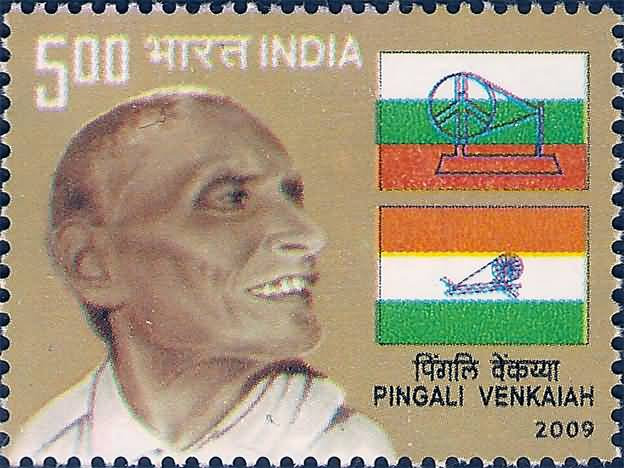
The Department of Posts is proud to honour Shri Pingali Venkaiah by issuing a commemorative postage stamp that depicts two of his significant flag designs, paying tribute to his extraordinary vision and dedication to the nation.
His life stands as a testament to intellectual brilliance, tireless perseverance, and unwavering patriotism.
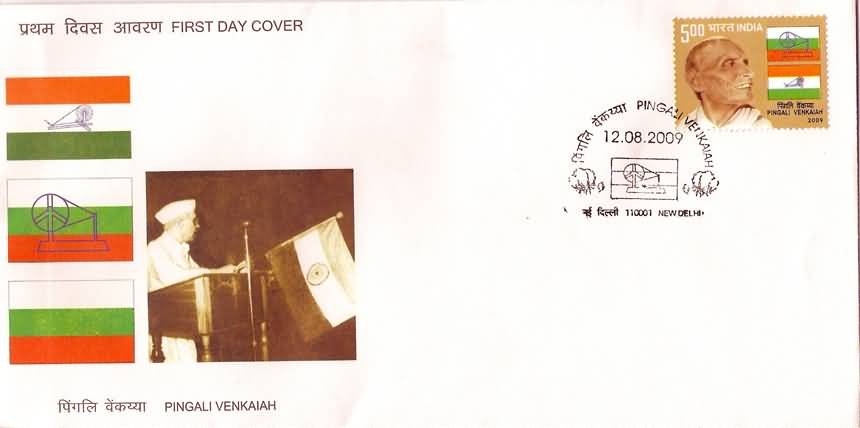
First Day Cover
Leave a Comment
You must be logged in to post a comment.