
Prabodh Chandra (1911-1986)
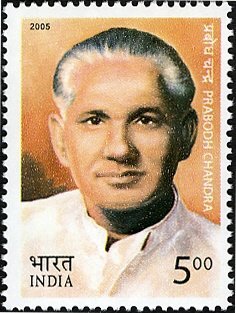
Technical Data
| Date of Issue | October 24, 2005 |
|---|---|
| Denomination | Rs. 5 |
| Quantity | 600,000 |
| Perforation | comb 13¼ |
| Printer | Security Printing Press, Nashik |
| Watermark | No Watermark |
| Colors | Multicolor |
| Catalog Codes |
Michel IN 2106 Stamp Number IN 2121 Yvert et Tellier IN 1867 Stanley Gibbons IN 2291 WADP Numbering System - WNS IN038.05 |
| Themes | Commemoration | Famous people | Men | Politicians |
Introduction
Prabodh Chandra was a distinguished freedom fighter, political leader, and writer who devoted his life to the service of the nation. Known for his visionary leadership and dedication to social justice, he played an important role in India’s freedom struggle and later contributed significantly to public life in independent India.
Early Life and Education
Prabodh Chandra was born on 24 October 1911 in Rawalpindi (now in Pakistan). His father, Satya Dev, served as the Headmaster of a Government High School, while his mother was Durga Devi.
He completed his matriculation from the Government High School in Gujrat in 1927. Later, he passed his Intermediate examination as a private candidate in 1930 and went on to complete his graduation and post-graduation from Forman Christian College in Lahore.
During his youth, he was deeply inspired by prominent national leaders such as Subhas Chandra Bose and Abul Kalam Azad. He was also influenced by the heroic lives of Shivaji and Giuseppe Garibaldi.
Role in the Freedom Movement
Prabodh Chandra began his political journey at the young age of 16. In 1927, he founded the Multan Student Union, marking the beginning of his active involvement in student politics.
He maintained close connections with revolutionary groups such as the Lahore Revolutionary Party and was arrested in connection with the Multan Bomb Case in 1929. He faced imprisonment several times for his nationalist activities—first in 1930 and 1936, and later during the freedom struggle from 1942 to 1945.
He also played a major role in organizing the student movement in Punjab and served as Chairman of the All-India Students’ Conference in 1936. In 1938, he was selected as the sole representative of Indian students to attend the World Youth Congress in Budapest, although he could not attend the event.
Political Career
After his early revolutionary activities, Prabodh Chandra joined the Indian National Congress and became a member of the Punjab Pradesh Congress Committee.
He was elected to the Punjab Legislative Assembly in 1946. After India gained independence, he continued his political career and was again elected to the Assembly in 1952, 1960, and 1962.
From March 1962 to March 1964, he served as the Speaker of the Punjab Legislative Assembly. Later, he also worked as a Minister in the Punjab Government, handling important portfolios such as Education, Health, and Local Self Government. He further served the nation as a Member of Parliament from 1971 to 1977.
Social Vision and Public Service
Prabodh Chandra was widely regarded as a leader of the people. He consistently worked for the upliftment of the poor and marginalized sections of society. A strong supporter of social equality, he also advocated the promotion of cottage industries while recognizing the importance of heavy industries for national development.
Literary Contributions
Apart from his political career, Prabodh Chandra was also an accomplished writer and editor. In 1936, he edited an English monthly titled “The Students’ Tribune” published from Lahore.
He also contributed articles to the quarterly journal “Contemporary India.” Among his notable publications were Student’s Movement in India (1939) and Sixty Years of Congress (1946), which reflected his deep engagement with political and social issues.
Legacy and Commemoration
Prabodh Chandra passed away on 8 February 1986. His lifelong dedication to freedom, social justice, and public service left a lasting legacy.
To honour his contributions to the nation, the India Post issued a commemorative postage stamp in his memory.
Leave a Comment
You must be logged in to post a comment.