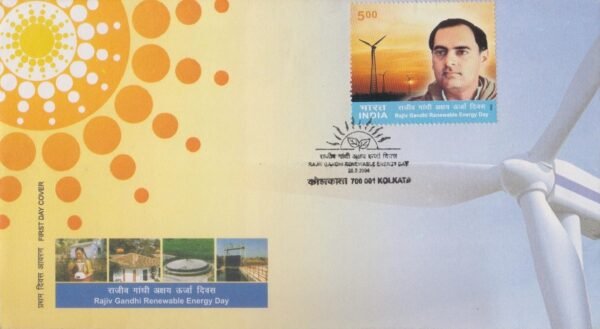
Rajiv Gandhi Renewable Energy Day

Technical Data
| Date of Issue | August 20, 2004 |
|---|---|
| Denomination | Rs. 5 |
| Quantity | 800,000 |
| Perforation | comb 13½ |
| Printer | Calcutta Security Printers Ltd |
| Watermark | No Watermark |
| Colors | Multicolor |
| Catalog Codes |
Michel IN 2040 Stamp Number IN 2072 Yvert et Tellier IN 1805 Stanley Gibbons IN 2218 WADP Numbering System - WNS IN026.04 |
| Themes | Anniversaries and Jubilees | Energy | Energy Conservation | Famous people | Men | Politicians | Windmills |
Promoting Renewable Energy in India
Rajiv Gandhi (1944–1991), who served as the Prime Minister of India from 1984 to 1989, is remembered as a visionary leader who sought to modernize the nation. His leadership emphasized the use of science and technology for development, economic modernization, and empowerment of local governance institutions such as Panchayati Raj and Nagarpalika.
One of Rajiv Gandhi’s major priorities was ensuring that every village in India had access to electricity. He strongly believed that no household should remain without power and therefore emphasized the development and use of alternative and renewable sources of energy.
Origin of Rajiv Gandhi Akshay Urja Diwas
To honour his vision of energy access and sustainable development, the Ministry of Non-Conventional Energy Sources of the Government of India declared 20 August 2004, the 60th birth anniversary of Rajiv Gandhi, as Rajiv Gandhi Akshay Urja Diwas.
The initiative aimed to promote renewable energy awareness and encourage citizens, particularly students, to understand the importance of clean and sustainable energy sources.
Awareness Campaign and Activities
As part of the campaign, educational and awareness programmes were conducted across the country. These initiatives focused especially on school children to promote the idea of energy security through renewable energy.
Various activities were organized at the district level, including:
- Essay writing competitions
- Painting competitions
- Debates and discussions
- Rallies and human chains
- Street plays and dramas using local folk art forms
These activities helped spread awareness about the importance of renewable energy and sustainable development.
Importance of Renewable Energy
Renewable energy is obtained from natural resources that are continuously replenished and environmentally friendly. India possesses vast potential for renewable energy, which can help address issues such as power shortages and lack of clean fuels in rural areas.
Major sources of renewable energy include:
- Biomass energy – Derived from agricultural residues, trees, cow dung, energy crops, and urban waste. It can be used to produce heat, electricity, biogas, and liquid fuels such as alcohol or biodiesel.
- Hydropower – Generated from the flow of water. Small and micro-hydropower systems can meet electricity needs in rural and remote areas.
- Solar energy – Harnessed using thermal systems and photovoltaic technology to generate electricity.
- Wind energy – Used primarily for electricity generation and water pumping.
- Ocean energy – Produced from tidal forces, waves, and thermal differences in the ocean.
The Sun, being the primary source of energy for life on Earth, forms the foundation for many renewable energy systems.
Renewable Energy Applications
India has already installed thousands of megawatts of renewable power capacity. Some of the most common applications include:
- Solar lanterns for rural lighting
- Domestic solar water heating systems
- Biogas plants for clean cooking fuel and electricity
- Small hydropower plants for decentralized power generation
These technologies play a significant role in providing clean, sustainable, and affordable energy, especially to remote villages.
Commemorative Stamp
To mark the significance of this initiative, India Post issued a commemorative postage stamp on Rajiv Gandhi Akshay Urja Diwas. The stamp highlights important renewable energy applications such as solar lanterns, solar water heating systems, biogas units, and small hydropower plants, symbolizing India’s commitment to sustainable energy and the fulfillment of Rajiv Gandhi’s vision for a brighter and electrified nation.
First Day Cover