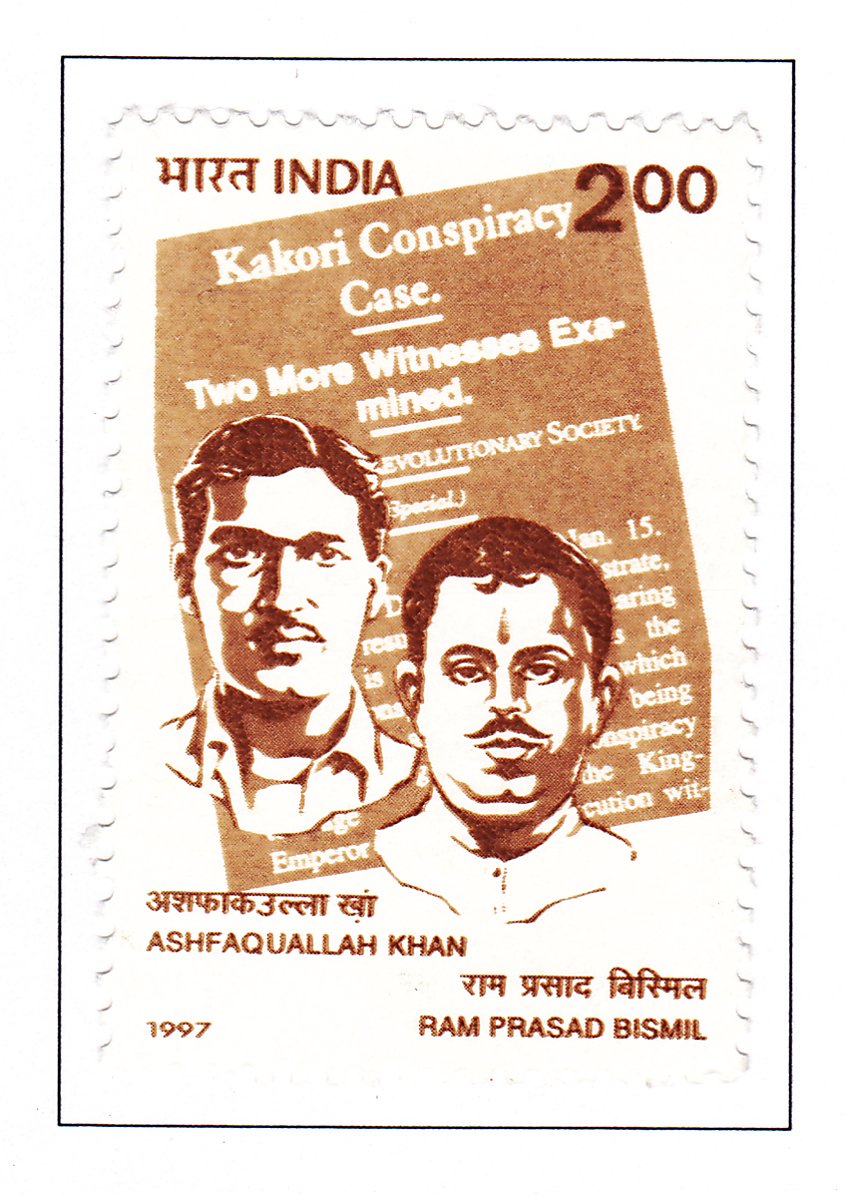
Ram Prasad Bismil and Ashfaquallah Khan
Technical Data
| Date of Issue | December 19, 1997 |
|---|---|
| Denomination | Rs. 2 |
| Quantity | 400,000 |
| Perforation | comb 13 |
| Printer | Security Printing Press, Nashik |
| Printing Process | Photogravure |
| Watermark | No Watermark |
| Colors | Red Brown |
| Credit (Designed By) | Smt. Alka Sharma |
| Catalog Codes |
Michel IN 1601 Stamp Number IN 1662 Yvert et Tellier IN 1367 Stanley Gibbons IN 1765 |
| Themes | Anniversaries and Jubilees | Famous people | Men | Revolutionaries |
Heroes of India’s Freedom Struggle
The history of India’s struggle for independence is filled with stories of courage, sacrifice, and patriotism. Among the most inspiring chapters is the revolutionary movement of the early 20th century, especially during the 1920s. Young men and women across the country bravely challenged British rule, willingly facing imprisonment and even death for the freedom of the nation.
Among these great revolutionaries, Ram Prasad Bismil and Ashfaqullah Khan hold a place of lasting honor.
Ram Prasad Bismil: A Fearless Revolutionary
From a young age, Ram Prasad Bismil was deeply committed to freeing India from colonial rule. Popularly known as Bismil, he became actively involved in revolutionary activities and participated in the Mainpuri Conspiracy.
After escaping arrest, he focused on building the Hindustan Republican Association (HRA), an organization dedicated to ending oppression in India through armed revolution.
Ashfaqullah Khan: Loyal Patriot and Comrade
Ashfaqullah Khan stood beside Bismil as one of the leading figures of the revolutionary movement. His bravery, loyalty, and commitment to India’s freedom made him one of the most respected revolutionaries of his time.
The friendship and partnership between Bismil and Ashfaqullah Khan remain a powerful symbol of unity and patriotism.
The Kakori Train Action of 1925
To raise funds for revolutionary activities, Bismil, Ashfaqullah Khan, and their associates organized a train hold-up near Kakori on the Lucknow–Saharanpur railway line in August 1925.
This event later became famous as the Kakori Conspiracy Case.
Although the revolutionaries had intended to avoid violence, one person was killed during the incident. British authorities launched a massive crackdown and arrested several revolutionaries after intense interrogations.
Trial and Martyrdom
A long court trial followed, involving 22 revolutionaries and lasting nearly one and a half years. The final sentences were severe.
The British Government sentenced the following revolutionaries to death:
- Ram Prasad Bismil
- Ashfaqullah Khan
- Rajendra Lahiri
- Roshan Singh
Many others were deported to the Cellular Jail in the Andamans.
On 19 December 1927, these heroes attained martyrdom for the motherland. Their sacrifices continue to inspire generations of Indians.
Legacy of Bismil and Ashfaqullah Khan
After the death of Bismil, the revolutionary movement was carried forward by Chandrashekhar Azad, Bhagat Singh, and Sukhdev Thapar.
They reorganized the movement and inspired youth across India to fight injustice. Over time, many revolutionaries shifted their focus toward building mass organizations of workers and peasants.
Symbol of Unity and Sacrifice
The story of Ram Prasad Bismil and Ashfaqullah Khan is not only about resistance—it is also about courage, friendship, and national unity beyond religious and social divides.
Their names remain forever etched in the annals of India’s freedom struggle.
Commemorative Stamp in Their Honor
The Department of Posts issued a special commemorative stamp to mark the martyrdom of Ram Prasad Bismil and Ashfaqullah Khan, paying tribute to their extraordinary sacrifice and to all those who gave their lives for India’s independence.
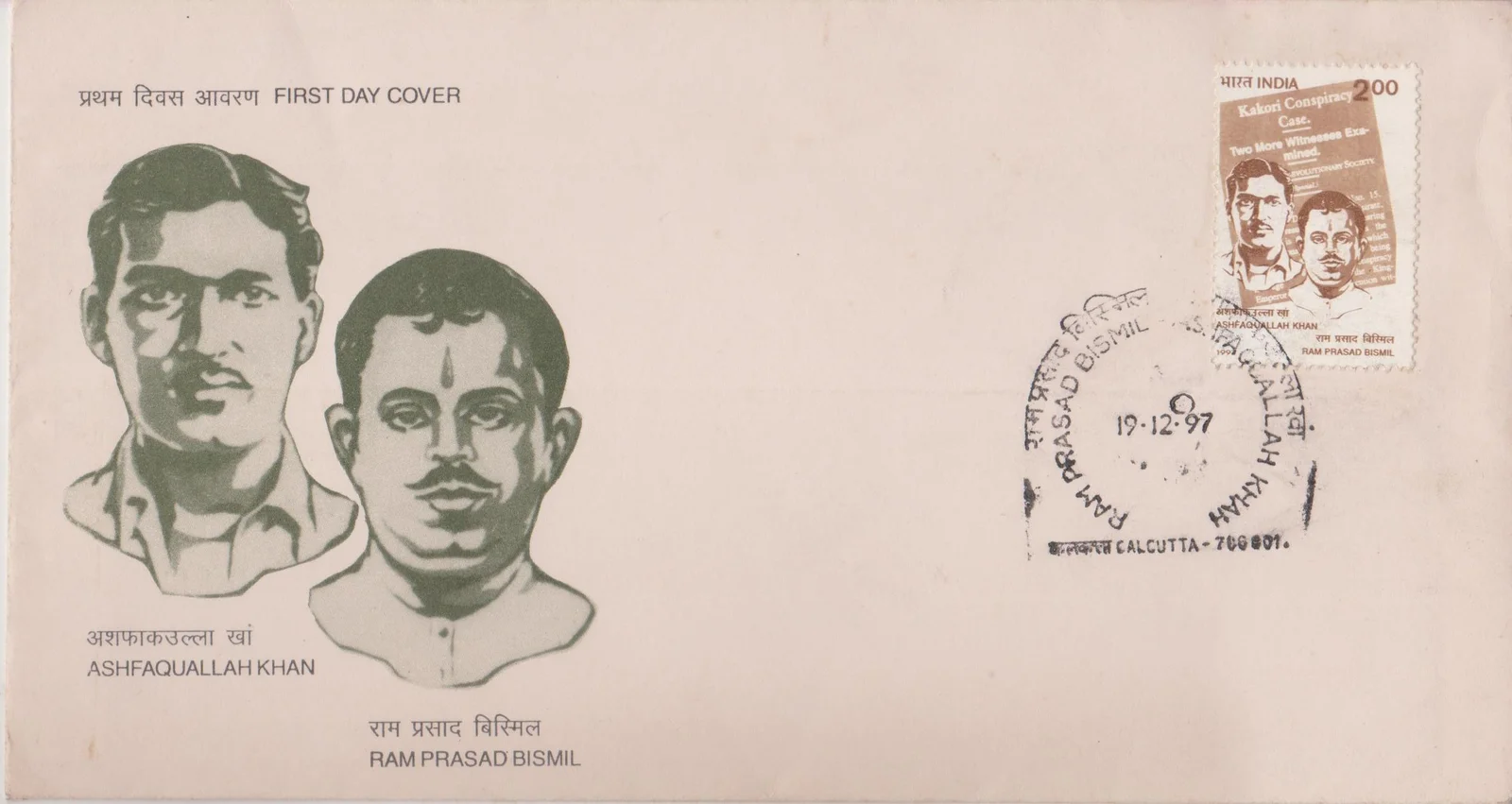
First Day Cover