
100 Years of Rashtriya Swayamsevak Sangh
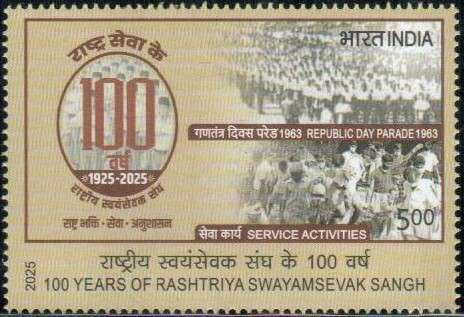
Technical Data
| Date of Issue | October 1, 2025 |
|---|---|
| Denomination | Rs. 5 |
| Quantity | 202,800 |
| Printer | Security Printing Press, Hyderabad |
| Printing Process | Wet Offset |
| Colors | Multicolor |
| Credit (Designed By) | Sh. Sankha Samanta |
| Catalog Codes |
Colnect codes IN 2025.10.01-01 |
| Themes | Anniversaries and Jubilees |
Foundation and Historical Context
The Rashtriya Swayamsevak Sangh (RSS) was founded on 27 September 1925 in Nagpur, Maharashtra, by Dr. Keshav Baliram Hedgewar. Its formation came during a period of intense socio-political awakening in colonial India, marked by the freedom struggle and widespread social reform movements. Conceived as a volunteer-based organization, the RSS emphasized discipline, social responsibility, and cultural awareness. Its vision was to instill national consciousness and self-reliance among citizens during India’s pre-independence era.
Organizational Structure and Growth
At the heart of the RSS structure are its Shakhas—local units where volunteers, known as Swayamsevaks, gather for physical training, community service, prayers, and moral education. This decentralized and participatory model enabled the organization to expand swiftly beyond Nagpur, spreading across Maharashtra and later throughout India.
Following the demise of Dr. Hedgewar in 1940, Madhav Sadashiv Golwalkar strengthened the RSS’s cadre-based framework, while Balasaheb Deoras guided it through a period of wider national outreach and engagement. Today, RSS Shakhas function across both urban and rural India, involving lakhs of participants from diverse backgrounds and age groups.
Nationwide Network and Civic Engagement
Over the decades, the RSS has inspired the creation of a vast network of affiliated organizations dedicated to education, health, social service, and community development. Notable among these are:
- Vidya Bharati – a network of educational institutions focused on holistic learning and character-building.
- Seva Bharati – initiatives in healthcare, disaster relief, and welfare for the underprivileged.
- Various youth, women’s, and farmers’ associations, which promote civic participation and empowerment.
RSS volunteers have been actively involved in national service, contributing to disaster relief, literacy drives, health camps, women’s empowerment, and rural development. These initiatives embody the principle of janbhagidari (mass participation), fostering a deep sense of community cohesion and collective responsibility.
A Century of Service and Nation-Building
The year 2025 marks the centenary of the Rashtriya Swayamsevak Sangh—a momentous milestone in India’s civic and cultural history. The organization’s journey from a local social initiative to a nationwide network stands as a testament to the power of volunteerism in shaping India’s social and national fabric. Through its sustained commitment to service, education, and social harmony, the RSS has contributed significantly to India’s nation-building journey over the past hundred years.
Commemorative Postage Stamp
To honor this historic occasion, the Department of Posts is proud to release a commemorative postage stamp marking 100 years of the Rashtriya Swayamsevak Sangh.
This stamp celebrates the enduring legacy of the RSS in:
- Fostering community initiatives,
- Promoting cultural awareness, and
- Supporting national integration and social service.
It serves as a tribute to the countless volunteers whose unwavering dedication has strengthened India’s educational, social, and civic foundations for a century—an emblem of unity, service, and nation-building.
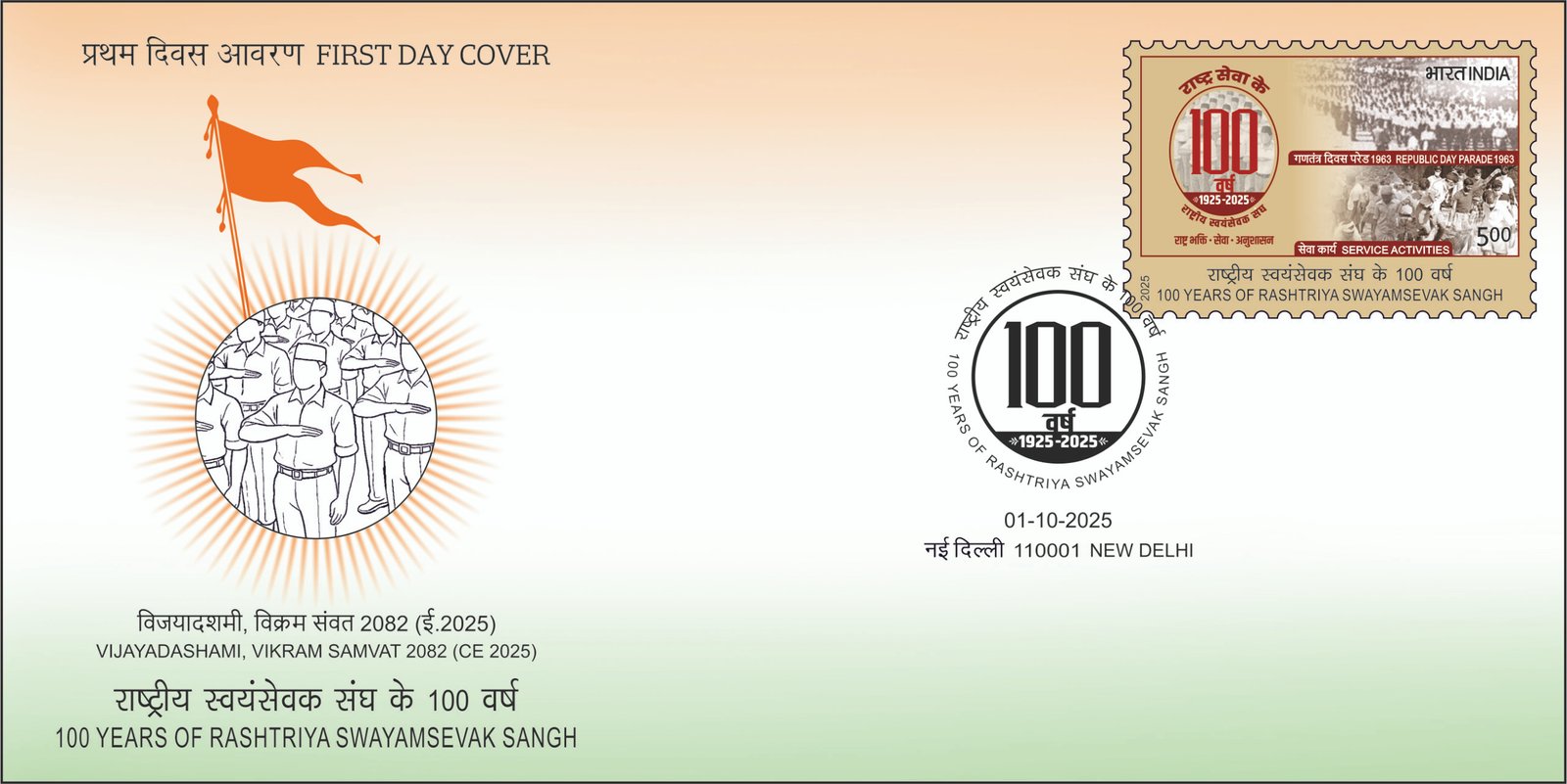
First Day Cover
Leave a Comment
You must be logged in to post a comment.