
Ritwik Ghatak
Technical Data
| Date of Issue | December 31, 2007 |
|---|---|
| Denomination | Rs. 5 |
| Quantity | 400,000 |
| Perforation | 13½ |
| Printer | India Security Press, Nasik |
| Printing Process | Photogravure |
| Watermark | No Watermark |
| Colors | Multicolor |
| Credit (Designed By) | Sh. Sankha Samanta |
| Catalog Codes |
Michel IN 2256 Stamp Number IN 2229 Yvert et Tellier IN 2021 Stanley Gibbons IN 2458 WADP Numbering System - WNS IN072.2007 |
| Themes | Commemoration | Famous people | Men | Movies | Optical Instruments |
A Visionary of Indian Cinema
Ritwik Ghatak is widely regarded as one of the most original and revolutionary figures in the history of Indian cinema. Though he directed only eight feature films and several short films and documentaries, his work stands among the most profound achievements in contemporary Indian filmmaking. His cinema, marked by emotional intensity and political commitment, continues to influence generations of filmmakers and scholars.
Early Life and Background
Ritwik Ghatak was born on 14 November 1925 in Dhaka, East Bengal (now Bangladesh). He belonged to an illustrious family; his father, Suresh Chandra Ghatak, was a district magistrate, poet, and playwright, and his mother was Indubala Devi. The youngest of eleven children, Ghatak moved with his family to Kolkata before the massive influx of refugees caused by the catastrophic Bengal famine of 1943 and the Partition of India in 1947.
The trauma of displacement and the plight of refugees deeply shaped his worldview. Identification with the uprooted and dispossessed became a defining feature of his creative practice, serving as a powerful metaphor for exile, cultural fragmentation, and loss.
Theatre and Political Engagement
In 1948, Ghatak wrote his first play Kala Sayar (The Dark Lake) and participated in the revival of the landmark play Nabanna. In 1951, he joined the Indian People’s Theatre Association (IPTA), where he wrote, directed, and acted in several plays. He also translated works of Bertolt Brecht and Nikolai Gogol into Bengali, reflecting his engagement with global theatrical traditions. His final play, Jwala (The Burning), was written and directed in 1957.
Entry into Cinema
Ghatak entered the film industry as an actor and assistant director in Nemai Ghosh’s Chinnamul (1950). Two years later, he completed his first film, Nagarik (1952), both films representing important breakthroughs in Indian cinema.
His early cinematic work combined documentary realism with stylized performances drawn from folk theatre, and a Brechtian approach to narrative and technique. His films often blended melodrama, music, and political consciousness, transforming popular cinematic forms into powerful vehicles for radical expression.
Themes and Major Works
Ghatak’s films are deeply autobiographical and rooted in the historical convulsions of the 1940s — World War II, the Bengal famine, communal violence, and especially the Partition of Bengal. His protagonists are frequently refugees, homeless families, parentless children, and members of the economically shattered middle class.
Among his most celebrated works are:
- Meghe Dhaka Tara (The Cloud-Capped Star, 1960)
- Komal Gandhar (E-Flat, 1961)
- Subarnarekha (1962)
These three films form a trilogy set in Kolkata, addressing the anguish and resilience of refugees.
Other notable feature films include:
- Ajantrik (1958)
- Bari Theke Paliye (1959)
- Titash Ekti Nadir Naam (1973)
- Jukti Takko Aar Gappo (1974)
He also created significant documentaries and short films, including The Life of Adivasis (1955), Puruliar Chhau (1970), and Amar Lenin (1970).
Despite critical acclaim, many of Ghatak’s films have historically been difficult to access, limiting their wider public reach.
Academic Contribution and Final Years
In 1966, Ghatak briefly moved to Pune to teach at the Film and Television Institute of India (FTII), where he influenced a new generation of filmmakers. He passed away on 6 February 1976, leaving behind a legacy that remains unparalleled in Indian film history.
Film critic Jacob Levich noted Ghatak’s audacious experimentation with cinematic language, describing his films as intensely personal yet epic in scope. His contemporary, Satyajit Ray, wrote in the foreword to Cinema and I that Ghatak was “one of the few truly original talents in the cinema this country has produced,” praising his epic style and powerful imagery.
Commemorative Postage Stamp
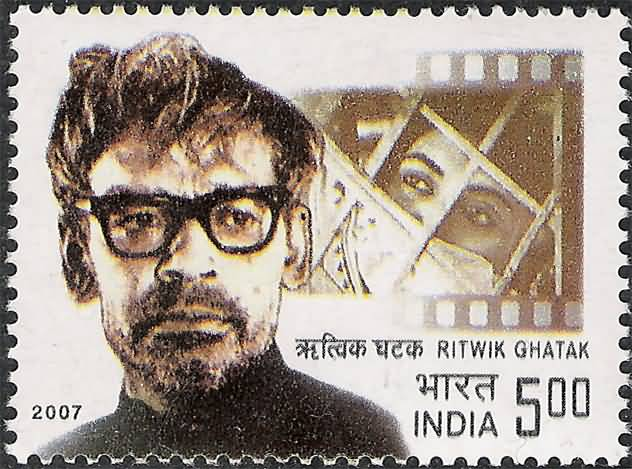
To honour his immense contribution to Indian cinema, India Post has released a commemorative postage stamp celebrating the life and work of Ritwik Ghatak. The stamp stands as a tribute to a filmmaker whose cinematic vision gave voice to the displaced and transformed personal anguish into epic art, securing his place among the greatest auteurs in Indian film history.
First Day Cover

Leave a Comment
You must be logged in to post a comment.