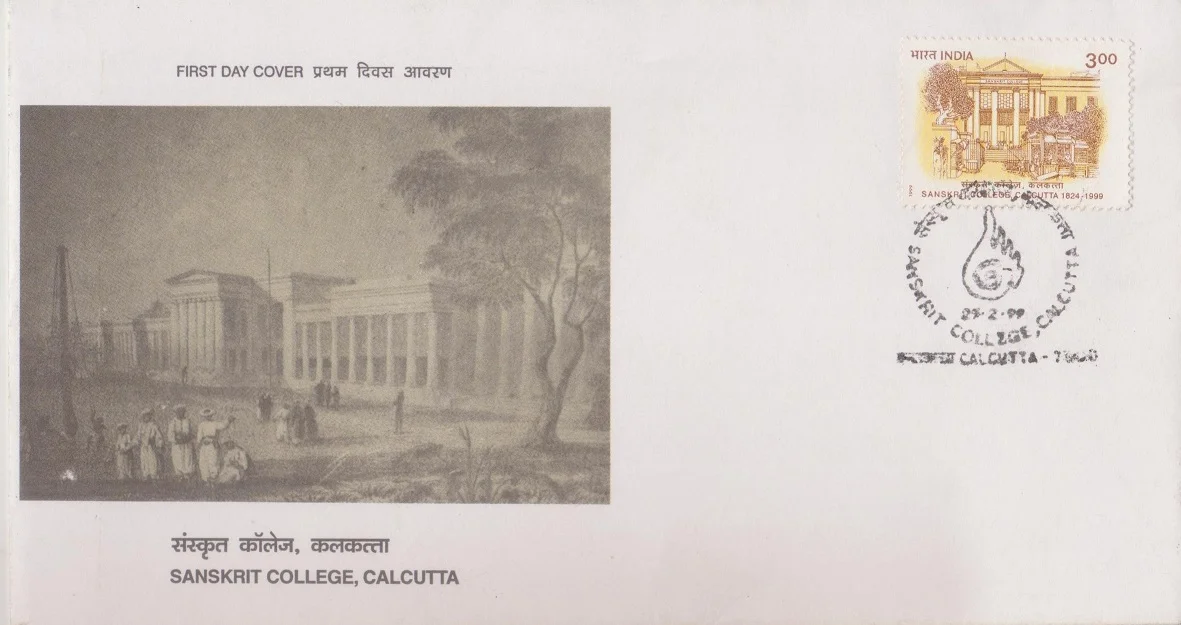
Sanskrit College, Calcutta

Technical Data
| Date of Issue | February 25, 1999 |
|---|---|
| Denomination | Rs. 3 |
| Quantity | 700,000 |
| Perforation | comb 13½ x 13 |
| Printer | Security Printing Press, Nashik |
| Printing Process | Photogravure |
| Watermark | No Watermark |
| Colors | Chestnut | Yellow ochre |
| Credit (Designed By) | |
| Catalog Codes |
Michel IN 1676 Stamp Number IN 1735 Yvert et Tellier IN 1443 Stanley Gibbons IN 1839 |
| Themes | Anniversaries and Jubilees | Buildings | Schools |
Celebrating 175 Years of Scholarship and Learning
The Sanskrit College, Calcutta, founded on 1 January 1824, completed 175 years in 1999. One of the oldest educational institutions in the Indian subcontinent, the college has preserved its rich tradition of scholarship, teaching, and research for nearly two centuries.
Foundation of Sanskrit College, Calcutta
The Sanskrit College was established to promote and spread the study of Sanskrit across India.
Its foundation marked an important chapter in the history of education in Bengal. The institution was created with the aim of providing “useful learning” to Indians of all communities and religious backgrounds through the medium of Sanskrit education.
Initially, the college functioned from a rented house. Later, it shifted to its own building, whose foundation stone was laid on 25 February 1824.
A major role in the establishment of the college was played by the British Indologist Dr. H. H. Wilson. Major A. Price became the first Secretary of the college and served until 1832, before the post of Principal was created.
Early Teaching and Curriculum
In its early years, the college was guided by eminent Sanskrit scholars such as Pandit Joygopal Tarkalankar and Pandit Premchand Tarkavagish.
The institution offered instruction in a wide range of classical subjects, including:
- Vyakarana (grammar)
- Alamkara (rhetoric)
- Kavya (poetry)
- Nyaya (logic)
- Vedanta
- Samkhya
- Mimamsa
- Smriti
- Jyotisha (astronomy and astrology)
- Ayurveda
- Purana and mythology
These subjects were taught by highly respected Sanskrit scholars and helped preserve the classical intellectual traditions of India.
In 1828, English was introduced as an additional subject, marking the beginning of a broader and more modern curriculum.
Ishwar Chandra Vidyasagar and Sanskrit College
One of the greatest figures associated with the college was Pandit Ishwar Chandra Vidyasagar.
He entered the college as a student in 1829 and completed his education there in 1841.
In 1851, Vidyasagar became the first Principal of Sanskrit College.
As Principal, he introduced important reforms in the institution. He revised the curriculum of Sanskrit studies and made English a compulsory subject.
His reforms modernized the college and helped bridge the gap between traditional Sanskrit learning and modern education.
The first student of Sanskrit College to receive a Bachelor of Arts degree graduated in 1860.
Public Sanskrit Examination and ‘Tirtha’ Title
Pandit Mahesh Chandra Nyayaratna made another important contribution to the development of the college.
He introduced the Public Sanskrit Examination system.
Students who passed these examinations in different branches of Sanskrit were awarded the prestigious title of “Tirtha.”
This system encouraged advanced scholarship and enhanced the academic reputation of the college.
Expansion of Research and Higher Education
Under the leadership of Dr. Sadananda Bhaduri, the Postgraduate Training and Research Department was established in 1951.
Research professors of great distinction were appointed in various branches of Sanskrit studies.
Another notable scholar associated with the college was Dr. Gaurinath Sastri, whose efforts further strengthened the institution’s academic standing.
Over time, Sanskrit College developed into a major center for higher learning and research.
Important Departments and Collections
Today, Sanskrit College includes several important academic and research facilities:
- Undergraduate Arts Department
- Postgraduate Training and Research Department
- Oriental Tol or Chatuspati
- Research Publication Department
- Foreign Language Department
- Research Journal titled “Our Heritage”
The journal “Our Heritage” has earned international recognition for its scholarly contributions.
The college also possesses an extraordinary collection of manuscripts and books.
Its manuscript section contains nearly 25,000 Sanskrit and Pali manuscripts.
The library holds more than 100,000 valuable printed books, making it one of the richest repositories of Sanskrit literature in India.
The institution also houses two museums dedicated to:
- Pandit Ishwar Chandra Vidyasagar
- Mahamahopadhyay Haraprasad Sastri
These museums preserve the memory of two of the most important scholars associated with the college.
175 Years Commemorative Stamp
The commemorative stamp issued by the Department of Posts honors the remarkable contribution of Sanskrit College, Calcutta to Indian education and scholarship.
For 175 years, the institution has played a vital role in preserving Sanskrit learning while adapting to modern educational needs.
The stamp stands as a tribute to one of India’s most distinguished educational institutions and its continuing legacy of knowledge, research, and cultural heritage.
First Day Cover