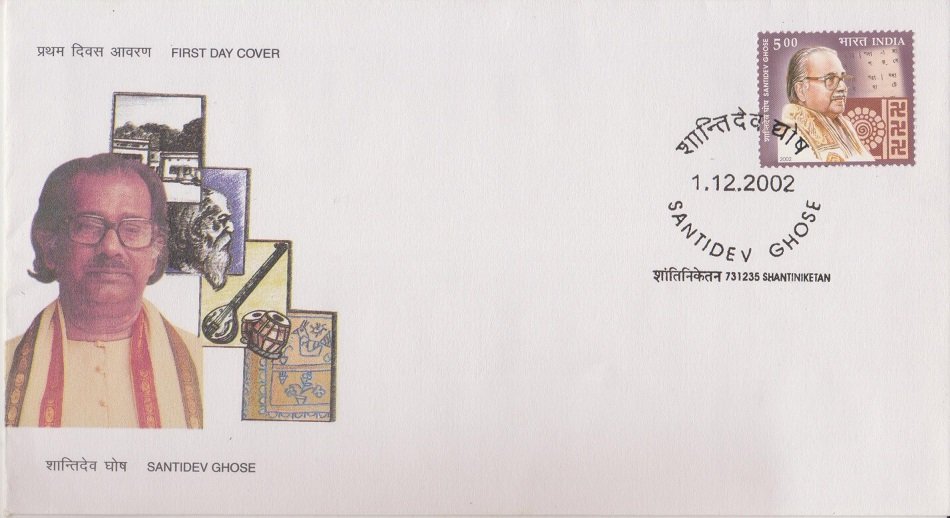
Santidev Ghose (1910 -1999)

Technical Data
| Date of Issue | December 1, 2002 |
|---|---|
| Denomination | Rs. 5 |
| Quantity | 400,000 |
| Perforation | comb 13¼ x 13 |
| Printer | Calcutta Security Printers Ltd |
| Printing Process | Offset Lithography |
| Watermark | No Watermark |
| Colors | Multicolor |
| Credit (Designed By) | Sh. Sankha Samanta |
| Catalog Codes |
Michel IN 1935 Stamp Number IN 1984 Yvert et Tellier IN 1700 Stanley Gibbons IN 2103 WADP Numbering System - WNS IN046.02 |
| Themes | Famous people | Men | Optical Instruments | Singers |
Pioneer of Rabindrasangeet and Dance
Santidev Ghose (1910–1999) was a towering figure in the cultural life of West Bengal, renowned as a master of Rabindrasangeet and dance, as well as a distinguished teacher, scholar, and writer.
Early Life and Association with Tagore
Born in Chandpur (now in Bangladesh), Santidev Ghose moved to Santiniketan as an infant. It was here that his artistic talents began to flourish. From an early age, he showed a strong inclination toward the performing arts.
His life took a decisive turn under the guidance of Rabindranath Tagore, who recognized his potential and personally mentored him. Santidev became part of Tagore’s performing troupe and traveled across India and Sri Lanka, gaining exposure to diverse artistic traditions.
Career at Visva-Bharati
In 1930, Santidev Ghose joined Visva-Bharati University as a teacher at the Sangeet Bhavana. His dedication and expertise led him to serve twice as its Principal.
Before his passing in 1941, Tagore entrusted Santidev with the crucial responsibility of preserving and propagating Rabindrasangeet in its pure form. Santidev upheld this responsibility throughout his life with deep commitment.
Contributions to Literature and Education
Santidev Ghose made significant contributions through his writings in Bengali on music, dance, and Tagore’s artistic philosophy. Many of his works are still used as important reference texts. Notable among them are:
- Rabindra Sangeet
- Java o Balir Nritya Geet (Music and Dance in Java and Bali)
- Rabindranather Purnanga Sikshadarshey Sangeet o Nritya
These works reflect his scholarly depth and dedication to preserving artistic traditions.
Awards and Honours
Santidev Ghose received numerous prestigious recognitions for his contributions:
- Padma Bhushan (1988)
- Fellowship of the Sangeet Natak Akademi (1976)
- Desikottama (Honorary D.Litt.) from Visva-Bharati
- Rabindra Tattvacharya from Tagore Research Institute
- A special Russian Medal (1961)
Cultural Impact
Perhaps Santidev Ghose’s greatest achievement was bringing Rabindrasangeet and dance closer to the common people without compromising their authenticity. His work ensured that Tagore’s artistic legacy remained vibrant and accessible.
He also played a key role in reviving and promoting folk traditions of Bengal, including:
- Baul and Fakir songs
- Chhau dance
- Alkap theatre
By encouraging a subtle fusion of folk and urban artistic streams, he contributed to a richer and more dynamic cultural landscape.
Legacy
Santidev Ghose remains a central figure in India’s cultural history. His dedication to preserving the purity of Rabindrasangeet, combined with his efforts to revitalize folk traditions, has left a lasting impact on the performing arts.
To honour his immense contribution, India Post issued a commemorative postage stamp, celebrating the life and legacy of this great cultural luminary.
First Day Cover