
Sardar Pratap Singh Kairon (1901-1965)
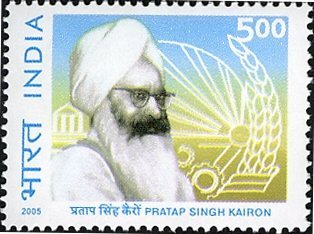
Technical Data
| Date of Issue | October 1, 2005 |
|---|---|
| Denomination | Rs. 5 |
| Quantity | 600,000 |
| Perforation | comb 13¼ |
| Printer | Security Printing Press, Nashik |
| Watermark | No Watermark |
| Colors | Multicolor |
| Catalog Codes |
Michel IN 2097 Stamp Number IN 2115 Yvert et Tellier IN 1861 Stanley Gibbons IN 2281 WADP Numbering System - WNS IN028.05 |
| Themes | Anniversaries and Jubilees | Famous people | Headgear | Men | Politicians |
Architect of Modern Punjab
Pratap Singh Kairon is widely regarded as the architect of modern Punjab. A dynamic and influential political leader, he played a crucial role in shaping the economic, agricultural, and industrial development of Punjab in the post-independence era. Known for his strong vision, determination, and leadership, Kairon left a lasting impact on the political and social landscape of the state.
Early Life and Education
Pratap Singh Kairon was born on 1 October 1901 in the village of Kairon in the Amritsar district of Punjab. He belonged to a modest farming family, and his father, Nihal Singh Kairon, was a pioneer of women’s education.
While studying at Khalsa College Amritsar, Kairon decided to travel to the United States for higher studies. During his time in America, he supported himself by working on farms and in factories. At the same time, he actively engaged with groups working for India’s independence. He later earned a Master’s degree in Political Science from the University of Michigan.
Exposure to American agricultural prosperity inspired him to believe that similar progress could be achieved for farmers in Punjab.
Entry into Politics and Freedom Struggle
After returning to India in 1929, Pratap Singh Kairon launched a progressive English weekly newspaper titled The New Era, whose first issue appeared on 13 April 1931. Soon afterward, he entered active politics and joined the Shiromani Akali Dal.
During this period, the Akali Dal worked closely with the Indian National Congress, and Kairon served as the General Secretary and later President of the Punjab Provincial Congress. When the two parties eventually parted ways, he remained with the Congress.
Kairon was deeply involved in India’s freedom struggle. He participated in the Civil Disobedience Movement in 1932 and was imprisoned for five years. In 1938, he was jailed again for leading the Kisan agitation against “Abiana.” Later, he was also imprisoned during the Quit India Movement.
Political Career and Leadership
Pratap Singh Kairon was elected to the Punjab Legislative Assembly in 1936 and again in 1946. In 1946, he also became a member of the All India Congress Committee and a member of the Constituent Assembly of India.
After independence, he joined the Punjab Cabinet in 1947 and became Minister for Rehabilitation in 1948. At that time, millions of refugees had migrated from Pakistan following the Partition of India. Instead of providing temporary relief, Kairon adopted a long-term strategy by giving refugees land and financial assistance, enabling them to rebuild their lives productively.
In 1956, he became the Chief Minister of Punjab and remained in office until 1964. During his tenure, he worked tirelessly to ensure the overall development of the state.
Contributions to Education and Development
Kairon strongly believed that education was the foundation of progress. As Chief Minister, he made primary and middle school education free and compulsory. He also promoted technical and higher education by establishing several major institutions.
Among the notable institutions developed during his time were:
- Kurukshetra University
- Punjabi University Patiala
- Punjab Agricultural University
- Postgraduate Institute of Medical Education and Research
He also established engineering colleges, polytechnics in each district, and several industrial training institutions to promote technical education.
Agricultural and Industrial Progress
Kairon worked to modernize agriculture by promoting scientific methods in farming, dairy, and poultry. His policies helped lay the foundation for Punjab’s later agricultural success.
At the same time, he focused on industrial development. Under his leadership, Punjab emerged as an important centre for small-scale industries. He was also instrumental in developing the industrial township of Faridabad and the planned garden city of Chandigarh.
In addition, he prioritized the development of essential infrastructure such as roads, irrigation systems, and electricity, which played a key role in Punjab’s economic growth.
Assassination and Legacy
On 6 February 1965, Sardar Pratap Singh Kairon was assassinated near Rasoi village on the national highway while travelling from Delhi to Chandigarh. His sudden death marked the end of a remarkable political career.
Despite this tragic end, his contributions continue to shape Punjab’s progress. His policies in education, agriculture, industry, and infrastructure transformed the state and laid the foundation for its prosperity.
To honour his remarkable service and enduring legacy, India Post issued a commemorative postage stamp on Sardar Pratap Singh Kairon, paying tribute to the visionary leader who helped build modern Punjab.
Leave a Comment
You must be logged in to post a comment.