
150th Birth Anniversary of Sardar Vallabhbhai Patel

Technical Data
| Date of Issue | October 30, 2025 |
|---|---|
| Denomination | Rs. 5 |
| Quantity | 202,800 |
| Printer | Security Printing Press, Hyderabad |
| Printing Process | Wet Offset |
| Credit (Designed By) | Mr. Suresh Kumar |
The Iron Man of India
Sardar Vallabhbhai Patel, born on October 31, 1875, in Nadiad, Gujarat, was one of the most towering leaders of India’s freedom struggle and a principal architect of independent India’s unity. Revered as the “Iron Man of India,” Patel’s strength, determination, and farsightedness were instrumental in transforming a fragmented colonial landscape into a united nation.
Early Life and Entry into Public Service
Patel’s journey into public life began with his deep empathy for the common people. His leadership during the Kheda Satyagraha of 1918, where he mobilised farmers against unjust taxation during a famine, marked his rise as a mass leader. The success of this movement earned him national recognition and the admiration of Mahatma Gandhi, under whose guidance Patel’s political stature grew rapidly.
Leadership in India’s Freedom Struggle
During the 1920s and 1930s, Sardar Patel emerged as one of the most disciplined and pragmatic leaders of the Indian National Congress.
He played a vital role in the Non-Cooperation Movement, the Civil Disobedience Movement, and the Quit India Movement, displaying remarkable organisational skill and courage.
His leadership in the Bardoli Satyagraha of 1928, where he led farmers in a successful non-violent protest against oppressive land revenue hikes, earned him the title “Sardar,” meaning leader or chief. This movement firmly established him as a defender of farmers’ rights and a symbol of India’s agrarian strength.
Architect of India’s Political Integration
After India attained independence in 1947, Sardar Patel faced one of the most formidable challenges in modern history — integrating over 500 princely states into the Indian Union.
As India’s first Deputy Prime Minister and Minister of Home Affairs, Patel pursued a policy of diplomacy, persuasion, and firmness to unify these states. His efforts led to the peaceful accession of most states, while decisive action ensured the integration of key territories such as Hyderabad and Jammu & Kashmir.
This monumental achievement earned him eternal respect as the Unifier of India, ensuring the stability and territorial integrity of the newly independent nation.
Vision for Social Reform and Development
Beyond political unification, Sardar Patel was deeply committed to social justice and national reconstruction.
He championed education, women’s empowerment, and the upliftment of marginalized communities, believing that true independence could only be achieved through equality and development. His policies emphasized the creation of a self-reliant and cohesive society, bound by shared values of unity and mutual respect.
Enduring Legacy
Sardar Vallabhbhai Patel passed away on December 15, 1950, leaving behind an indelible legacy of strength, unity, and nation-building. His life continues to inspire generations of Indians to uphold the ideals of integrity, discipline, and patriotism.
The Statue of Unity, the world’s tallest statue dedicated to him, stands as a testament to his monumental role in shaping modern India.
Philatelic Tribute
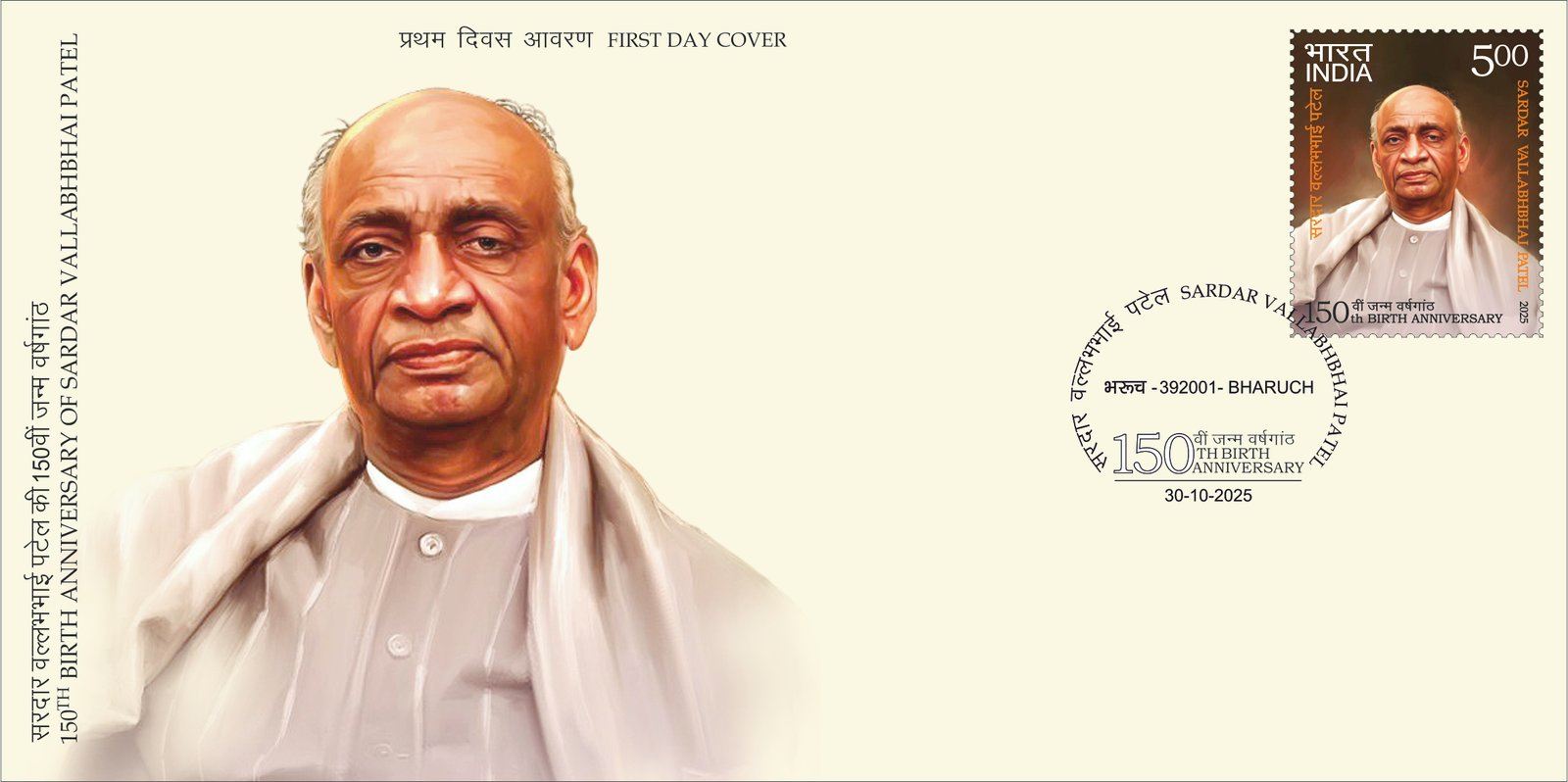
To honour the 150th Birth Anniversary of Sardar Vallabhbhai Patel, the Department of Posts, Government of India, proudly issues a commemorative postage stamp celebrating his unparalleled contributions to the nation.
This philatelic tribute not only commemorates Patel’s enduring spirit but also reaffirms India Post’s commitment to preserving and promoting the nation’s rich historical and cultural heritage.
The stamp stands as a symbol of India’s unity — a reflection of the Iron Man’s vision for a strong, harmonious, and progressive nation.
First Day Cover
Leave a Comment
You must be logged in to post a comment.