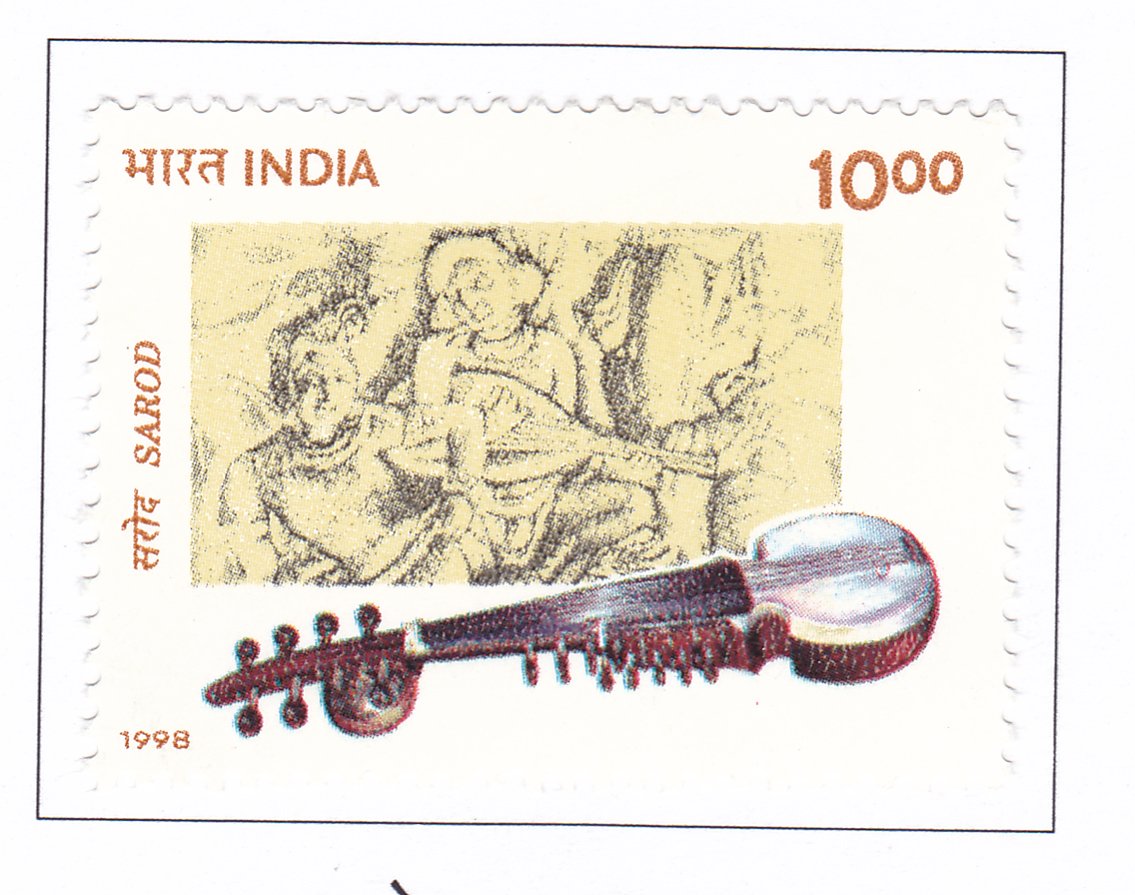
Sarod
Technical Data
| Stamp Set | Indian Musical Instruments |
|---|---|
| Date of Issue | December 29, 1998 |
| Denomination | Rs. 10 |
| Quantity | 700,000 |
| Perforation | comb 13½ x 13 |
| Printer | Security Printing Press, Nashik |
| Printing Process | Photogravure |
| Watermark | No Watermark |
| Colors | Multicolor |
| Credit (Designed By) | Sh. Sankha Samanta |
| Catalog Codes |
Michel IN 1666 Stamp Number IN 1724 Yvert et Tellier IN 1431 Stanley Gibbons IN 1829 |
| Themes | Musical Instruments |
The Classical String Instrument of Indian Music
The Sarod is one of the most prominent musical instruments of India, known for its deep, rich, and expressive sound. As a key example of Tata Vadya (string instruments), the sarod holds a vital place in Hindustani classical music.
Origin and Classification
The Sarod belongs to the category of string instruments described in the Natya Shastra, compiled by Bharat Muni.
In this classification, Tata Vadya instruments produce sound through the vibration of strings, which are plucked using fingers or a plectrum. The sarod follows this principle, creating its distinctive tonal quality.
Structure and Design
The Sarod is known for its unique construction:
- A hollow wooden body with a metal fingerboard
- Multiple strings, including main, drone, and sympathetic strings
- Played using a plectrum (java)
- No frets, allowing smooth gliding between notes
This fretless design enables musicians to produce subtle tonal variations and intricate melodies.
Musical Characteristics
The Sarod is admired for:
- Deep, resonant, and introspective sound
- Ability to produce smooth slides (meend)
- Versatility in both slow (Alap) and fast compositions
Its tonal depth makes it ideal for expressing complex emotions in classical ragas.
Historical Significance
The sarod is believed to have evolved from earlier string instruments such as the rabab. Over time, it developed into a refined classical instrument widely used in Hindustani music.
String instruments have ancient roots in India, with early depictions found in places like the Bhimbetka Rock Shelters, indicating a long tradition of chordophones in Indian culture.
Cultural Importance
The Sarod plays a central role in Indian classical music:
- Widely used in solo performances
- Accompanies vocal and instrumental music
- Represents the sophistication of Hindustani musical traditions
It has been popularized by legendary musicians and continues to be a symbol of musical excellence.
Representation in Commemorative Stamps
The cultural importance of the Sarod has been recognized by India Post, which featured it in a commemorative stamp series on Musical Instruments of India.
This series highlights:
- The heritage of Indian classical instruments
- Their artistic and historical value
- The continuity of musical traditions in India
Conclusion
The Sarod is a timeless instrument that embodies the richness of Indian classical music. With its deep tones and expressive capabilities, it continues to captivate audiences and preserve India’s musical legacy.
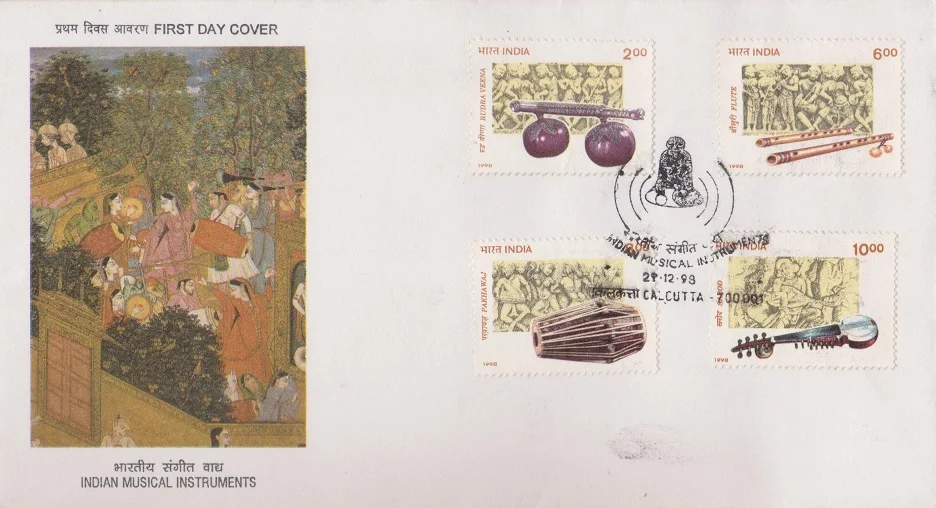
First Day Cover