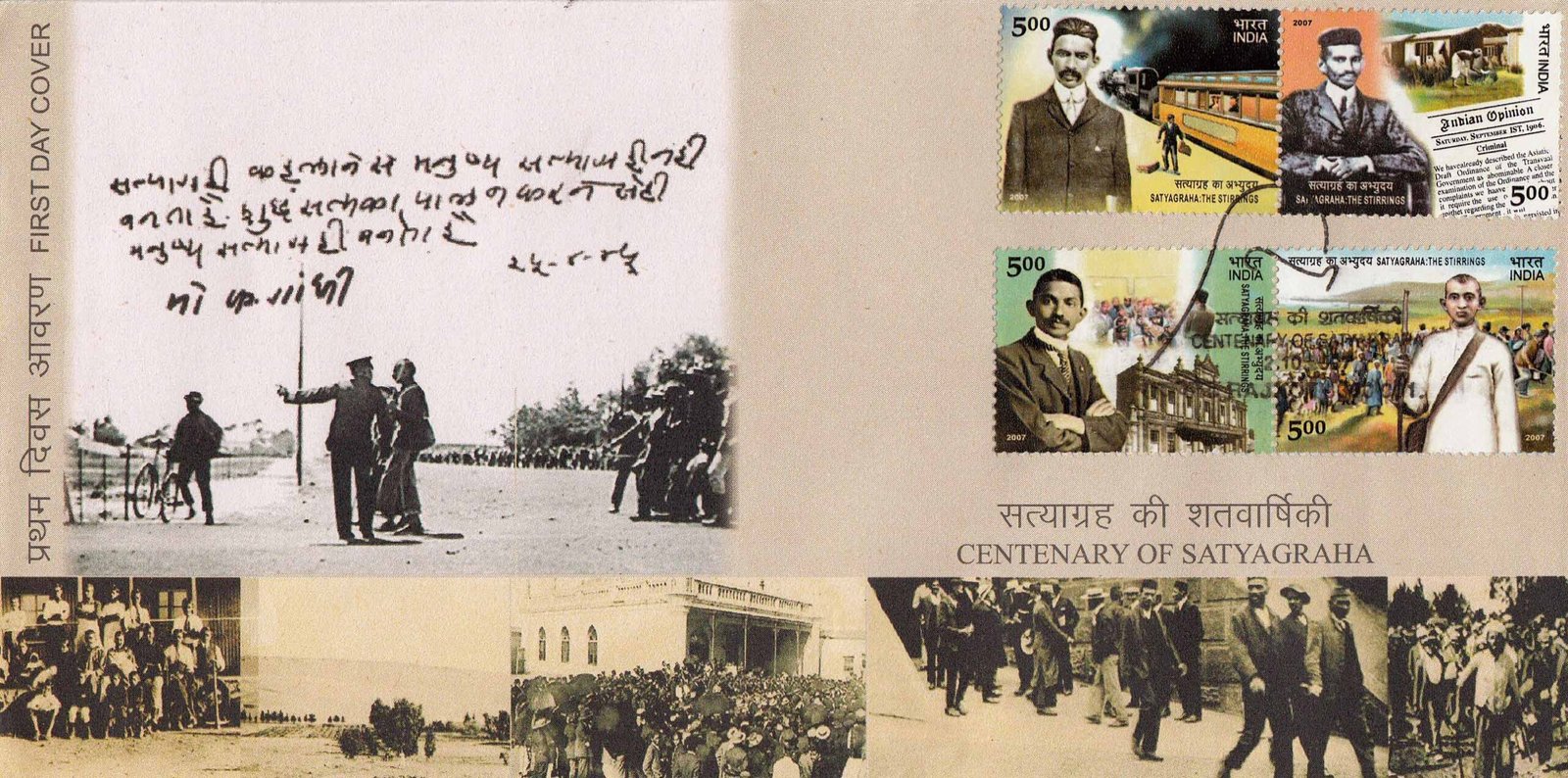
Satyagraha : The Stirring

Technical Data
| Date of Issue | October 2, 2007 |
|---|---|
| Denomination | Rs. 5 |
| Quantity | 800,000 |
| Perforation | 13½ x 13 |
| Printer | India Security Press, Nasik |
| Printing Process | Photogravure |
| Watermark | No Watermark |
| Colors | Multicolor |
| Credit (Designed By) | Sh. Sankha Samanta |
| Catalog Codes |
Michel IN 2226A Stamp Number IN 2208a Yvert et Tellier IN 1991 Stanley Gibbons IN 2423 WADP Numbering System - WNS IN042.2007 |
| Themes | Anniversaries and Jubilees | Famous people | Freedom Fighters | Men | Railways |
The Power of Truth and Non-Violence
Satyagraha is the philosophy of non-violent resistance most famously associated with Mahatma Gandhi, who used it as a powerful moral force to challenge injustice and ultimately bring an end to British rule in India. Rooted in truth and non-violence, Satyagraha became one of the most influential ideas in the history of global resistance movements.
Origin of Satyagraha in South Africa
The concept of Satyagraha was first conceived by Gandhi in South Africa in 1893, during his struggle against racially discriminatory laws. He defined it as a technique of mass resistance based on truth (Satya) and guided by non-violence. Rather than being created overnight, Satyagraha evolved gradually through practice—first in South Africa and later in India—refined with each application as a moral response to oppression and violence.
The philosophy was first publicly tested on 11 September 1906, at a historic gathering of over three thousand people of the “coloured race” at the Empire Theatre in Johannesburg. Addressing the audience, a young lawyer, Mohandas Karamchand Gandhi, offered a new path of redemption for the oppressed—the path of Satyagraha.
Satyagraha as a Tool of Self-Purification
Satyagraha was not merely a political strategy; it was a core element of Gandhi’s programme of national self-purification. While campaigning against racial injustice in South Africa, Gandhi observed that his compatriots lacked self-respect, courage, and collective organization. In a striking call, he urged them to “rebel against themselves,” inspiring a moral awakening that laid the foundation for organized, disciplined resistance.
Meaning and Philosophy of Satyagraha
Gandhi himself explained the essence of Satyagraha in profound terms:
“Truth (Satya) implies love, and firmness (Agraha) engenders and therefore serves as a synonym for force. I thus began to call the Indian movement Satyagraha, that is to say, the Force which is born of Truth and Love or Non-violence.”
Through this philosophy, Gandhi demonstrated that moral courage and non-violent action could become forces more powerful than weapons.
Global Impact and Legacy
Satyagraha proved instrumental in India’s freedom struggle, compelling the British to relinquish power without the violent upheavals seen in many other revolutions across Asia and Africa. Over time, the philosophy spread across the world, influencing movements for civil rights, justice, and peace.
Commemorative Stamp on the Centenary of Satyagraha
To honour this transformative philosophy, the Department of Posts issued a commemorative postage stamp on the centenary of Satyagraha. This stamp artistically portray the early stirrings of the movement and celebrate the enduring spirit of truth and non-violence.
The commemorative release invites reflection on how a colossal revolution was achieved without bloodshed and encourages humanity to seek alternatives to violence—an urgent message in a world where conflict continues to threaten the fabric of civilized existence.
First Day Cover