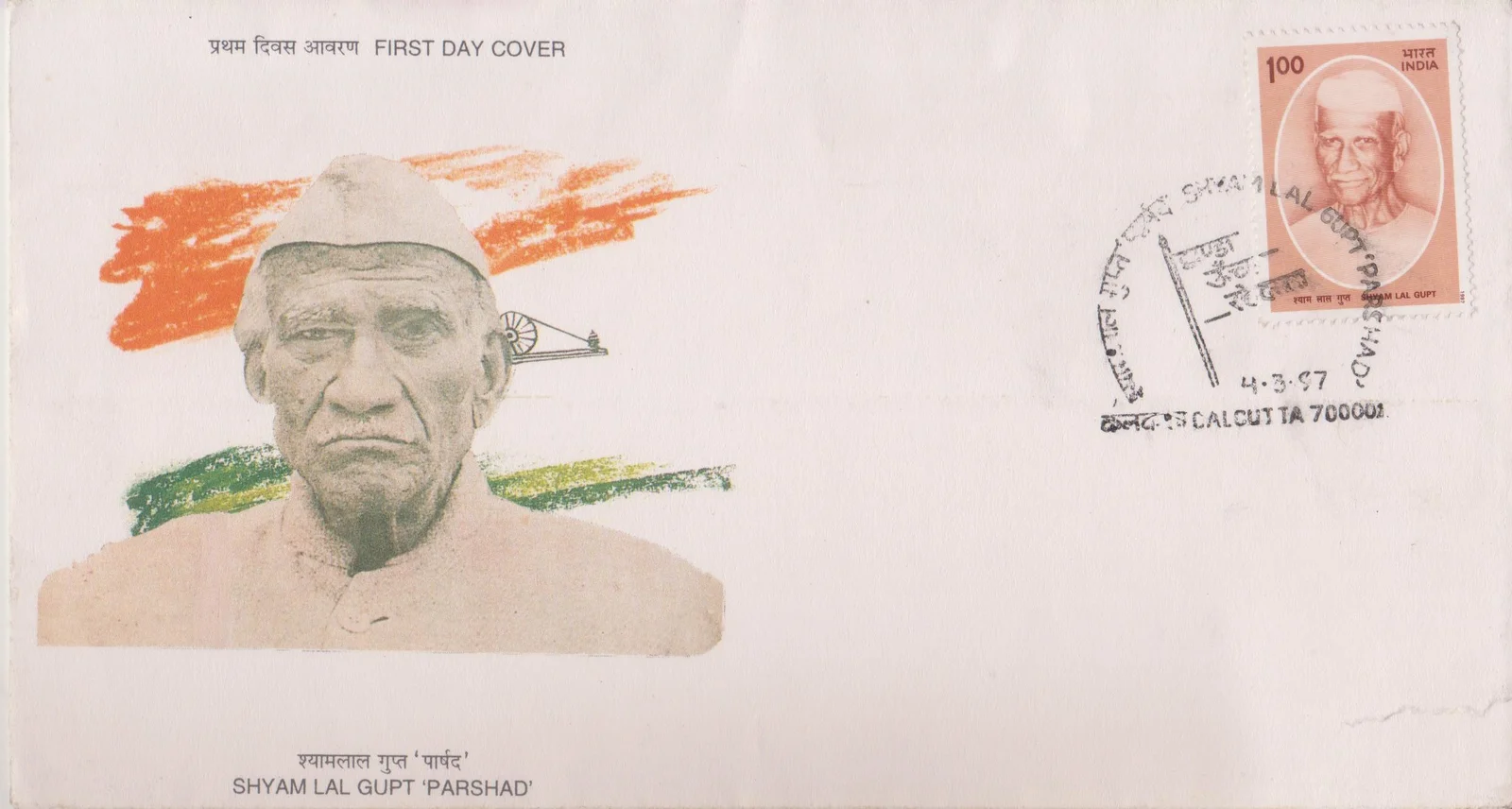
Shyam Lal Gupt ‘Parshad’ (1896-1977)
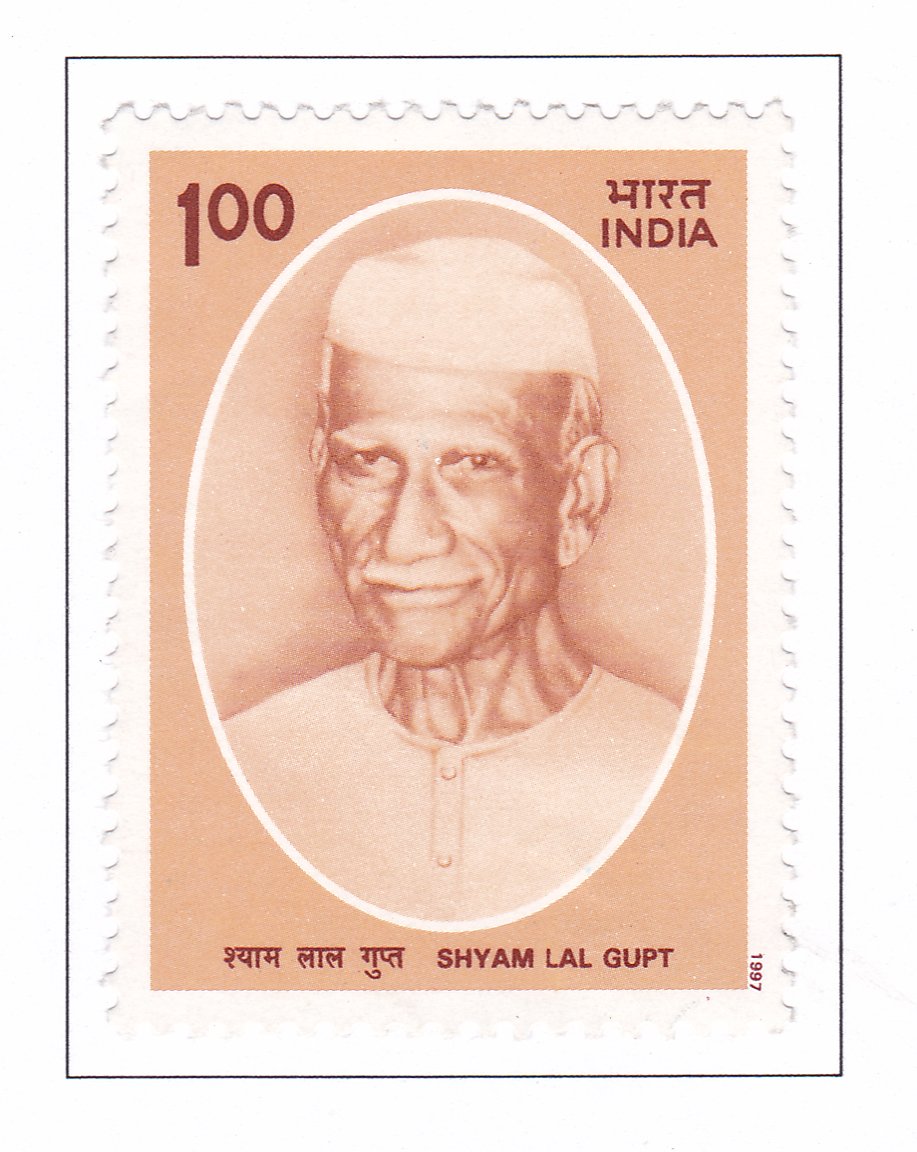
Technical Data
| Stamp Set | Birth Centenary |
|---|---|
| Date of Issue | March 4, 1997 |
| Denomination | Rs. 1 |
| Quantity | 400,000 |
| Perforation | comb 13 x 13½ |
| Printer | Calcutta Security Printers Ltd |
| Printing Process | Offset Lithography |
| Watermark | No Watermark |
| Colors | Multicolor |
| Credit (Designed By) | Parshad Smriti Sansthan |
| Catalog Codes |
Michel IN 1539 Stamp Number IN 1598 Yvert et Tellier IN 1317 Stanley Gibbons IN 1703 |
| Themes | Anniversaries and Jubilees | Famous people | Headgear | Men | Reformers |
Freedom Fighter and Writer of “Jhanda Ooncha Rahe Hamara”
Shyam Lal Gupt Parshad was a noted freedom fighter, patriot, poet, and social reformer best remembered for writing the iconic national flag song “झंडा ऊँचा रहे हमारा”. His contribution to India’s independence movement and social welfare made him a respected public figure.
Born on 9 September 1896 in Narwal, Shyam Lal Gupt ‘Parshad’ devoted his life to the nation.
Early Role in India’s Freedom Movement
Shyam Lal Gupt Parshad joined the Indian freedom movement in 1915 and made Fatehpur his main area of political activity.
From 1920 onward, he served for several years as Chairman of the Fatehpur District Congress Committee.
Imprisonment During National Struggle
During the Non-Cooperation Movement, he was imprisoned for his nationalist activities.
The British District Collector declared him one of the most dangerous revolutionaries and sent him to Central Jail Agra under special security.
In 1930, he was jailed again for his participation in the Salt Satyagraha.
During imprisonment, he came into contact with many national leaders, including:
- Motilal Nehru
- Mahadev Desai
- Ram Naresh Tripathi
Writer of “Jhanda Ooncha Rahe Hamara”
On the night of 3/4 March 1924, Shyam Lal Gupt wrote the patriotic song “झंडा ऊँचा रहे हमारा”, dedicated to India’s national flag.
Mahatma Gandhi had wished for a simple song honoring the national flag in the language of ordinary people, and this composition fulfilled that vision.
Originally written in seven stanzas, the first and last two stanzas became widely popular and were sung by freedom fighters across India during the struggle for independence.
First Public Performance of the Song
The song was first sung publicly on 13 April 1924 at Phool Bagh in Kanpur during a gathering commemorating the Jallianwala Bagh Massacre.
The event was attended by Jawaharlal Nehru, who later said:
People may not know Parshadji, but the whole country knows his song on the National Flag.
In 1952, Shyam Lal Gupt personally recited the song at the Red Fort.
Social Work and Reform
Beyond politics, Shyam Lal Gupt dedicated himself to social upliftment. He worked tirelessly for:
- Hindu-Muslim unity
- Promotion of Khadi
- Welfare of women and children in rural areas
- Education and orphan care
- Community development
He stayed away from active politics and focused on public service.
Institutions Founded by Him
He played a key role in establishing:
- Ganesh Seva Ashram
- Several orphanages
- Schools and teaching institutions
Awards and Recognition
For his valuable contribution to the nation, he was awarded the Padma Shri on 26 January 1976.
Legacy of Shyam Lal Gupt ‘Parshad’
Shyam Lal Gupt Parshad is remembered as a patriot whose words inspired a nation and whose life was dedicated to unity, education, and service.
Commemorative Postage Stamp
The Department of Posts issued a special commemorative postage stamp to mark the writing of this memorable song and honor the memory of Shyam Lal Gupt ‘Parshad’.
First Day Cover