Siddavanahalli Nijalingappa

Technical Data
| Date of Issue | December 28, 2003 |
|---|---|
| Denomination | Rs. 5 |
| Quantity | 400,000 |
| Perforation | comb 13 |
| Printer | Madras Security Printers |
| Printing Process | Offset Lithography |
| Watermark | No Watermark |
| Colors | Multicolor |
| Credit (Designed By) | Smt. Alka Sharma |
| Catalog Codes |
Michel IN 2014 Stamp Number IN 2049 Yvert et Tellier IN 1779 Stanley Gibbons IN 2191 WADP Numbering System - WNS IN070.03 |
| Themes | Famous people | Lawyers-Advocates | Men | Optical Instruments | Politicians | Teachers |
Visionary Leader of Karnataka
Introduction
A simple country gentleman, deeply religious, fiercely patriotic and gifted with remarkable leadership qualities—such was Siddavanahalli Nijalingappa. His life and work left an indelible imprint on the history of Karnataka. Through his dedication to public service and national development, Nijalingappa emerged as one of the most respected leaders of modern India.
Early Life and Education
Siddavanahalli Nijalingappa was born on 10 December 1902. He enjoyed a secure childhood where the teachings of his parents instilled in him values of integrity, secularism, and service to society. His early education at Davangere and Chitradurga broadened his outlook and shaped his personality.
He later moved to Pune where he studied law at Fergusson College and obtained his degree in 1926. As a lawyer, he believed that the pursuit of truth and justice should always prevail over the desire for wealth. Inspired by the freedom struggle, he gave up foreign goods and adopted Khadi as his attire.
Role in the Karnataka Unification Movement
One of the most significant phases of Nijalingappa’s life was his leadership in the Karnataka Ekikarna (Unification) Movement. At that time, Kannada-speaking regions were divided into several territories including the princely Mysore State, parts of the Hyderabad State, Madras Karnataka, Bombay Karnataka, and Coorg.
Despite the divisions caused by regional, caste and political differences, Nijalingappa successfully united these areas by emphasizing the shared identity of the Kannada language. His diplomatic skill and leadership played a crucial role in creating a unified Karnataka state.
Participation in the Freedom Movement
Nijalingappa was deeply influenced by the ideals of Mahatma Gandhi and actively participated in the Indian freedom struggle as a member of the Indian National Congress.
In 1938, he took part in the Flag Movement at Shivapur, for which he was arrested. He also organized and led protests against restrictive forest laws near Chitradurga, encouraging Congress workers to defy the colonial regulations.
Chief Minister of Karnataka
The formation of a separate Karnataka marked another major milestone in Nijalingappa’s career. He became one of the key leaders who persuaded the central government to reorganize states along linguistic lines.
During his two terms as Chief Minister, he introduced several developmental initiatives, including:
- Nationalization of the Kolar Gold Fields in 1956
- Expansion of reservation policies to promote social justice
- Establishment of the Bangalore Dairy
- Promotion of Khadi and village industries
- Construction of the Tunga Canal
- Development of Mangalore Harbour
- Growth of agro-industries, wool industry, cooperative sugar factories, mining and road infrastructure
- Establishment of the Sainik School Bijapur
Leadership at the National Level
Nijalingappa later entered national politics and became the President of the Indian National Congress during a period of intense internal conflict. This era witnessed tensions between the old leadership and a younger generation, which eventually resulted in the split of the Congress party despite his sincere attempts to prevent it.
A Statesman with Gandhian Ideals
In the final phase of his life, Nijalingappa emerged as a respected statesman guided by Gandhian values. Even in old age and declining health, he worked tirelessly to uphold the principles of ethical politics and moral leadership. He strongly opposed the pursuit of power for personal gain and emphasized the importance of honesty, equality and democracy in public life.
He envisioned an India that was not only politically independent but also economically strong, socially vibrant and progressive in outlook.
Commemorative Postage Stamp
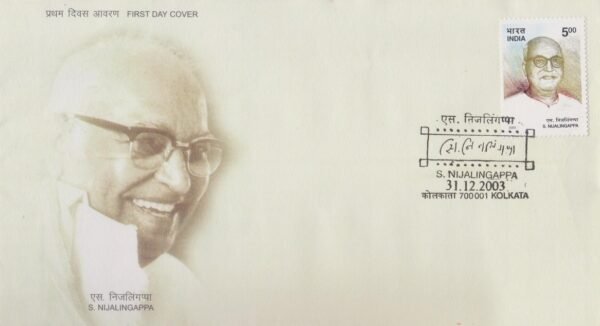
To honour the life and contributions of this visionary leader, India Post issued a commemorative postage stamp paying tribute to Siddavanahalli Nijalingappa and his remarkable service to the nation.
First Day Cover