Sindhu Darshan Festival
Technical Data
| Date of Issue | July 28, 1999 |
|---|---|
| Denomination | Rs. 3 |
| Quantity | 1,400,000 |
| Perforation | comb 13½ x 13 |
| Printer | Security Printing Press, Nashik |
| Printing Process | Photogravure |
| Watermark | No Watermark |
| Colors | Multicolor |
| Credit (Designed By) | R. N. Pasricha |
| Catalog Codes |
Michel IN 1692 Stamp Number IN 1753 Yvert et Tellier IN 1459 Stanley Gibbons IN 1855 |
| Themes | Festivals | Landscapes | Rivers |
Symbol of India’s Ancient Civilization
The Sindhu, also known as the Indus River, is one of the most important and historic rivers in the world. It symbolizes the strength, continuity, and cultural heritage of ancient Indian civilization, which developed over thousands of years along its banks. The discovery of the Indus Valley Civilization near the river has further highlighted the antiquity and greatness of India’s early culture.
The Historical Importance of the Sindhu River
The Sindhu River is a great trans-Himalayan river and one of the longest rivers in the world, with a total length of nearly 2,900 kilometers. The word “Sindhu” appears in the Rig Veda, the oldest known scripture of ancient India, and is believed to be the source of the name “India.”
The river rises in south-western Tibet near Lake Mansarovar at an altitude of about 16,000 feet. It enters India near Demchok in Ladakh and is first joined by the Zanskar River on its left bank. Further downstream, the Sindhu receives water from several other important tributaries, including the Shyok, Shigar, Hunza, and Gilgit rivers, which bring glacial waters from the region east of Nanga Parbat.
The Sindhu then flows westward, crosses the Kashmir border near Batalik, and finally enters Pakistan before emptying into the Arabian Sea.
Sindhu River in Ancient Indian Literature
The Sindhu River occupies a revered place in ancient Indian texts and literature. In the Ramayana, the river is given the title “Mahanadi,” meaning “the mighty river.” In the Mahabharata, the Sindhu is respectfully mentioned alongside the sacred rivers Ganga and Saraswati.
References to the Sindhu also appear in several classical literary works, including Kalidasa’s Raghuvamsa. The Rig Veda contains many vivid descriptions of the river. Its powerful and fast-flowing waters are described as so swift that nothing can stop them. The sound of the rushing Sindhu is said to echo through the skies, and the river is compared to a thundering bull.
Sindhu Darshan Project and Festival
The Sindhu Darshan project was launched to draw attention to the heritage and cultural values represented by the Sindhu River. The project celebrates the river as a symbol of India’s ethnic diversity, cultural unity, and communal harmony.
The Sindhu Darshan Festival, held in Ladakh, also highlights the region’s unique cultural traditions and scenic beauty. Through this initiative, visitors are introduced to the topographical grandeur of Ladakh as well as the spiritual and historical significance of the Sindhu River.
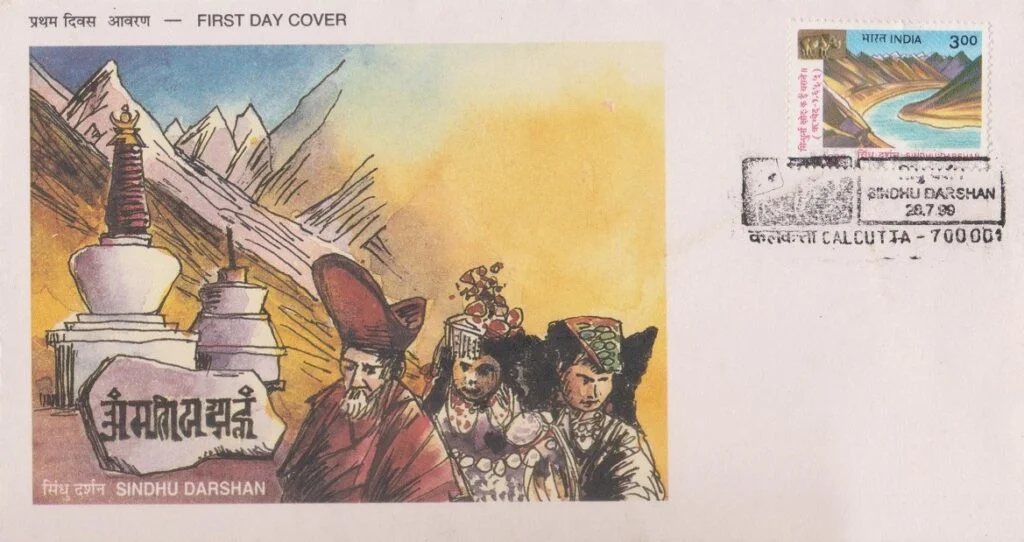
The First Day Cover designed for the commemorative stamp reflects these themes. It combines the cultural and natural beauty of Ladakh and includes the inscription of a Buddhist hymn or mantra traditionally chanted in the region as a prayer in praise of God.
Design of the Sindhu Commemorative Stamp
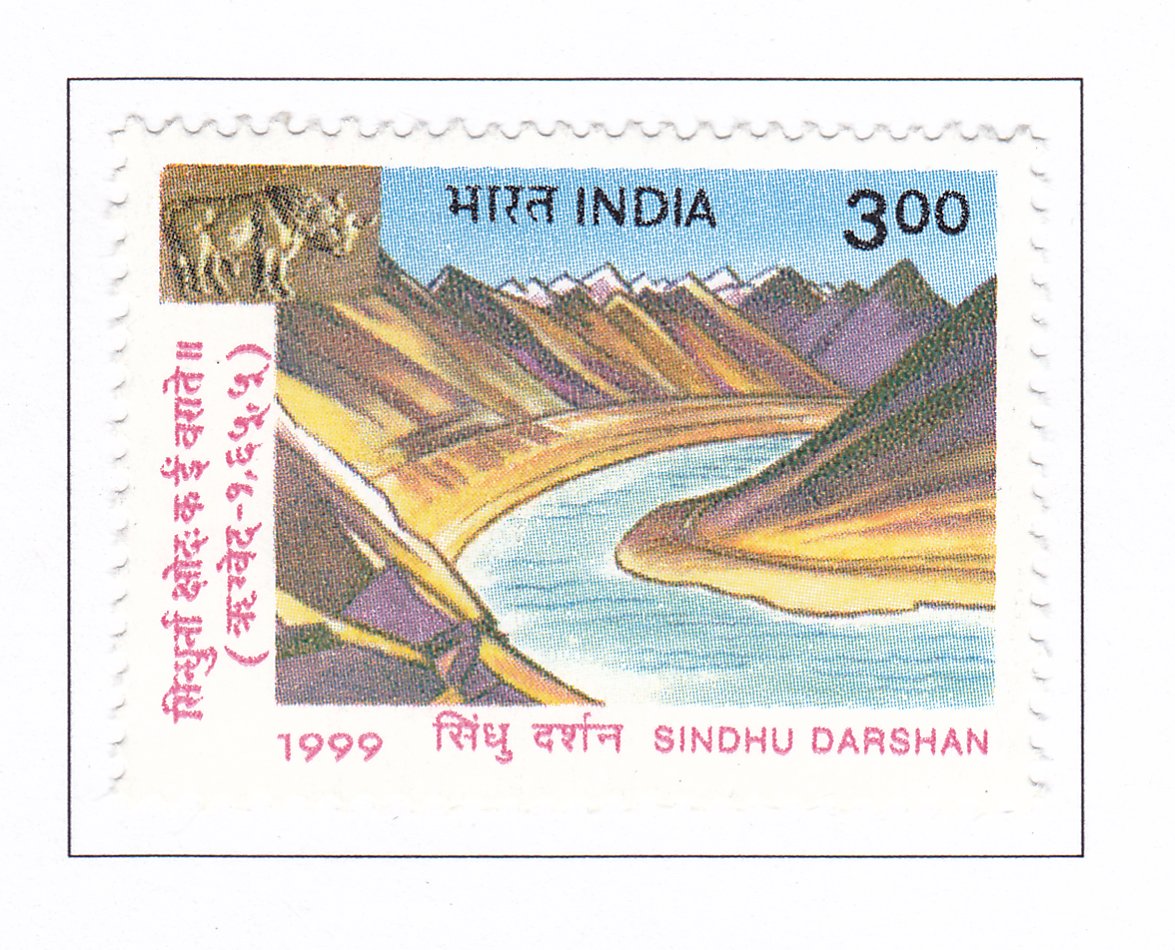
The commemorative postage stamp on the Sindhu River features a beautiful landscape from the upper reaches of the river. It also includes an inset of the famous Vrishabha, or bull seal, from the Indus Valley Civilization, symbolizing the connection between the river and one of the world’s oldest civilizations.
The stamp further includes the famous Rig Veda line:
“So swift is Sindhu, nothing can impede.”
The design of the First Day Cover also blends important cultural and topographical elements of Ladakh, making it a tribute to both the Sindhu River and the heritage of the region.
Significance of the Sindhu River Stamp
The Department of Posts issued this special commemorative stamp on the occasion of the Sindhu Darshan Festival. The stamp honors the Sindhu River as an enduring symbol of India’s glorious ancient civilization and cultural legacy.
As one of the longest rivers in Asia, the Indus River begins near Lake Mansarovar in Tibet, flows through Ladakh and Pakistan, and finally merges into the Arabian Sea. The commemorative stamp captures not only the geographical importance of the river but also its spiritual, literary, and historical significance.
The Sindhu River continues to remain a timeless symbol of India’s identity, heritage, and civilizational continuity.
First Day Cover