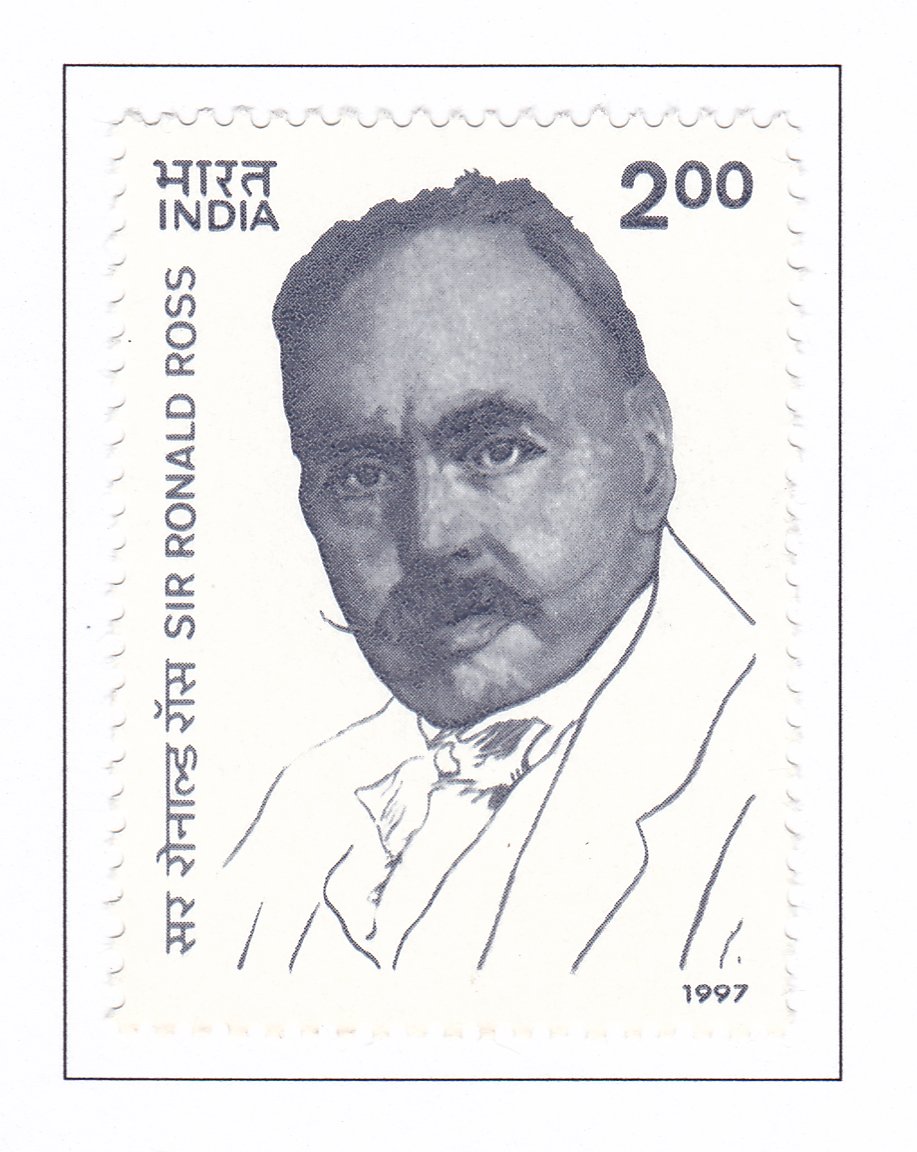
Sir Ronald Ross
Technical Data
| Date of Issue | August 20, 1997 |
|---|---|
| Denomination | Rs. 2 |
| Quantity | 400,000 |
| Perforation | comb 13 x 13½ |
| Printer | Security Printing Press, Nashik |
| Printing Process | Photogravure |
| Watermark | No Watermark |
| Colors | Slate |
| Credit (Designed By) | |
| Catalog Codes |
Michel IN 1564 Stamp Number IN 1615 Yvert et Tellier IN 1335 Stanley Gibbons IN 1728 |
| Themes | Anniversaries and Jubilees | Famous people | Healthcare | Nobel Laureates | Scientists |
Early Life and Education
Sir Ronald Ross was born on 13 May 1857 at Almora, then in the state of Uttar Pradesh. His father, Sir Campbell Ross, was a General in the British Army serving in India. After schooling in England, Ross studied medicine at St. Bartholomew’s Hospital, United Kingdom. He qualified as a Member of the Royal College of Surgeons in 1879 and joined the Indian Medical Service in 1881.
Interest in Tropical Medicine
Ross later trained in bacteriology and specialized in tropical diseases. Influenced by Sir Patrick Manson, a leading expert in tropical medicine, he began research into the cause and spread of malaria.
Historic Discovery of Malaria Transmission
On 20 August 1897, in a small laboratory at Secunderabad (Andhra Pradesh), Ross made his landmark discovery. He identified the pigmented oocysts of the malaria parasite inside the Anopheles mosquito, famously described by him as the “dapple-winged mosquito.”
This discovery solved one of the greatest mysteries in tropical medicine by proving that malaria is transmitted through mosquitoes.
Scientific Contributions
Sir Ronald Ross made several pioneering contributions to medical science:
- First to count parasites to measure malaria infection intensity
- Laid the foundation for the study of malarial communities
- Highlighted the importance of the average enlarged spleen in malaria research
- First to use the thick film technique, later adopted worldwide for blood examination
Honours and Recognition
Ross received many international honours for his achievements:
- Elected Fellow of the Royal Society in 1901
- Awarded the Royal Medal in 1909
- Received the Nobel Prize in Medicine in 1902
- Knighted in 1911
From 1913 until his death in 1932, he also served as editor of Science Progress.
Centenary Commemoration
To mark 100 years of his epoch-making discovery, the Indian Society of Parasitology organized the II-Global Meet on Parasitic Diseases in Secunderabad from 18–22 August 1997.
Commemorative Stamp
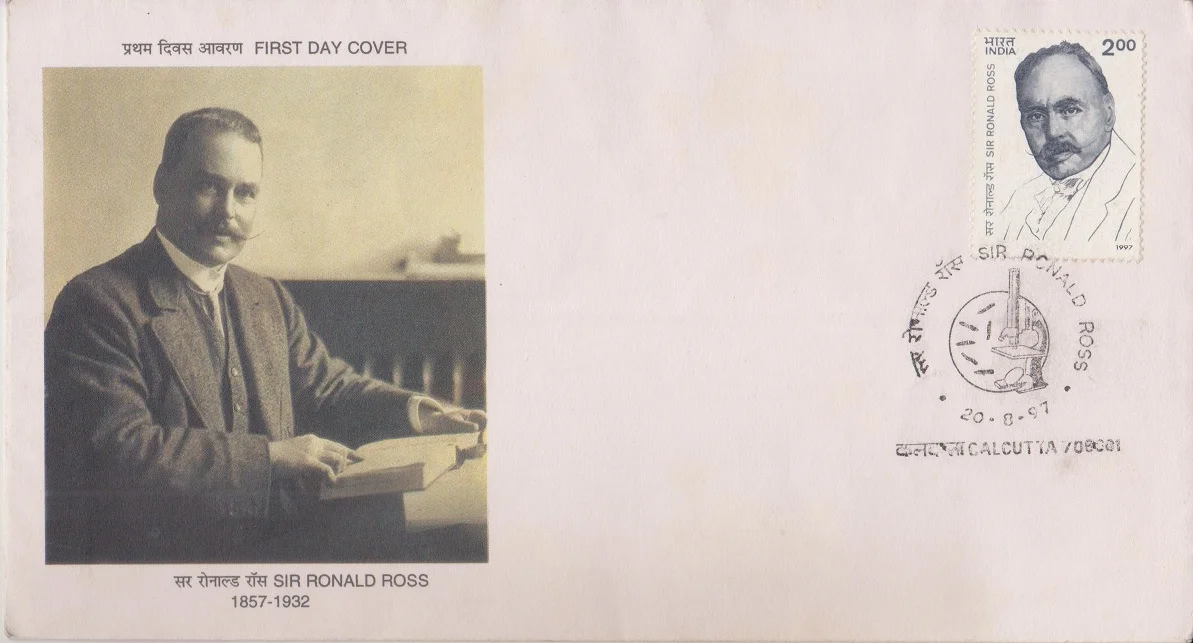
The Department of Posts issued a special postage stamp in honour of Sir Ronald Ross, paying tribute to the scientist whose discovery brought relief to millions across the world.
First Day Cover