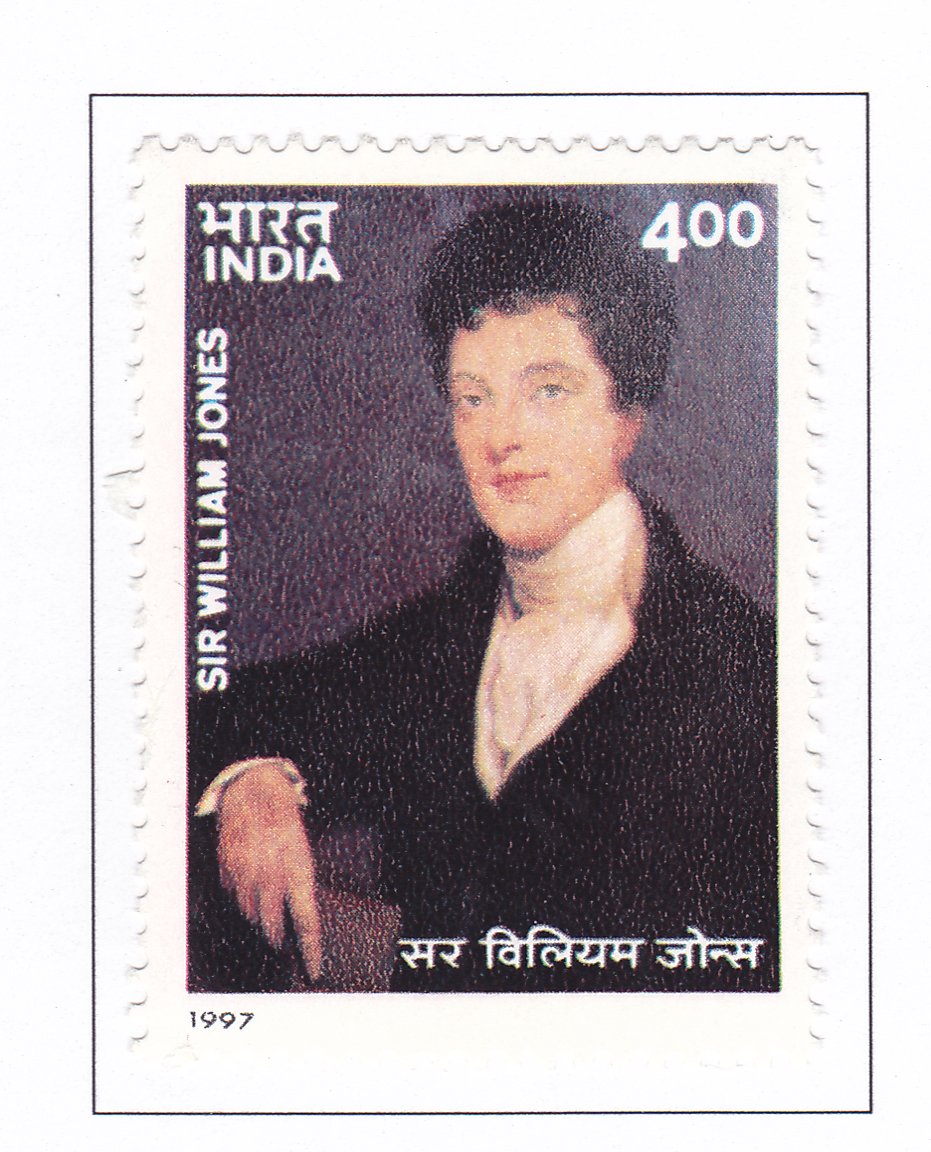
Sir William Jones
Technical Data
| Date of Issue | September 28, 1997 |
|---|---|
| Denomination | Rs. 4 |
| Quantity | 400,000 |
| Perforation | comb 13 x 13½ |
| Printer | Security Printing Press, Nashik |
| Printing Process | Photogravure |
| Watermark | No Watermark |
| Colors | Multicolor |
| Credit (Designed By) | |
| Catalog Codes |
Michel IN 1573 Stamp Number IN 1626 Yvert et Tellier IN 1343 Stanley Gibbons IN 1737 |
| Themes | Anniversaries and Jubilees | Famous people | Lawyers-Advocates | Men |
Introduction
Sir William Jones was one of the greatest scholars of the eighteenth century and a pioneer in the study of Indian culture, language, and history. He was born in London on 28 September 1746.
Early Life and Education
Despite an accident that permanently damaged his right eye, William Jones excelled in studies from an early age. At Harrow School, he gained the reputation of being a brilliant scholar.
By the age of twelve, he knew The Tempest by heart. By twenty, he had mastered several languages including:
- French
- Italian
- Spanish
- Portuguese
- Greek
- Latin
He could even compose original literary works in these languages. In childhood, he translated works of Ovid and Virgil into English.
Oriental Scholarship and Legal Career
During college, Jones began studying Arabic and soon became famous for his knowledge of Eastern languages. In 1768, Christian VII requested him to translate the history of Nader Shah, known as Tarikh-i-Nadiri, into French.
He later entered the legal profession and was admitted to the Bar in 1770. His book, Essay on the Law of Bailments (1781), was regarded as a legal classic.
Founder of the Asiatic Society
Sir William Jones founded Asiatic Society in 1784 to promote research in ancient history, culture, and chronology. This institution became a landmark in Oriental and Indian studies.
Contributions to Indian Studies
Jones is widely regarded as the founding father of Indology and Oriental studies. His major achievements include:
Comparative Linguistics
He laid the foundations of Comparative Philology and recognized the relationship among Indo-European languages such as Sanskrit, Greek, and Latin.
Indian Chronology
His paper On the Chronology of the Hindus (1788) was the first major attempt to create a systematic chronology of ancient India.
Sanskrit Literature
He translated Abhijnanashakuntalam by Kalidasa, introducing Sanskrit drama to the Western world.
Transliteration System
He created a uniform system for transliterating Indian languages into Roman script, which influenced later scholars.
Impact on India
Sir William Jones helped revive interest in India’s ancient heritage. Through his writings and translations, he showed the world that India possessed:
- Great literature equal to any in the world
- A refined classical language in Sanskrit
- Rich philosophy
- Advanced astronomy and science
His work also indirectly inspired pride in Indian civilization and contributed to the rise of modern Indian nationalism.
Death
Sir William Jones died at the age of 48, leaving behind an extraordinary legacy of scholarship.
Commemorative Stamp Issue
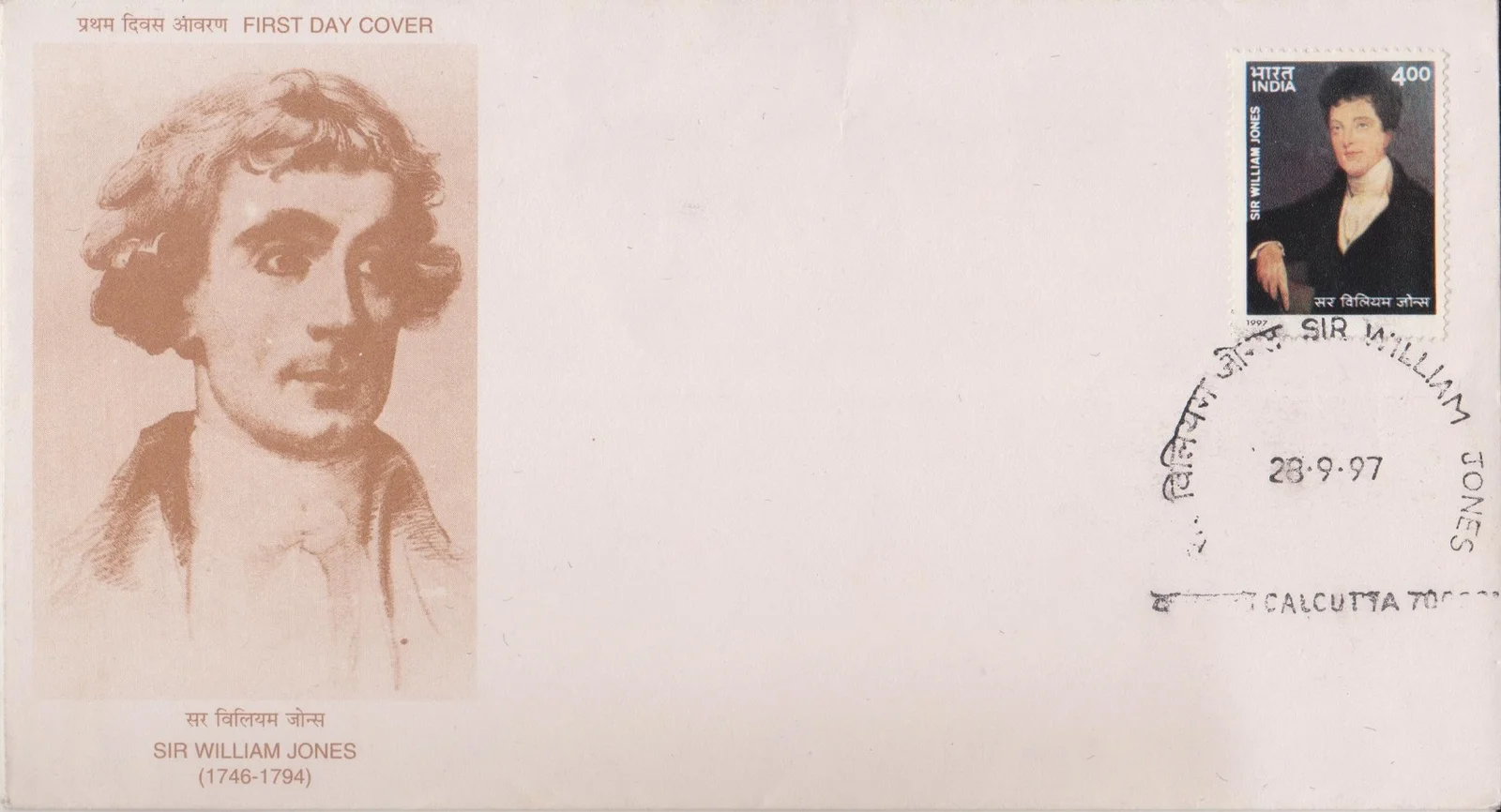
The Department of Posts issued a special commemorative postage stamp to mark the 250th Birth Anniversary of Sir William Jones, honouring his immense contribution to language studies, Indian culture, and world scholarship.
First Day Cover