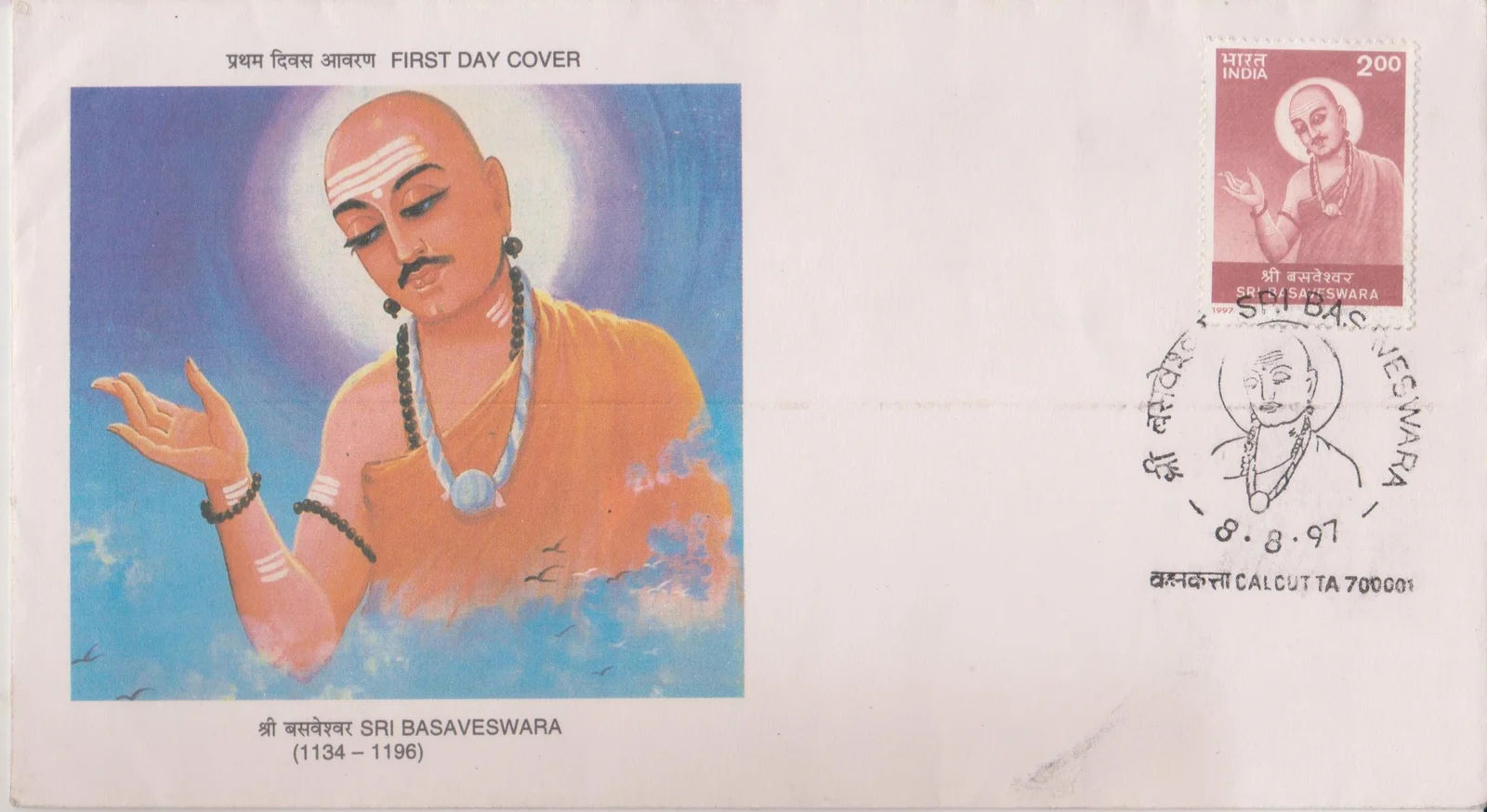
Sri Basaveswara (12th-century)

Technical Data
| Date of Issue | August 8, 1997 |
|---|---|
| Denomination | Rs. 2 |
| Quantity | 400,000 |
| Perforation | comb 13 x 13½ |
| Printer | Security Printing Press, Nashik |
| Printing Process | Photogravure |
| Watermark | No Watermark |
| Colors | Claret |
| Credit (Designed By) | |
| Catalog Codes |
Michel IN 1557 Stamp Number IN 1618 Yvert et Tellier IN 1329 Stanley Gibbons IN 1721 |
| Themes | Famous people | Men | Reformers | Statesmen |
Introduction
Sri Basaveswara was a great 12th-century social reformer, saint-poet, philosopher, and visionary thinker. He is remembered for promoting equality, fraternity, dignity of labour, and justice in society. Through his short and powerful sayings known as Vachanas, he spread progressive ideas that challenged social evils and inspired generations.
Early Life and Education
As a seeker of truth, the young Basaveswara left his parents and native village and went to Kudala Sangama, an important centre of learning. There he came under the guidance of Sri Jataveda Muni, head of the Gurukula, and pursued both academic and spiritual education.
Public Life and Administration
Later, Basaveswara moved to Mangalavede and then to Kalyana, the capital of the Chalukya kingdom. After marriage, he joined the royal treasury as an accountant. Due to his honesty, intelligence, and dedication, he rose successively to become:
- Treasury Officer
- Finance Minister
- Prime Minister
During his service, he introduced reforms and worked to improve the economic and social welfare of the kingdom.
Founder of Anubhava Mantapa
Sri Basaveswara established the Anubhava Mantapa, a socio-spiritual academy that functioned as a forum for free thought and open discussion on morality, ethics, and social justice. It is often regarded as an early form of a democratic spiritual parliament or open university.
Through this institution, he promoted:
- Adult education
- Literacy for all
- Social equality
- Free exchange of ideas
Champion of Equality and Women’s Rights
Basaveswara strongly opposed caste discrimination and untouchability. He also supported equality and dignity for women. Under his inspiration, Anubhava Mantapa had 770 saints, among whom 60 were women, a remarkable achievement for that era.
Lingayat Philosophy
He formulated and preached the principles of Lingayatism, a revolutionary code of conduct based on:
- Equality of caste and creed
- Respect for women
- Honest labour
- Rejection of superstition
- Direct spiritual devotion
Final Years
His reformist ideas faced resistance from orthodox groups, leading to his exile by the Chalukya king. True to his principle of nonviolence, Basaveswara accepted banishment peacefully and returned to Kudala Sangama, where he spent his final years in meditation.
Legacy
More than 800 years ago, Sri Basaveswara stood far ahead of his time in his struggle against caste oppression and social injustice. He remains one of India’s greatest reformers and spiritual leaders.
Commemorative Stamp
The Department of Posts issued a commemorative postage stamp on the occasion of the 800th Death Anniversary of Sri Basaveswara, honouring his immense contribution to social upliftment and human values.
First Day Cover