
Sri Krishnadevaraya
Technical Data
| Date of Issue | January 27, 2011 |
|---|---|
| Denomination | Rs. 5 |
| Quantity | 300,000 |
| Perforation | 13 |
| Printer | Security Printing Press, Hyderabad |
| Printing Process | Wet Offset |
| Watermark | No Watermark |
| Colors | Multicolor |
| Credit (Designed By) | Sh. Sankha Samanta |
| Catalog Codes |
Michel IN 2548 Stamp Number IN 2485 Yvert et Tellier IN 2311 Stanley Gibbons IN 2789 WADP Numbering System - WNS IN002.2011 |
| Themes | Coins | Commemoration | Elephants | Famous people | Men | Religion |
Emperor of the Vijayanagara Empire (1509–1529)
The Vijayanagara Empire
The Vijayanagara Empire, founded in 1336 by the Sangama brothers, was one of the most powerful empires in South Indian history. It was ruled successively by four imperial dynasties—Sangama, Salva, Tuluva and Aravidu. Sri Krishnadevaraya belonged to the Tuluva dynasty, the third ruling house of the empire.
Early Life and Accession
Krishnadevaraya was the son of Nagalamba and Narasanayaka, also known as Narasimharaya. He ascended the throne in February 1509. However, historical evidence also points to 24 January 1510 as a coronation date. It is widely believed that his coronation was conducted more than once—initially in 1509 and again on 11 March 1513, after he successfully subdued rebellious local chiefs and consolidated his authority.
Military Achievements and Expansion
Krishnadevaraya’s reign is remembered for its remarkable military successes. His campaigns against the Ummatturu chiefs, Kalinga, and his decisive victories over the Bahmani Kingdom, including the capture of Raichur and Mudgal, were among the most illustrious achievements of the Vijayanagara Empire. These victories strengthened imperial control and expanded the empire’s influence.
Foreign Relations and Trade
He maintained cordial diplomatic relations with the Portuguese, which helped promote maritime trade and economic prosperity. The interaction with European traders enhanced the empire’s access to horses, firearms and global commerce.
Patron of Literature and Learning
A scholar-emperor, Krishnadevaraya was himself a distinguished writer. He composed “Amukthamalyada” in Sanskrit and “Marichi Parinayamu” in Telugu. His court was adorned by eight eminent poets known as the Ashtadiggajas. During his reign, Sanskrit, Telugu, Kannada and Tamil literature, along with music, dance and drama, received equal patronage, ushering in a golden age of cultural efflorescence.
Contributions to Art and Architecture
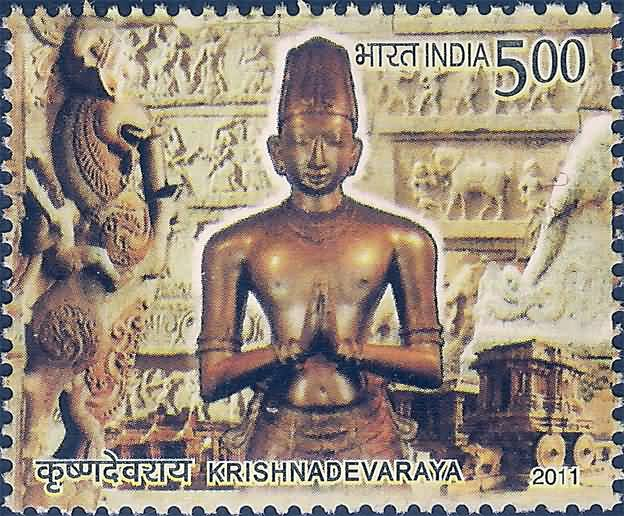
Krishnadevaraya’s reign marked a high point in Vijayanagara art and architecture. In his capital, he built the Balakrishna, Ananthashayana and Lakshminarasimha temples. He enriched the Vithala Temple at Hampi with a Kalyanamantapa, hundred-pillared halls, and the iconic stone chariot. Across the empire, he contributed generously to temples at Tiruvannamalai, Chidambaram, Srirangam, Tirupati and Kalahasti.
Religious Devotion
A devout follower of Lord Venkateshwara of Tirupati, Krishnadevaraya made substantial endowments to the Tirumala temple, reinforcing its religious and cultural prominence.
Contemporary Accounts
Accounts of Krishnadevaraya’s administration, lifestyle and the grandeur of Vijayanagara were recorded by foreign travelers such as Barbosa, Tomé Pires, Domingo Paes and Nuniz, whose travelogues provide valuable insights into the empire and its capital city.
Legacy
The political stability, military strength, cultural brilliance and architectural grandeur achieved during Krishnadevaraya’s reign elevated him to an enduring stature among the greatest emperors of the Vijayanagara Empire.
Philatelic Commemoration
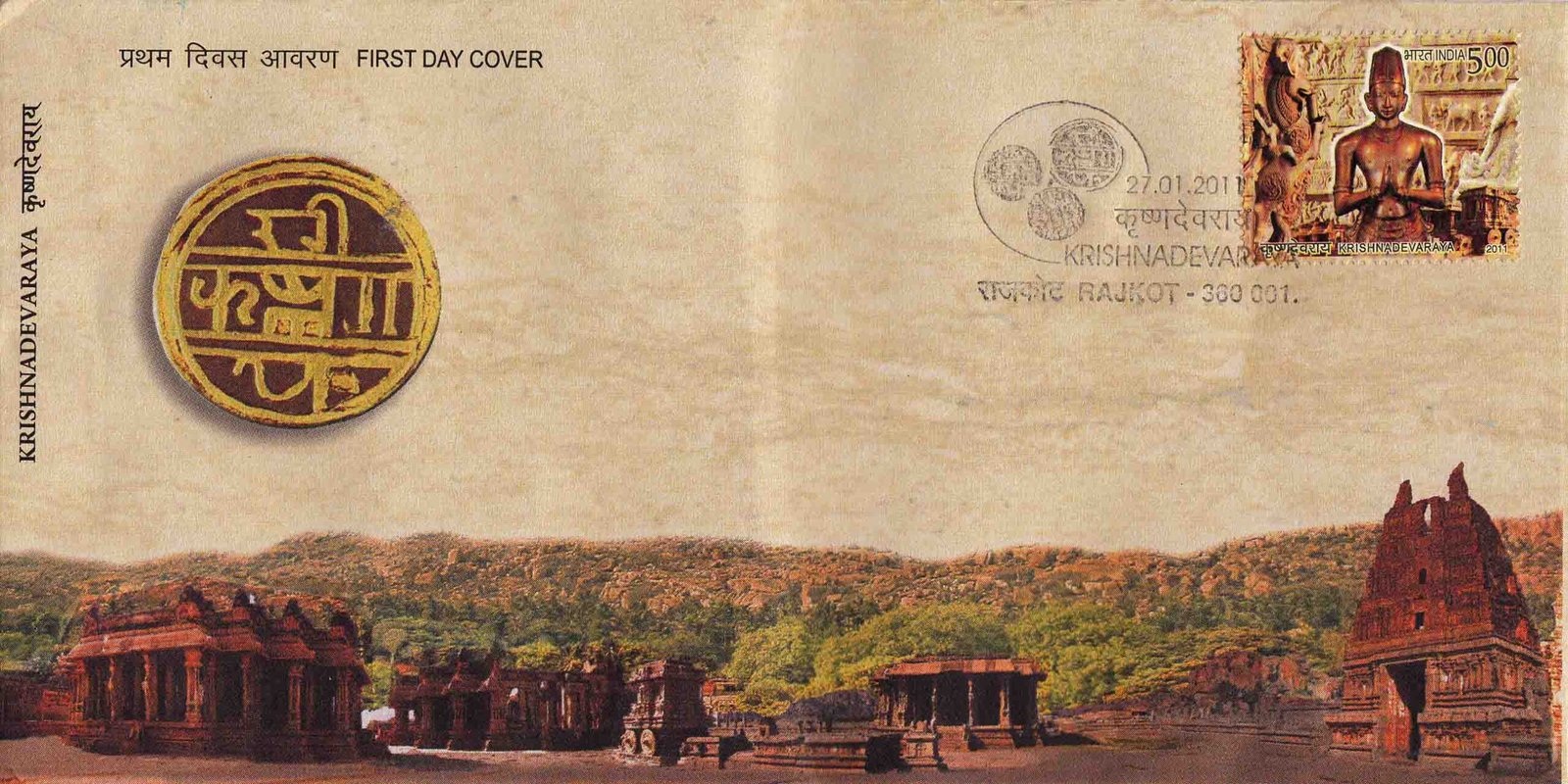
To mark the 500th Anniversary of the Coronation of Sri Krishnadevaraya, the illustrious third ruler of the Tuluva dynasty, India Post proudly issues a commemorative postage stamp, honouring his exceptional contribution to Indian history, culture and governance.
First Day Cover
Leave a Comment
You must be logged in to post a comment.