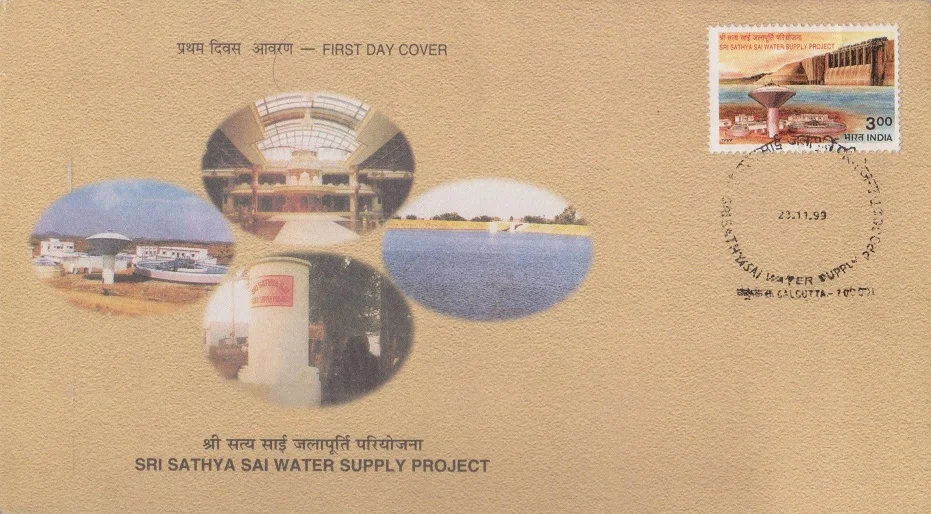
Sri Sathya Sai Water Supply Project
Technical Data
| Date of Issue | November 23, 1999 |
|---|---|
| Denomination | Rs. 3 |
| Quantity | 1,400,000 |
| Perforation | comb 13 x 13¼ |
| Printer | Security Printing Press, Nashik |
| Printing Process | Photogravure |
| Watermark | No Watermark |
| Colors | Multicolor |
| Credit (Designed By) | |
| Catalog Codes |
Michel IN 1721 Stamp Number IN 1782 Yvert et Tellier IN 1488 Stanley Gibbons IN 1884 |
| Themes | Dams | Water | Water Towers |
A Landmark Rural Water Initiative in India
Access to safe drinking water has long been a priority in independent India, especially for rural and underprivileged communities. Recognizing this need early, policymakers introduced the national water supply and sanitation programme in 1954. Later, the Government of India strengthened these efforts through the Accelerated Rural Water Supply Programme (ARWSP) in 1972–73, providing full financial support to states and union territories.
In 1986, the Technology Mission on Drinking Water was launched to improve water access, introduce suitable technologies, and enhance the efficiency of existing programmes. Despite these initiatives, achieving the recommended supply of 40 litres per capita per day (lpcd) for humans remained a challenge. Out of approximately 13 lakh habitats in India, nearly 4 lakh still lacked access to safe drinking water.
Role of the Sri Sathya Sai Drinking Water Supply Project
In this challenging scenario, the Sri Sathya Sai Drinking Water Supply Project emerged as a transformative initiative. Undertaken by the Sri Sathya Sai Central Trust under the guidance of Sri Sathya Sai Baba, the project addressed severe water scarcity in Anantapur district—a drought-prone region with high fluoride levels in groundwater.
Completed in less than 18 months at a cost of around ₹250 crore, the project benefited nearly 32 lakh people. Impressively, the first phase became operational within just six months, covering 125 villages out of a total of 731.
This large-scale initiative was inaugurated by Shankar Dayal Sharma and marked a significant milestone in providing clean and treated drinking water directly to households.
Key Components of the Project
The Sri Sathya Sai Drinking Water Supply Project consists of four major schemes:
- Comprehensive Protected Water Supply (CPWS) Schemes
These involve infiltration and collection wells near reservoirs such as Chitravathi, covering 169 villages. Additional sources like the Pennar and Hagari rivers support 93 villages. - Direct Pumping and Filtration System
Water is pumped from the Penna Ahobilam Balancing Reservoir and treated using rapid sand filtration. This system supplies water to 93 villages through major pipelines. - Summer Storage Tank-Based Supply
Water from the Tungabhadra High Level Canal is stored in large tanks (up to 100 acres) and distributed to 97 villages. - Protected Water Supply (PWS) Scheme
This includes deep borewells, storage tanks, and pipeline networks, covering 279 villages.
Project Scale and Infrastructure
The project spans an area of 19,125 sq. km and includes:
- 2,500 km of pipelines
- 268 overhead service reservoirs (OHSRs)
- 124 ground-level service reservoirs (GLSRs)
- 21 balancing reservoirs
- 40 booster stations
- 7 storage tanks
- 13 infiltration wells
- 280 borewells
What makes the Sri Sathya Sai Drinking Water Supply Project unique is that it was entirely funded by a charitable organization and completed within a strict timeline—an unprecedented achievement in India.
Expansion and Social Impact
Following its success in Anantapur, the Sri Sathya Sai Central Trust has extended similar projects to districts like Mahabubnagar and Medak, covering around 300 villages.
Beyond water supply, the Trust has made significant contributions in education and healthcare through its institutions and hospitals, reinforcing its commitment to social welfare.
Recognition and Legacy
In recognition of this pioneering effort, India Post issued a commemorative postage stamp honoring the Sri Sathya Sai Drinking Water Supply Project. This initiative stands as a model for large-scale, community-focused water solutions in India.
Conclusion
The Sri Sathya Sai Drinking Water Supply Project is a remarkable example of how vision, commitment, and efficient execution can address critical challenges like rural water scarcity. It not only transformed millions of lives but also set a benchmark for future water management projects in India.
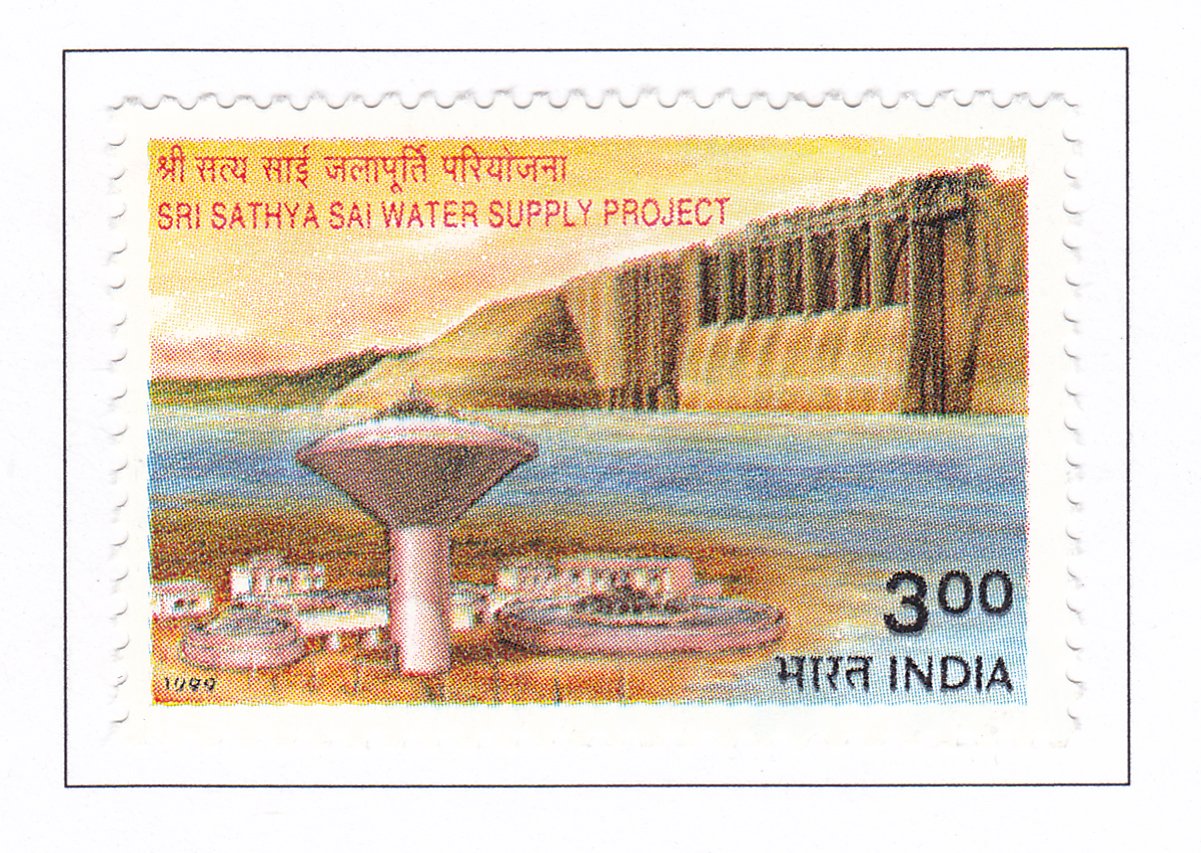
First Day Cover