
Srinivasa Ramanujan
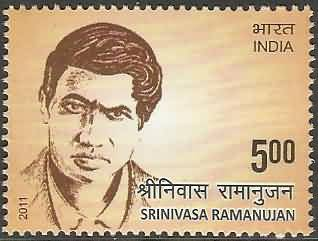
Technical Data
| Date of Issue | December 26, 2011 |
|---|---|
| Denomination | Rs. 5 |
| Quantity | 300,000 |
| Perforation | 13 |
| Printer | Security Printing Press, Hyderabad |
| Printing Process | Wet Offset |
| Watermark | No Watermark |
| Colors | Multicolor |
| Credit (Designed By) | Sh. Brahm Prakash |
| Catalog Codes |
Michel IN 2636 Stanley Gibbons IN 2855 WADP Numbering System - WNS IN060.2011 |
| Themes | Anniversaries and Jubilees | Famous people | Mathematicians | Men |
A Legacy of Mathematical Brilliance
Srinivasa Ramanujan (1887–1920) occupies a revered place in the long and distinguished tradition of Indian mathematics, a lineage that stretches back over 25 centuries. His contributions to mathematical science were not only pioneering but often revolutionary, earning him global recognition despite his unconventional academic journey.
Early Life and Education
Ramanujan was born on 22 December 1887 in Erode, Tamil Nadu. His family later moved to Kumbakonam, about 160 kilometres from Chennai, where he completed his schooling. His life took a decisive turn at the age of 15, when he discovered “Synopsis of Elementary Results in Pure and Applied Mathematics” by George Shoobridge Carr. Written in a concise and open-ended style, the book enabled Ramanujan to teach himself advanced mathematics and laid the foundation for his extraordinary intellectual development.
Struggles and Early Career
Ramanujan’s early years were marked by financial hardship and prolonged unemployment. His marriage in 1909 compelled him to seek stable employment, and after much struggle, he secured a clerical position at the Madras Port Trust, Chennai. Despite these challenges, his passion for mathematics never waned.
Path-Breaking Mathematical Work
During this period, Ramanujan worked intensely on subjects such as Bernoulli numbers, hypergeometric series, and elliptic functions. He began posing and solving complex problems in the Journal of the Indian Mathematical Society. His 1911 research paper on Bernoulli numbers was widely appreciated and brought him recognition for the originality and brilliance of his ideas. His lack of formal university education ceased to be an obstacle as he gained acceptance as a mathematical genius within academic circles.
Recognition and Journey to England
Ramanujan’s growing reputation earned him a scholarship from the University of Madras. Through well-wishers, he began corresponding with leading mathematicians in England, including Godfrey Harold Hardy, who quickly recognized his exceptional talent. In 1914, Ramanujan travelled to England under a grant from Trinity College, Cambridge, beginning a remarkable collaboration with Hardy that profoundly shaped modern mathematics.
Achievements and International Honours
Despite persistent health problems, Ramanujan continued to produce significant work and published papers in leading journals across England and Europe. Possessing an instinctive grasp of mathematics, he often arrived at profound results without formal proofs. While some theorems were later found incorrect, his mastery of several mathematical domains was acknowledged as unparalleled.
In 1918, Ramanujan became the first Indian to be elected a Fellow of the Royal Society of London. In the same year, he was also elected a Fellow of Trinity College, Cambridge, marking the highest recognition of his genius.
Declining Health and Untimely Demise
Ramanujan’s health deteriorated severely during his stay in England, and in 1917, he contracted tuberculosis. He returned to India in 1919, but despite medical treatment, his condition worsened. He passed away on 26 April 1920 in Kumbakonam, at the young age of 32, leaving behind a body of work that continues to inspire mathematicians worldwide.
Commemorative Postage Stamp
India Post pays tribute to this extraordinary mathematical genius by issuing a Commemorative Postage Stamp in honour of Srinivasa Ramanujan, celebrating his enduring legacy and his immeasurable contribution to the world of mathematics.
First Day Cover

Leave a Comment
You must be logged in to post a comment.