
St Joseph’s Boys High School Bangalore

Technical Data
| Date of Issue | November 28, 2008 |
|---|---|
| Denomination | Rs. 5 |
| Quantity | 400,000 |
| Perforation | 13½ |
| Printer | Security Printing Press, Hyderabad |
| Printing Process | Wet Offset |
| Watermark | No Watermark |
| Colors | Multicolor |
| Credit (Designed By) | Sh. Brahm Prakash |
| Catalog Codes |
Michel IN 2315 Stamp Number IN 2274 Stanley Gibbons IN 2528 Michel IN IN059.2008 |
| Themes | Anniversaries and Jubilees | Buildings | Schools |
A Legacy of Excellence in Education
St. Joseph’s Boys’ High School stands as one of India’s most distinguished educational institutions, with a legacy that dates back to the mid-19th century. Rooted in a vision of holistic education and moral formation, the school has played a pioneering role in shaping generations of students.
Early Beginnings
As early as 1841, Bishop Bonnaud envisioned the establishment of a Catholic High School in Bangalore. This vision began to take shape in 1850 when the priests of the Missions Étrangères de Paris (MEP) purchased land at St. John’s Hill for Rs. 1000. In 1854, Fr. Bouteloup constructed a house at a cost of Rs. 3000, naming it St. Joseph’s Seminary.
With the establishment of the University of Madras in 1858, students could prepare for the matriculation examinations. It was decided to open a school catering to both European and Indian pupils. In the terminology of the time, what was then called a “college” would correspond to today’s high school.
Foundation and Growth
St. Joseph’s School was formally founded in 1865, offering European and Anglo-Indian families access to a liberal and comprehensive education. The institution emphasized sound moral training, intellectual development, discipline, gentlemanly conduct, and physical fitness.
The school provided spacious playgrounds for cricket, football, hockey, tennis, badminton, and other sports. It also maintained a Cadet Platoon and a Boy Scouts’ Troop, fostering leadership and discipline. A Debating and Literary Society encouraged intellectual engagement among senior students, while monthly educational lantern lectures broadened their perspectives.
Located between Museum Road and Residency Road in the European quarter of Bangalore, the school buildings were spacious and well-ventilated. The curriculum prepared students for Government High and Middle School Examinations, as well as the Cambridge School Certificate examinations. Recognition by the University of Cambridge enabled senior students to obtain Certificate A.
Institutional Expansion
In 1923, St. Joseph’s College was separated from the school, resulting in three distinct institutions: St. Joseph’s School, St. Joseph’s College, and St. Joseph’s Indian School.
The school celebrated its centenary in 1958, an event graced by Rajendra Prasad, India’s first President. In 1968, St. Joseph’s European High School was officially renamed St. Joseph’s Boys’ High School.
Modern Development
Entering the 21st century, the school continued to expand its infrastructure and academic facilities. The foundation stone for a new building was laid in 2001, with the Western Wing inaugurated in 2002, the Eastern Wing in 2003, and the Central Administrative Block in 2006.
Today, the school offers state-of-the-art facilities including broadband connectivity, LCD-enabled classrooms, a public address system, advanced laboratories, and extensive research and reference resources. For the first time, girls were admitted to Standards XI and XII, reflecting the institution’s evolving and inclusive outlook.
Motto and Mission
Guided by its motto “Faith and Toil,” St. Joseph’s Boys’ High School seeks not merely to create competitive individuals but to form men and women dedicated to service, excellence, and integrity. It continues to stand as a beacon of world-class education grounded in strong moral values.
Commemorative Postage Stamp
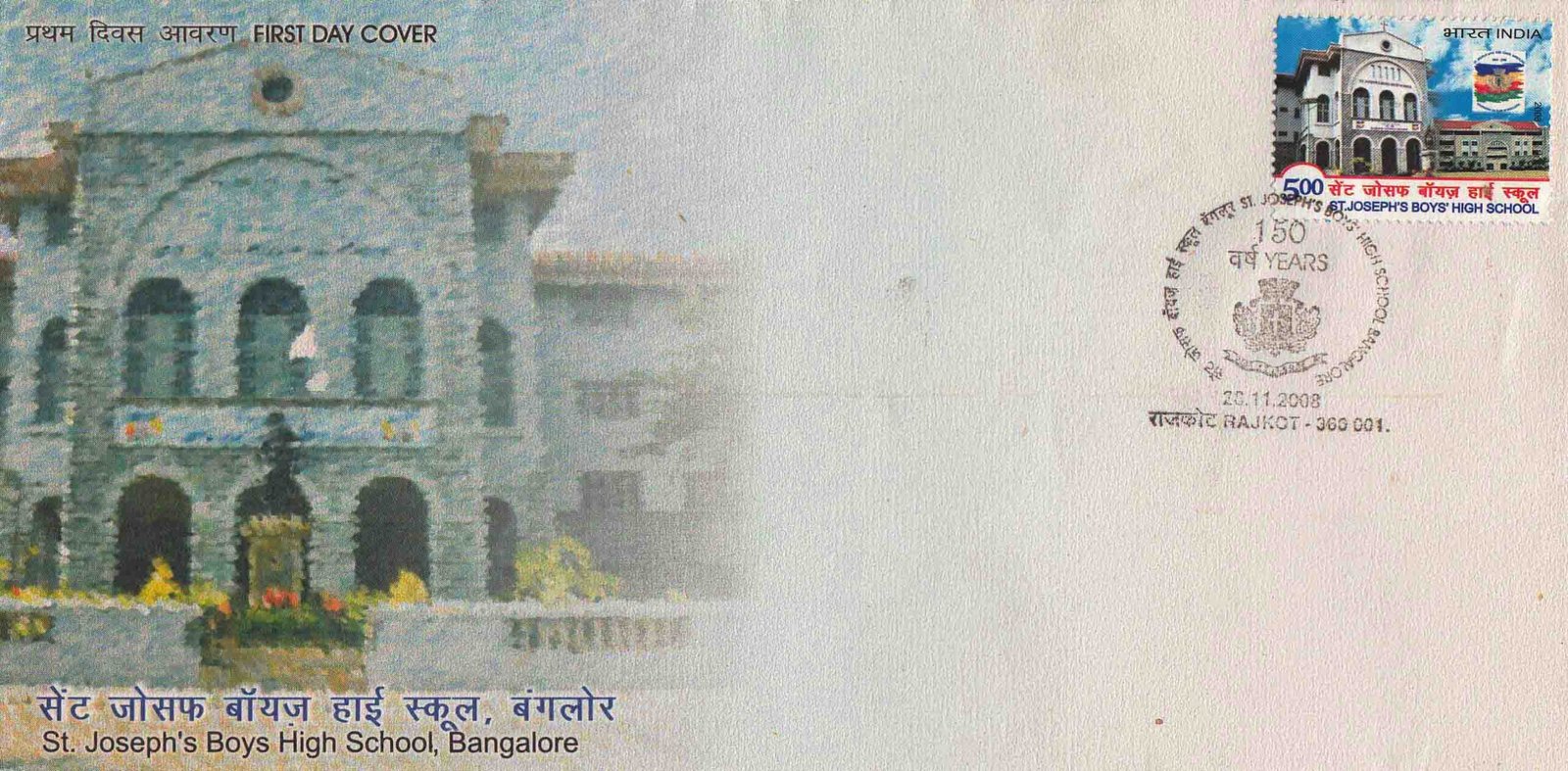
In recognition of its enduring contribution to education and nation-building, India Post has issued a commemorative postage stamp on St. Joseph’s Boys’ High School, celebrating its rich heritage and lasting impact on generations of students.
First Day Cover
Leave a Comment
You must be logged in to post a comment.