
Swami Ekrasanand Saraswati
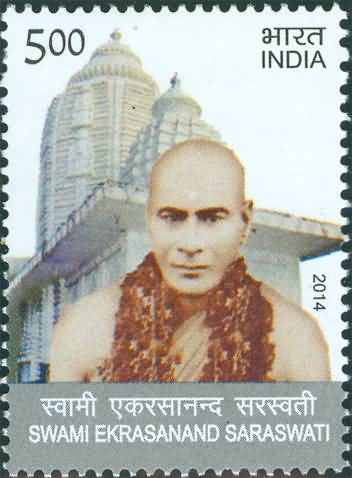
Technical Data
| Date of Issue | December 4, 2014 |
|---|---|
| Denomination | Rs. 5 |
| Quantity | 600,000 |
| Printer | Security Printing Press, Hyderabad |
| Printing Process | Wet Offset |
| Watermark | No Watermark |
| Colors | Multicolor |
| Credit (Designed By) | Smt. Alka Sharma |
| Catalog Codes |
Michel IN 2854 Yvert et Tellier IN 2598 Stanley Gibbons IN 3028 |
| Themes | Commemoration | Famous people | Saints | Temples |
A Saint Dedicated to the Service of Humanity
Early Life and Spiritual Inclinations
Swami Ekrasanand Saraswati, a revered saint known for his selfless service and deep spiritual insight, was born on 29 August 1866 in the village of Bhuriyana, district Jodhpur, Rajasthan. Born into a Brahmin family to Pt. Radha Krishna and Palubai, he was named Narayan Das in his childhood.
From an early age, Narayan Das displayed exceptional virtues—politeness, kindness, courtesy, and a natural inclination toward spirituality. These early traits laid the foundation for a life dedicated entirely to the upliftment of humanity.
Spiritual Journey and Renunciation
Seeking higher spiritual knowledge, young Narayan Das travelled to the sacred Himalayan region and immersed himself in deep meditation at Badrinath Dham. His spiritual quest then took him to Kashi, where he met his guru, Swami Ganeshanand, who bestowed upon him the monastic name “Swami Ekrasanand.”
After mastering the Vedas in Kashi, he journeyed across India, visiting many holy cities—Mathura, Vrindavan, Haridwar, Rishikesh, and others. His peaceful demeanour and spiritual aura earned him respect wherever he travelled. When he reached Teekamgarh in Madhya Pradesh, the king himself extended a warm welcome to the ascetic saint.
Founding of Daivi Sampad Mandal (1914)
In 1914, Swami Ekrasanand Saraswati established the Daivi Sampad Mandal, inspired by the principles of Sarv Bhoot Hite Ratah and the divine qualities (Daivi Sampatti) described in the 16th chapter of the Srimad Bhagwad Gita.
The organisation aims to cultivate noble virtues in society, irrespective of caste, race, or religion. Its focus includes:
- Fearlessness and purity of mind
- Meditation and Yoga for spiritual awakening
- Charity and compassion
- Truthfulness, non-violence, detachment
- Peace, mercy, modesty, forgiveness and patience
- Discipline and control over the senses
Swami Ekrasanand’s followers abide by his ten sacred gospels, which promote love, devotion to God, and universal brotherhood.
A Legacy Sustained Through Institutions
The saint’s disciples continue to uphold his teachings through various institutions established in his honour, including:
- Sri Ekrasanand Ashram
- Sri Ekrasanand Sanskrit Mahavidyalaya
- Sri Ekrasanand Adarsh Inter College
- Sri Ekrasanand Dharmath Ayurvedic Hospital
Under the Daivi Sampad Mandal, these institutions promote self-discipline, moral conduct, and spiritual development. Conferences, satsangs, meditation sessions, Yoga camps, Ayurvedic health camps, and discourses are regularly organised to enrich the lives of devotees and the wider community.
The Saint’s Attainment of Nirvana
Swami Ekrasanand Saraswati left his mortal body on 9 September 1938, leaving behind a legacy of spiritual wisdom, compassion, and unwavering dedication to the welfare of all beings. His life continues to inspire thousands who walk the path of righteousness, service, and devotion.
Philatelic Tribute: Commemorative Postage Stamp
A commemorative postage stamp honouring Swami Ekrasanand Saraswati was issued, celebrating his immense contribution to society and spiritual upliftment. Through this philatelic tribute, his teachings and legacy continue to reach countless people—just as he devoted his life to reaching every soul with love, knowledge, and humility.
Leave a Comment
You must be logged in to post a comment.