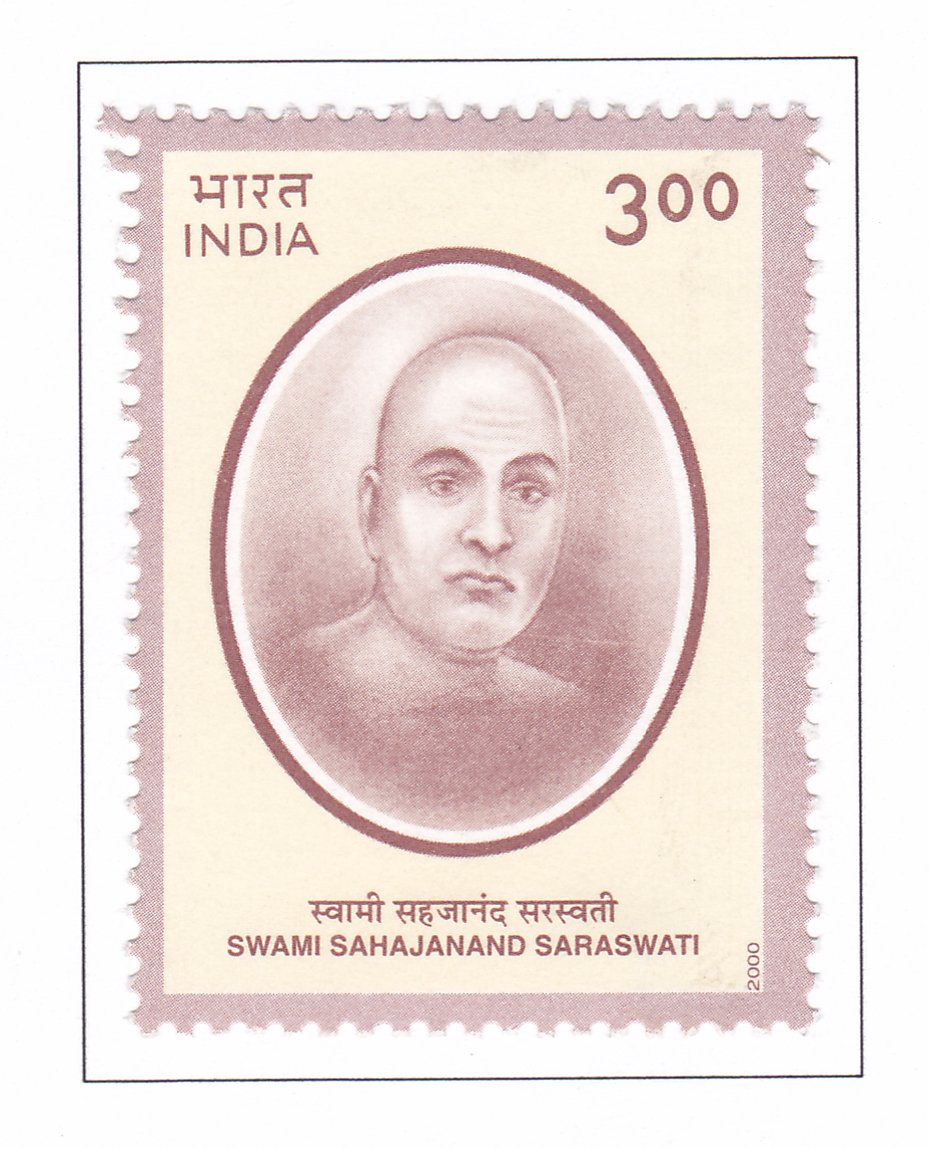
Swami Sahajanand Saraswati (1889-1950)
Technical Data
| Date of Issue | June 26, 2000 |
|---|---|
| Denomination | Rs. 3 |
| Quantity | 400,000 |
| Perforation | comb 13 x 13½ |
| Printer | Calcutta Security Printers Ltd |
| Printing Process | Offset Lithography |
| Watermark | No Watermark |
| Colors | Multicolor |
| Credit (Designed By) | Sh. Sankha Samanta |
| Catalog Codes |
Michel IN 1767 Stamp Number IN 1836 Yvert et Tellier IN 1533 Stanley Gibbons IN 1940 |
| Themes | Anniversaries and Jubilees | Famous people | Men | Reformers |
Pioneer of India’s Peasant Movement
Swami Sahajanand Saraswati (1889–1950) was a revered sanyasi, freedom fighter, and one of the foremost leaders of India’s peasant movement. He dedicated his life to achieving political and economic justice for farmers and the oppressed sections of society.
Early Life and Spiritual Journey
Born in Ghazipur district of Uttar Pradesh, Swami Sahajanand Saraswati was a brilliant student from a young age. He renounced his home and family to embrace a life of asceticism.
He later moved to Varanasi, where he spent nine years studying Sanskrit and Hindu philosophy, shaping his intellectual and spiritual foundation.
Role in India’s Freedom Movement
The arrival of Mahatma Gandhi gave a new direction to India’s struggle for independence. Inspired by Gandhi’s call, Swami Sahajanand actively participated in movements such as the Non-Cooperation Movement and Civil Disobedience Movement.
He played a key role in mobilizing people in Shahabad (Bihar) and Ghazipur (Uttar Pradesh), organizing public meetings, encouraging mass participation, and collecting funds for the Tilak Swaraj Fund. His efforts led to his arrest and imprisonment for one year.
Promotion of Khadi and Social Reform
Between 1924 and 1928, Swami Sahajanand focused on promoting Khadi and prohibition, key elements of Gandhi’s constructive programme.
He established a Khadi weaving center at Simri and set up an ashram at Bihata for political and Sanskrit education. His dedication earned him positions in the All India Congress Committee, as well as provincial Congress committees.
Leadership in the Kisan Movement
Swami Sahajanand Saraswati became a powerful voice against feudal oppression. He strongly advocated for the abolition of the zamindari system and supported peasant ownership of land.
He addressed issues such as forced labor, illegal taxation, and eviction, organizing peasant struggles across Bihar. By the mid-1930s, under his leadership, the peasant movement became a major political force.
His efforts contributed significantly to the success of the Congress in the 1936 Bihar Legislative Assembly elections and led to important tenancy reforms that benefited farmers.
Influence and Popularity
Known for his powerful speeches and strong leadership, Swami Sahajanand inspired millions of farmers to stand up for their rights. He was affectionately called “Kisan Pran” (the life force of farmers) by his followers.
In recognition of his popularity, “Sahajanand Day” was observed across Bihar on 19 April 1940 to protest his arrest.
Literary Contributions
Apart from activism, Swami Sahajanand Saraswati was also a prolific writer and journalist. He published the Hindi weekly Hunkar from Patna.
His notable works on peasant struggles include:
- The Other Side of the Shield
- Rent Reduction in Bihar: How it Works
- Gaya Ke Kisano Ki Karun Kahani
- How the Kisans Fight
- Kisan Sabha Ke Sansmaran
Legacy and Recognition
Swami Sahajanand Saraswati’s contributions to India’s freedom struggle and agrarian reforms remain unparalleled. In 1949, the nation honored him by celebrating his Diamond Jubilee.
He is also known as the founder of the All India Kisan Sabha, which became a major platform for farmers’ rights.
In recognition of his immense contributions, the Department of Posts issued a commemorative postage stamp in his honor.
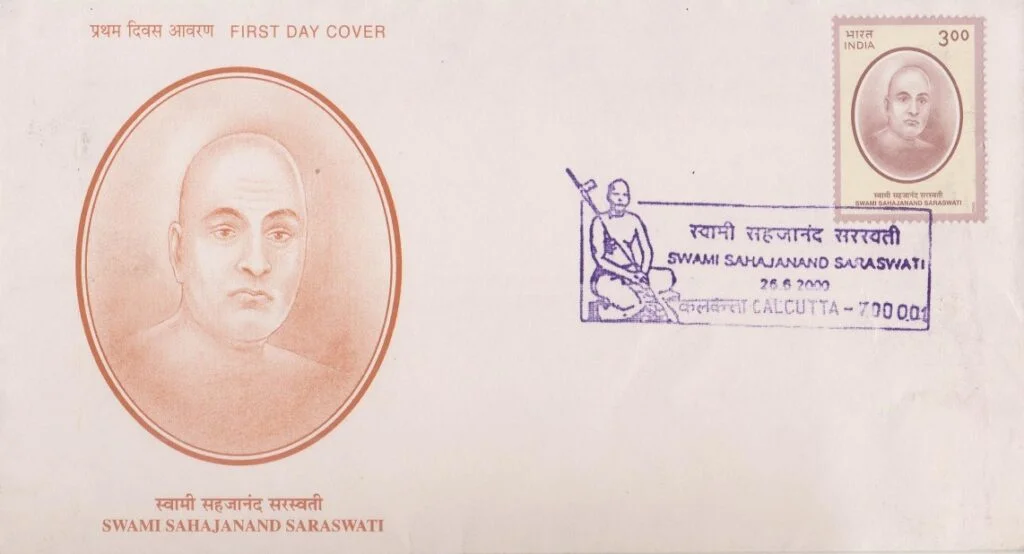
First Day Cover