
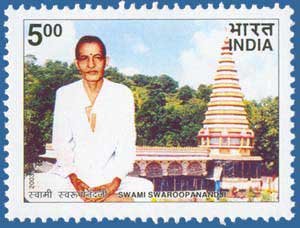
Swami Swaroopanandji (1903-1974)
Technical Data
| Date of Issue | December 20, 2003 |
|---|---|
| Denomination | Rs. 5 |
| Quantity | 400,000 |
| Perforation | comb 13½ x 13 |
| Printer | Eagle Press Ltd. |
| Printing Process | Offset Lithography |
| Watermark | No Watermark |
| Colors | Multicolor |
| Credit (Designed By) | Smt. Alka Sharma |
| Catalog Codes |
Michel IN 2007 Stamp Number IN 2045 Yvert et Tellier IN 1772 Stanley Gibbons IN 2183 WADP Numbering System - WNS IN064.03 |
| Themes | Anniversaries and Jubilees | Famous people | Men | Religion |
Spiritual Leader and Social Reformer
Introduction
Swami Swaroopanand, originally named Ramachandra Vishnu Godbole, was a revered spiritual leader, social reformer and scholar. His life was dedicated to spirituality, education, and the dissemination of religious knowledge among the common people. Through his teachings and literary contributions, he helped make the philosophical works of medieval saints more accessible to modern readers.
Early Life and Education
Swami Swaroopanandji was born on 15 December 1903 in Pawas, located in the Ratnagiri district of Maharashtra. From a young age, he showed a keen interest in religious scriptures and spiritual studies.
His early education was shaped by teachers of the Aryan Education Society in Mumbai, who encouraged his interest in spirituality and philosophy. Later, he graduated from Tilak Maharashtra Vidyapeeth in Pune.
Influence of the Freedom Movement
During his student years, the ideas of national leaders like Bal Gangadhar Tilak and Mahatma Gandhi deeply influenced him. Inspired by their patriotic vision, he decided to dedicate his life to the service of the nation rather than pursuing higher academic studies.
He returned to Pawas and established a school named “Swavalambanashram”. The institution aimed to promote patriotism, self-reliance, and independence among students in accordance with the ideals of the national movement. The school functioned from 1922 to 1927 but had to close due to lack of support from the local community.
Spiritual Journey
Despite the setback, he continued to devote himself to both spiritual growth and national service. In 1923, he was initiated into the Nath Sect by his guru Baba Maharaj Vaidya.
Even while pursuing spiritual practices, he expressed strong nationalist sentiments through public speeches. When he defied government restrictions and travelled to Pune to participate in a nationwide strike, he was arrested in 1930 along with other freedom fighters. His time in prison became an important phase in his life, providing him with an opportunity for deep meditation and reflection.
Life as Swami Swaroopanand
After his release, his guru appointed him as the leader of the sect and gave him the spiritual name Swaroopanand. In 1934, a near-death experience transformed his life completely. From then onward, he adopted a simple spiritual lifestyle and spent the rest of his life at “Anant Niwas” in Pawas.
For nearly four decades, he dedicated himself to spiritual teaching and literary work. His primary mission was to make the teachings of Sant Dnyaneshwar understandable to ordinary people.
Literary Contributions
Many of the classical works of Sant Dnyaneshwar—such as Dnyaneshwari, Amritanubhav, and Changdev Pasashti—were written in old Marathi, making them difficult for modern readers to understand.
Swami Swaroopanand translated and interpreted these texts into modern Marathi, enabling common people to grasp their spiritual message and philosophical depth. His work helped preserve and spread the rich heritage of Marathi spiritual literature.
Philosophy and Legacy
Swami Swaroopanand embodied the ideals of the Bhagavad Gita, combining devotion, knowledge, and detachment in his life. Through his teachings and writings, he encouraged spiritual growth, moral values, and self-realization.
He attained Mahasamadhi on 15 August 1974 at Pawas, leaving behind a lasting spiritual legacy.
Commemorative Postage Stamp
To honour his contributions to spirituality and literature, India Post issued a commemorative postage stamp on the birth centenary of Swami Swaroopanand, recognizing his efforts in translating and popularizing the works of Sant Dnyaneshwar for modern readers.
First Day Cover