
T. N. Rajarathinam Pillai
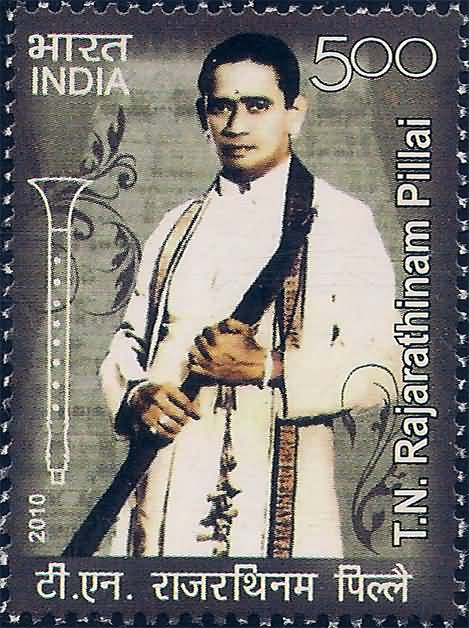
Technical Data
| Date of Issue | December 3, 2010 |
|---|---|
| Denomination | Rs. 5 |
| Quantity | 300,000 |
| Perforation | 13½ |
| Printer | Security Printing Press, Hyderabad |
| Printing Process | Wet Offset |
| Watermark | No Watermark |
| Colors | Multicolor |
| Credit (Designed By) | Sh. Brahm Prakash |
| Catalog Codes |
Michel IN 2530 Stamp Number IN 2469 Yvert et Tellier IN 2294 Stanley Gibbons IN 2294 WADP Numbering System - WNS IN076.2010 |
| Themes | Famous people | Men | Musical Instruments | Musicians |
The Emperor of Nagaswaram
Early Life and Musical Roots
T. N. Rajarathinam Pillai was born on 27 August 1898 to Shri Kuppuswami Pillai and Smt. Govindammal in Thiruvaduthurai in Tanjavur District of Tamil Nadu. Tanjavur, often regarded as the cradle of Tamil culture and art, has produced numerous celebrated dancers, musicians, and artists who shaped the course of South Indian classical traditions.
Among the distinguished musicians of the region was the great Nagaswara Vidwan Natesa Pillai, who wished to take young Rajarathinam as his disciple and train him in the art of playing the Nagaswaram. Unfortunately, Natesa Pillai passed away before fulfilling this desire. Rajarathinam was then trained in vocal music and gave his maiden vocal performance at the tender age of seven.
Training in Nagaswaram
Honouring the wish of Natesa Pillai and encouraged by family elders, Rajarathinam Pillai later began learning the Nagaswaram under the guidance of Shri Ammachatram Kannuswami Pillai, a renowned Nagaswaram vidwan. Through relentless practice, deep dedication, and disciplined application, he mastered the instrument with exceptional brilliance.
The Nagaswaram, a powerful wind instrument integral to South Indian temple and ceremonial music, found in him one of its most illustrious exponents. His ability to render elaborate and expansive raga alapanas for hours became his hallmark. His performances were marked by depth, grandeur, and emotional intensity, earning him widespread acclaim.
Contribution to Indian Classical Music
Rajarathinam Pillai elevated the status of the Nagaswaram to concert platform dignity, bringing it into mainstream Carnatic classical music with renewed prestige. His artistry transformed the perception of the instrument and inspired generations of musicians.
He also briefly appeared in films, showcasing his versatility beyond the classical stage.
Historic Performance at Independence
When India attained Independence in 1947, Rajarathinam Pillai had the rare honour of presenting a recital at the historic Darbar Hall of Rashtrapati Bhavan before a distinguished gathering. This performance symbolized national pride and cultural heritage at a defining moment in India’s history.
Legacy and Commemorative Stamp
T. N. Rajarathinam Pillai passed away on 12 December 1956, leaving behind a towering legacy in Carnatic music. His name continues to be revered among musicians and music lovers alike.
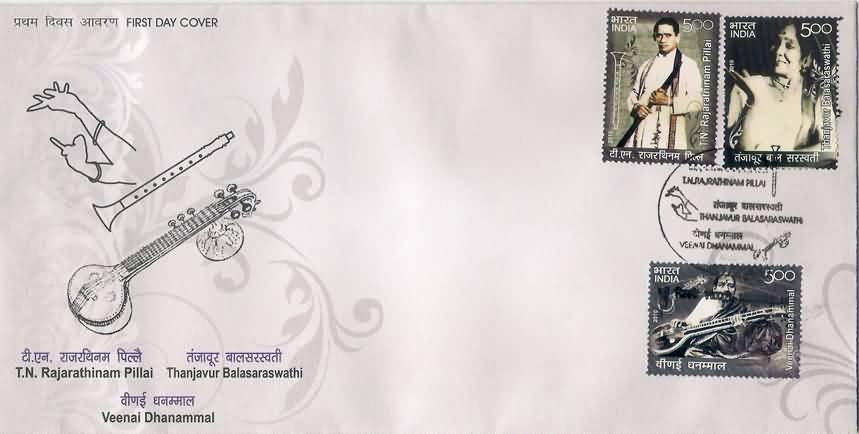
In recognition of his immense contribution to Indian classical music, India Post issued a commemorative postage stamp in his honour, along with stamps dedicated to Balasaraswati and Veenai Dhanammal. This philatelic tribute celebrates three iconic figures who enriched India’s cultural and musical heritage.
First Day Cover
Leave a Comment
You must be logged in to post a comment.