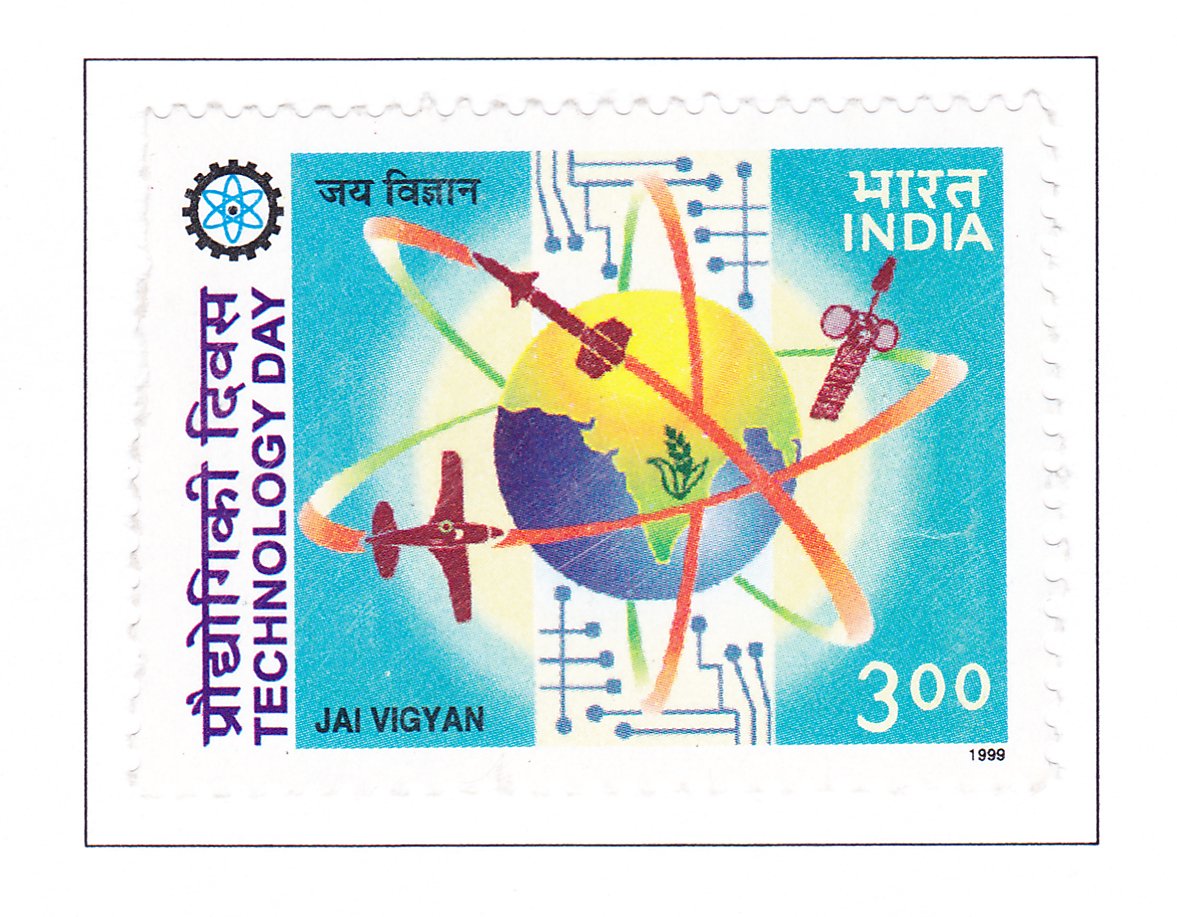
Technology Day – Jai Vigyan
Technical Data
| Date of Issue | May 11, 1999 |
|---|---|
| Denomination | Rs. 3 |
| Quantity | 700,000 |
| Perforation | comb 13½ |
| Printer | Calcutta Security Printers Ltd |
| Printing Process | Offset Lithography |
| Watermark | No Watermark |
| Colors | Multicolor |
| Credit (Designed By) | Adrian Cowasjee |
| Catalog Codes |
Michel IN 1685 Stamp Number IN 1746 Yvert et Tellier IN 1452 Stanley Gibbons IN 1848 |
| Themes | Aircraft | Aviation | Globes | Rockets | Satellites |
Celebrating India’s Scientific and Technological Achievements
National Technology Day is celebrated every year on 11 May to honor the remarkable achievements of Indian scientists, engineers, and technologists. The day recognizes India’s progress in science and technology and commemorates the important technological milestones that have strengthened the nation’s security, economy, and self-reliance.
The Department of Posts issued a commemorative postage stamp to mark the first anniversary of National Technology Day and to pay tribute to India’s scientific community.
India’s Rich Technological Heritage
India’s technological heritage can be traced back to the Indus Valley Civilization. The civilization developed advanced techniques in metallurgy, town planning, construction, hydraulics, navigation, food processing, and even surgery.
Over the centuries, India continued to build on this tradition of innovation. After independence, Indian scientists and technologists worked tirelessly to develop new technologies that contributed to national security, economic growth, and social progress.
These achievements have played a major role in improving the quality of life and building self-confidence among the people of India.
India’s Achievements in Space Technology
India is among the few countries in the world with the capability to launch satellites into space.
Indian space technology has transformed the country in several ways. It has improved:
- Weather forecasting
- Disaster management
- Telecommunications
- Defence preparedness
- Remote sensing and resource management
One of the notable achievements in this field was the launch of the INSAT-2E satellite, which captured the imagination of the nation and demonstrated India’s growing strength in space research and communication technology.
Defence Technology and Missile Development
Indian scientists and technologists have made major contributions to the country’s defence capabilities.
Through the design and development of tactical missiles, combat aircraft, armored vehicles, and radar systems, India has strengthened its armed forces and improved national security.
Among the important milestones in defence technology were the successful test firing of the Agni-II missile and the Trishul missile. These achievements reflected India’s growing expertise in indigenous missile technology.
India’s Nuclear Technology Capabilities
India is one of the few nations that has mastered the complete nuclear fuel cycle and the production of atomic materials.
Indian nuclear scientists have developed indigenous capabilities in:
- Nuclear power generation
- Atomic energy projects
- Nuclear research
- Strategic weapons systems
A landmark moment in India’s technological history came on 11 May 1998, when the country successfully conducted three nuclear tests at Pokhran in Rajasthan. These tests demonstrated India’s scientific capability and technological self-reliance.
Agricultural Technology and the Green Revolution
India’s agricultural scientists have also played a key role in national development.
The Green Revolution transformed Indian agriculture and enabled the country to become self-sufficient in food grain production.
Today, advances in biotechnology and genetic engineering are helping Indian agriculture achieve even greater progress.
The wheat plant featured on the National Technology Day stamp symbolizes the contribution of agricultural scientists to India’s prosperity and food security.
Medical and Industrial Progress in India
Technological development in healthcare, medicines, and medical systems has significantly improved the health of the Indian people.
Since independence, India has witnessed:
- A major increase in life expectancy
- Better healthcare facilities
- Growth in pharmaceutical research
- Development of indigenous drugs and therapies
Indian industry has also expanded rapidly. Since independence, industrial production has grown more than twenty times and now covers a wide range of industrial and consumer products.
Small-scale and rural industries, supported by innovation and entrepreneurship, have helped spread economic opportunities across the country.
Why 11 May is Celebrated as National Technology Day
The date 11 May 1998 occupies a special place in India’s scientific history because three important technological achievements took place on that day:
- The successful nuclear tests at Pokhran
- The successful test firing of the Trishul missile
- The maiden certification test flight of Hansa-3, India’s first indigenous all-composite two-seater aircraft
In recognition of these achievements and the contributions of Indian scientists and technologists, the Government of India declared 11 May as National Technology Day.
Design of the National Technology Day Commemorative Stamp
The National Technology Day commemorative stamp beautifully represents India’s technological progress.
The stamp features a globe surrounded by three orbits. Within these orbits are:
- The INSAT-2E satellite
- The Hansa aircraft
- The Trishul missile
- A wheat plant representing agricultural progress
The globe and its orbits can also be interpreted as an atom with orbiting electrons, symbolizing India’s achievements in nuclear science.
The commemorative stamp serves as a tribute to the scientists and technologists whose work has contributed to India’s prestige, prosperity, and national development.
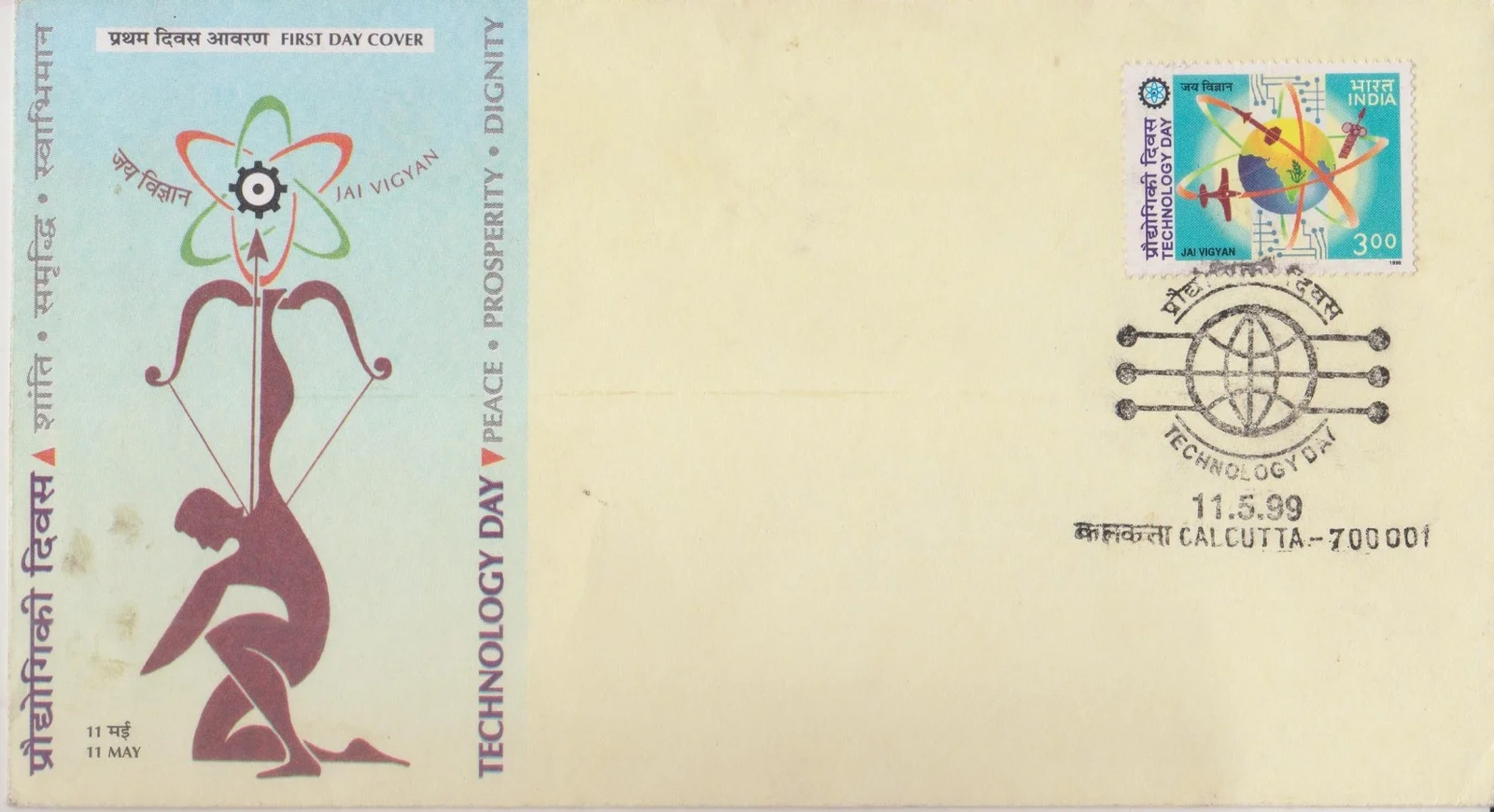
First Day Cover