The Aga Khan Award For Architecture

Technical Data
| Date of Issue | November 28, 2004 |
|---|---|
| Denomination | Rs. 30 |
| Quantity | 200,000 |
| Perforation | comb14 |
| Printer | Security Printing Press, Nashik |
| Printing Process | Photogravure |
| Watermark | No Watermark |
| Colors | Multicolor |
| Credit (Designed By) | Smt. Alka Sharma |
| Catalog Codes |
Michel IN BL29 Stamp Number IN 2089c Yvert et Tellier IN BF29 Stanley Gibbons IN MS2244 WADP Numbering System - WNS 049MS.2004 |
| Themes | Architecture | Fortresses / Strongholds | Places | UNESCO World Heritage Sites |
Stamps in this Miniature Sheet
The Aga Khan Award for Architecture was established in 1977 by Aga Khan IV to promote a deeper understanding and appreciation of Islamic culture through architecture. The award recognizes architectural excellence across a wide range of fields, including modern design, restoration, community development, heritage conservation, landscaping, and environmental sustainability.
By celebrating innovative architectural projects, the award encourages the preservation of cultural diversity and architectural heritage. Presented every three years, the award carries prize money of up to US$500,000, making it one of the largest and most prestigious architectural awards in the world. Since its inception, the award has completed several cycles, with the Ninth Award Cycle covering the period from 2002 to 2004.
Agra Fort: A Mughal Architectural Marvel
One of the iconic monuments associated with the award celebrations is the magnificent Agra Fort. Located in the historic city of Agra, the fort stands majestically on the western bank of the Yamuna River, close to the gardens of the Taj Mahal.
Built primarily from red sandstone, Agra Fort is one of the most significant Mughal monuments of the 16th and 17th centuries. In recognition of its historical and architectural importance, it was added to the UNESCO World Heritage List in 1983. Today, it is among the major heritage monuments preserved by the Archaeological Survey of India.
History of Agra Fort
The construction of Agra Fort began in 1565 under the Mughal emperor Akbar and was largely completed by 1571. Later Mughal rulers, especially Shah Jahan, added several palaces and elegant structures within the fort complex.
During Akbar’s reign, the fort mainly served as a military stronghold, but under Shah Jahan, it evolved into a royal palace and court complex. The architectural concept of Agra Fort later influenced the design of the Red Fort in Delhi.
Architecture and Structure
Agra Fort is designed as an irregular semicircle, following the curve of the Yamuna River. It was constructed on the foundations of an earlier brick fort built by the Lodi Dynasty.
Key architectural features include:
- Massive double walls rising about 20 meters high
- A circumference of approximately 2.5 kilometres
- Two defensive moats surrounding the fort
- Strategic openings for musketeers along the walls
The fort combines architectural influences from Central Asia (Transoxiana) with regional traditions of Gujarat, Malwa, and Rajasthan, resulting in a unique blend of Mughal design.
Inside the fort are several palaces, halls, and pavilions built in both red sandstone and white marble, reflecting the evolving tastes of Mughal architecture.
Khas Mahal and Other Important Structures
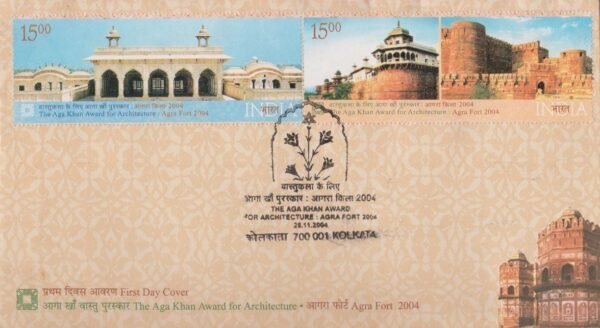
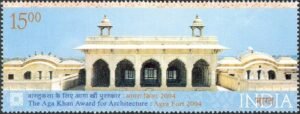
To commemorate the 2004 Aga Khan Award for Architecture, two postage stamps were issued featuring important structures within Agra Fort, particularly the Khas Mahal.
Built entirely of white marble by Shah Jahan in 1637, the Khas Mahal served as the emperor’s private palace and overlooks the elegant Angoori Bagh.
Notable architectural elements include:
- Three riverside pavilions overlooking the Yamuna
- A central pavilion used as the emperor’s sleeping chamber
- Five arches on the front façade and three arches on each side
- Decorative turrets rising from the roof
On either side of the central pavilion are two additional structures:
- Bangla-i-Darshan – where the emperor held public audiences
- Bangla-i-Jahanara – the pavilion associated with his daughter Jahanara Begum
Mussaman Burj and Shah Jahan’s Final Years
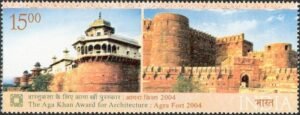
Another remarkable structure inside the fort is the Musamman Burj, an elegant octagonal marble pavilion with delicate lattice screens and ornamental niches.
From this tower, royal women could observe the outside world without being seen. The structure also provides a stunning view of the Taj Mahal across the river.
According to historical accounts, this is the place where Shah Jahan spent the last years of his life, imprisoned by his son Aurangzeb, gazing toward the mausoleum he built for Mumtaz Mahal.
Amar Singh Gate
The southern side of Agra Fort features the impressive Amar Singh Gate, one of the two major entrances to the fort. Added by Shah Jahan, the gate was named after the Rajput warrior Amar Singh Rathore.
Philatelic Tribute
To mark the Ninth Aga Khan Award for Architecture (2002–2004), India Post issued a Miniature Sheet consisting of set of two postage stamps featuring the architectural splendour of Agra Fort.
These stamps celebrate not only the fort’s historical importance but also its enduring legacy as one of the finest examples of Mughal architecture and world heritage.
First Day Cover