Agra Fort

Technical Data
| Date of Issue | November 28, 2004 |
|---|---|
| Denomination | Rs. 15 |
| Quantity | 800,000 |
| Perforation | comb 14 |
| Printer | Security Printing Press, Nashik |
| Printing Process | Photogravure |
| Watermark | No Watermark |
| Colors | Multicolor |
| Credit (Designed By) | Smt. Alka Sharma |
| Catalog Codes |
Michel IN 2063 Stamp Number IN 2089b Yvert et Tellier IN 1834 Stanley Gibbons IN 2243 WADP Numbering System - WNS IN049.04 |
| Themes | Architecture | Fortresses / Strongholds | UNESCO World Heritage Sites |
A Majestic Mughal Stronghold in Agra
The Agra Fort is one of the most magnificent monuments of the Mughal era and an outstanding example of Indo-Islamic architecture. Located in the historic city of Agra, the fort stands on the western bank of the Yamuna River, close to the world-famous Taj Mahal.
Built primarily of red sandstone, Agra Fort served as the main residence of the Mughal emperors for several generations. Due to its immense historical and architectural significance, it was declared a UNESCO World Heritage Site in 1983 and is now preserved by the Archaeological Survey of India.
History of Agra Fort
The construction of Agra Fort began in 1565 under the Mughal emperor Akbar. The fort was largely completed by 1571, although many additions were made later by subsequent rulers, particularly Shah Jahan.
Originally, the fort served mainly as a military stronghold during Akbar’s reign. Over time, however, it evolved into a royal palace complex and administrative centre. Shah Jahan added several elegant marble structures within the fort, transforming parts of it into a luxurious imperial residence. The design of Agra Fort also influenced the construction of the famous Red Fort in Delhi.
Architecture and Layout
Agra Fort is built in the shape of an irregular semicircle, following the natural curve of the Yamuna River. It stands on the site of an earlier brick fort constructed by the Lodi Dynasty.
The fort’s imposing defensive features include:
- Massive double walls rising about 20 metres high
- A circumference of approximately 2.5 kilometres
- Strategic openings in the walls for musketeers
- Two protective moats surrounding the fort
Inside the fort complex are numerous palaces, courtyards, mosques, and audience halls constructed from red sandstone and white marble. The architectural style blends influences from Central Asia, particularly Transoxanian traditions, with regional elements from Gujarat, Malwa, and Rajasthan.
Khas Mahal and Angoori Bagh
One of the most elegant structures within the fort is the Khas Mahal, built entirely of white marble by Shah Jahan in 1637. This private palace overlooks the beautiful Angoori Bagh.
The Khas Mahal features:
- Three riverside pavilions overlooking the Yamuna
- A central pavilion used as the emperor’s private chamber
- Elegant arches and decorative marble work
- Two flanking pavilions known as Bangla-i-Darshan and Bangla-i-Jahanara, associated with royal audiences and the emperor’s daughter Jahanara Begum
Musamman Burj and Shah Jahan’s Imprisonment
Another remarkable structure within the fort is the Musamman Burj, a beautiful octagonal tower decorated with delicate marble lattice screens.
This pavilion offered a clear view of the Taj Mahal across the Yamuna River. According to tradition, Shah Jahan spent the last years of his life here after being imprisoned by his son Aurangzeb, gazing toward the monument he built for his beloved wife Mumtaz Mahal.
Amar Singh Gate
The southern side of the fort features the grand Amar Singh Gate, one of the main entrances to the complex. Named after the Rajput warrior Amar Singh Rathore, the gate was added during the reign of Shah Jahan and remains the principal entry point for visitors today.
Commemorative Postage Stamp
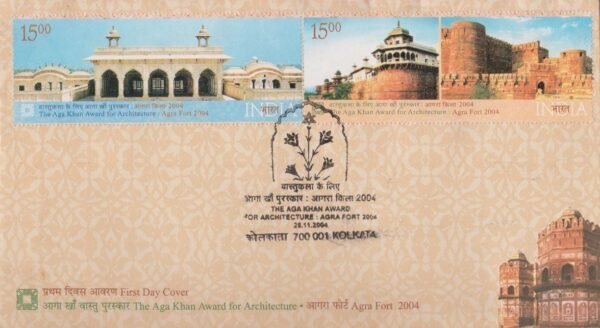
To celebrate the architectural significance of this historic monument, India Post issued a commemorative postage stamp featuring Agra Fort. The stamp was released in connection with the Aga Khan Award for Architecture (2002–2004 cycle).
Legacy of Agra Fort
Today, Agra Fort remains one of the most important heritage monuments in India. Its majestic architecture, rich Mughal history, and proximity to the Taj Mahal make it a major attraction for visitors from around the world. As a symbol of imperial power, artistic brilliance, and historical legacy, Agra Fort continues to stand as a remarkable testament to the grandeur of the Mughal Empire.
First Day Cover