
The Doon School, Dehradun

Technical Data
| Date of Issue | October 22, 2010 |
|---|---|
| Denomination | Rs. 5 |
| Quantity | 400,000 |
| Perforation | 13½ |
| Printer | Security Printing Press, Hyderabad |
| Printing Process | Wet Offset |
| Watermark | No Watermark |
| Colors | Multicolor |
| Credit (Designed By) | Smt. Alka Sharma |
| Catalog Codes |
Michel IN 2517 Stamp Number IN 2455 Yvert et Tellier IN 2280 Stanley Gibbons IN 2755 WADP Numbering System - WNS IN063.2010 |
| Themes | Anniversaries and Jubilees | Buildings | Schools |
The Doon School was founded in 1935 by Satish Ranjan Das, a prominent barrister from Kolkata. Inspired by the British model of public schools, he envisioned an Indian public residential school for Indian boys in the foothills of the Himalayas. Thus was established The Doon School in Dehradun, with a mission to combine modern education with strong values and character building.
Ideals and Educational Philosophy
The school’s core ideals focus on imparting modern education while nurturing character, intellect, and a healthy body. Its academic curriculum is enriched with leadership programmes, sports, societies, and diverse co-curricular activities.
A distinctive feature of the school is the intense intra-mural competition among its boarding houses. This system instills discipline, resilience, and the spirit of fair play, teaching students to “play the game of life” with grace and honesty.
Academic and Cultural Excellence
In an increasingly competitive educational environment, The Doon School has consistently maintained high academic standards without compromising on co-curricular engagement. The school hosts an annual music festival, stages seven plays each year, conducts debates in both English and Hindi, and publishes eight school publications along with organizing numerous writing competitions.
Notably, the Doon School Weekly, the school’s newspaper, has been published every Saturday at breakfast since 1936 — a rare and remarkable tradition in school journalism.
Pioneering Educational Practices
The Doon School introduced several innovative practices in Indian education:
- Elected School Council: A representative body comprising boys and masters that assists in school governance.
- Adventure and Mountaineering: A strong tradition of Himalayan expeditions, with boys and masters climbing peaks over 20,000 feet. Each term includes expeditions into the Himalayas.
- Social and Community Service: The school actively promotes service to society. The concept of Socially Useful Productive Work (SUPW), now compulsory in Indian schools, was inspired by Doon’s earlier “labour quotas” programme.
Governance and Legacy
The school is owned by the Indian Public Schools’ Society (IPSS) and is governed by a Board of Governors. It operates on a no profit–no loss basis, emphasizing service over commercial gain.
The Doon School boasts an impressive network of distinguished alumni who have excelled in diverse fields. The international magazine The Economist once described its alumni network as the second most influential in the world after Harvard’s. The school has received wide acclaim globally and is frequently rated among the best residential schools in India.
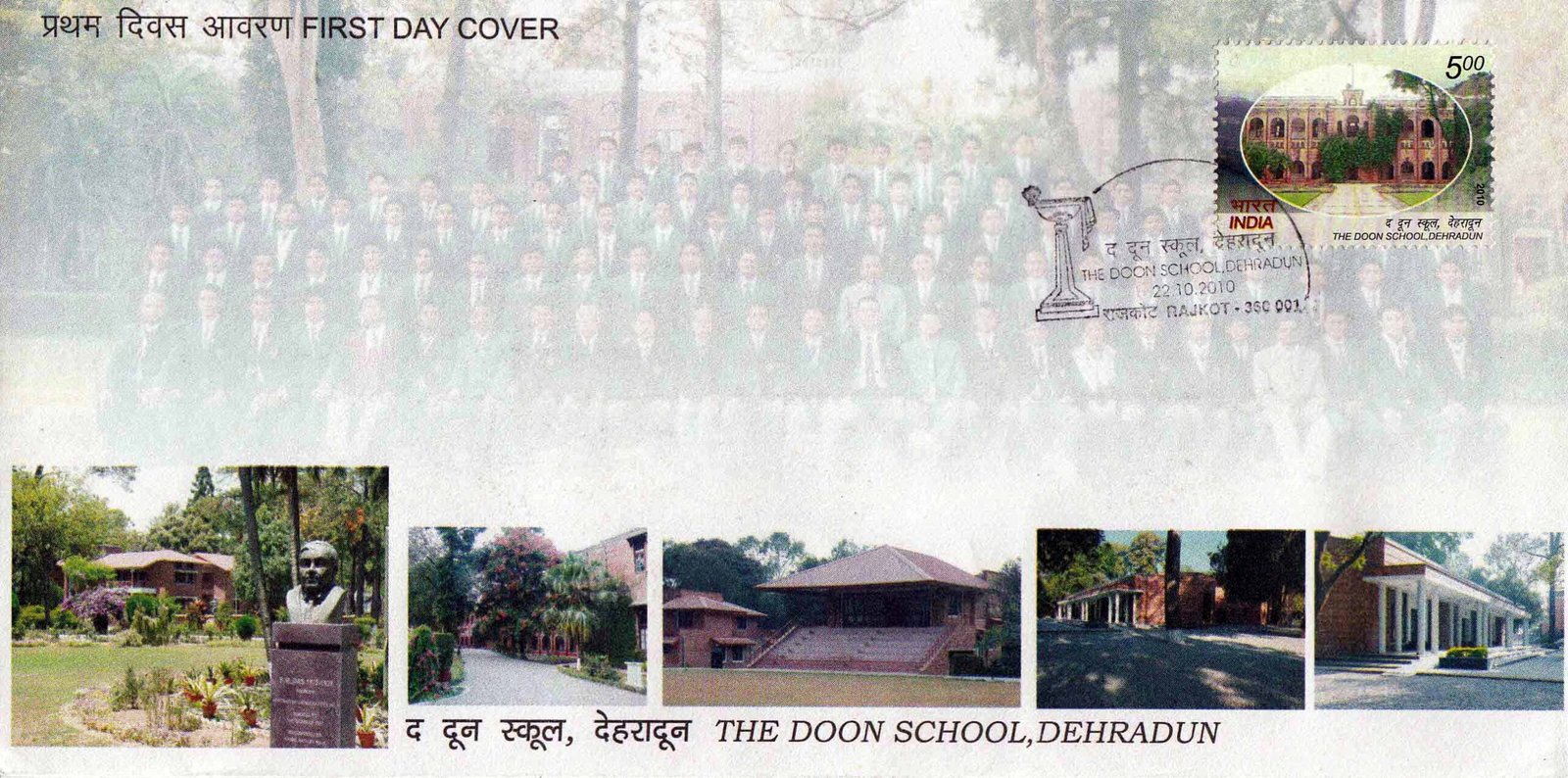
In recognition of its outstanding contribution to education and nation-building, India Post issued a commemorative postage stamp honouring The Doon School, Dehradun.
First Day Cover
Leave a Comment
You must be logged in to post a comment.