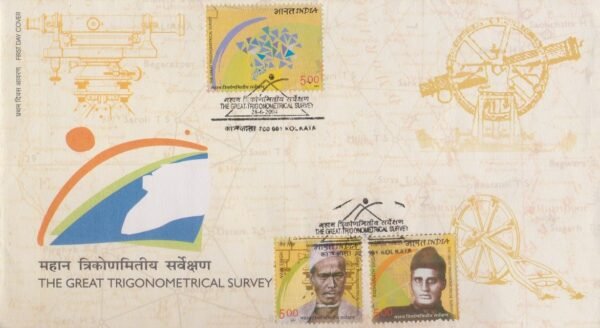
Radhanath Sikdar (1813-1870)

Technical Data
| Date of Issue | June 28, 2004 |
|---|---|
| Denomination | Rs. 5 |
| Quantity | 800,000 |
| Perforation | comb 13 x 13½ |
| Printer | Calcutta Security Printers Ltd |
| Printing Process | Photogravure |
| Watermark | No Watermark |
| Colors | Multicolor |
| Credit (Designed By) | Shri Kamleshwar Singh Smt. Alka Sharma |
| Catalog Codes |
Michel IN 2031 Stamp Number IN 2066 Yvert et Tellier IN 1797 Stanley Gibbons IN 2209 WADP Numbering System - WNS IN017.04 |
| Themes | Famous people | Geodesy and Surveying | Headgear | Men |
Early Life and Education
Radhanath Sikdar was one of the most brilliant Indian mathematicians and surveyors associated with the Great Trigonometrical Survey conducted by the Survey of India. From a young age, he displayed remarkable mathematical ability and analytical skills, which later helped him make significant contributions to surveying and geodesy.
Career with the Survey of India
Radhanath Sikdar joined the Survey of India at Mussoorie at the age of 21. He was appointed as a “computer” (a term used at the time for a mathematical calculator) in 1831 and soon joined field operations under George Everest. His exceptional talent in mathematical computation quickly made him an important member of the survey team.
Discovery of the Height of Mount Everest
Sikdar is widely credited with calculating the height of the world’s tallest mountain, Mount Everest. Using complex trigonometric calculations derived from survey data, he determined that the Himalayan peak known then as “Peak XV” was the highest mountain on Earth. This discovery marked a significant achievement in the history of geographical science.
Scientific Contributions
Apart from calculating the height of Mount Everest, Radhanath Sikdar made several other important contributions to the survey. He prepared the first edition of the Auxiliary Tables, which greatly assisted surveyors in performing complex calculations. He also helped in compiling the important reference work Manual of Surveying for India. His expertise and dedication made him a trusted associate not only of George Everest but also of his successor.
Later Life and Legacy
After the departure of George Everest, Sikdar continued to serve under the new Surveyor General and remained an important member of the Survey of India. He retired from service in March 1862. Radhanath Sikdar passed away on 17 May 1870, leaving behind a remarkable legacy in the field of scientific surveying and geographical discovery.
Commemorative Postage Stamp
To honour his contribution to the Great Trigonometrical Survey of India, India Post issued a commemorative postage stamp featuring Radhanath Sikdar. The stamp also depicts surveying instruments such as the theodolite, symbolizing the scientific efforts that helped accurately measure and map the Indian subcontinent.
First Day Cover