
Bharat Meets Ram
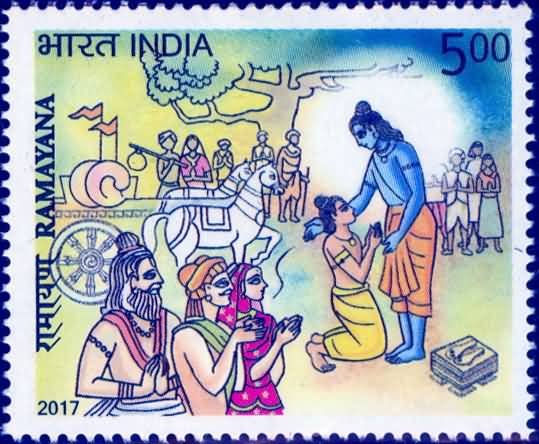
Technical Data
| Date of Issue | September 22, 2017 |
|---|---|
| Denomination | Rs. 5 |
| Perforation | 13 x 13¾ |
| Printer | Security Printing Press, Hyderabad |
| Printing Process | Wet Offset |
| Watermark | No Watermark |
| Colors | Multicolor |
| Credit (Designed By) | Sh. Sankha Samanta Smt. Alka Sharma |
| Catalog Codes |
Michel IN 3204A Yvert et Tellier IN 2895 |
| Themes | Literature |
A Testament of Brotherhood and Dharma
The episode of Bharat Meets Ram in the Ramayana is one of the most emotional and spiritually powerful moments in the epic. It reflects the ideals of brotherhood, sacrifice, humility, and unwavering commitment to Dharma.
The News of Exile
After Lord Ram left Ayodhya to honor his father King Dashrath’s promise to Queen Kaikeyi, Bharat was away from the kingdom. Upon his return, he was devastated to learn that his mother Kaikeyi had demanded two boons — the exile of Ram for fourteen years and the coronation of Bharat as king.
Grief-stricken by his father’s demise and ashamed of the circumstances that led to Ram’s exile, Bharat firmly rejected the throne. He resolved to bring Ram back to Ayodhya and restore him as the rightful king.
The Journey to Chitrakut
With ministers, sages, and the citizens of Ayodhya, Bharat journeyed to Chitrakut, where Ram, Sita, and Lakshman had taken shelter during their exile.
The meeting between the brothers was deeply emotional. Bharat fell at Ram’s feet, pleading with him to return and rule Ayodhya. His anguish reflected his purity of heart and absolute devotion to his elder brother.
Ram’s Firm Resolve
Despite Bharat’s heartfelt appeal, Ram remained steadfast in his commitment to Dharma. He explained that fulfilling their father’s promise was his foremost duty. As Maryada Purushottam, Ram chose righteousness over personal comfort or emotional persuasion.
Bharat, understanding Ram’s unwavering sense of duty, accepted his decision but refused to sit on the throne as king.
The Symbol of the Paduka
In a profound gesture of humility and devotion, Bharat requested Ram’s wooden paduka (sandals). He placed them on the throne of Ayodhya and ruled the kingdom as a regent, considering himself merely a caretaker until Ram’s return.
For fourteen years, Bharat lived a life of austerity, awaiting his brother’s return. This act symbolizes:
- Supreme brotherly love
- Renunciation of power
- Loyalty and righteousness
- Respect for Dharma and duty
Spiritual and Cultural Significance
The meeting of Bharat and Ram exemplifies the highest ideals of family bonds and moral responsibility. It portrays:
- Ram as the upholder of promises and righteousness
- Bharat as the embodiment of selflessness and devotion
- The triumph of duty over personal desire
This episode continues to inspire generations with its message of integrity, humility, and sacrifice.
Commemorative Postage Stamp
The Department of Posts has honored this moving episode in the Special Commemorative Postage Stamp series on the Ramayana.
The stamp depicting Bharat Meets Ram captures the emotional reunion at Chitrakut — Bharat bowing before Ram, while Ram stands with compassion and grace. The artwork beautifully conveys the depth of devotion and the sacred bond between the brothers.
Through this commemorative postage stamp, the timeless values of brotherhood and Dharma are preserved in philatelic history.
First Day Cover

Leave a Comment
You must be logged in to post a comment.