
Ram Sita Wedding
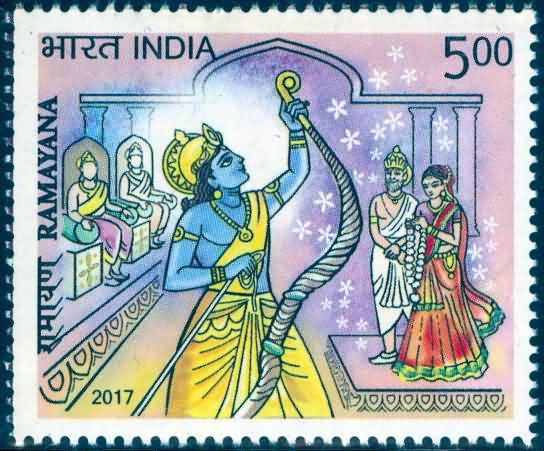
Technical Data
| Date of Issue | September 22, 2017 |
|---|---|
| Denomination | Rs. 5 |
| Perforation | 13 x 13¾ |
| Printer | Security Printing Press, Hyderabad |
| Printing Process | Wet Offset |
| Watermark | No Watermark |
| Colors | Multicolor |
| Credit (Designed By) | Sh. Sankha Samanta Smt. Alka Sharma |
| Catalog Codes |
Michel IN 3202A Yvert et Tellier IN 2893 |
| Themes | Literature |
The Sacred Union of Dharma and Devotion
The Wedding of Lord Ram and Goddess Sita is one of the most joyous and divine episodes of the Ramayana. It symbolizes the union of righteousness and virtue, strength and grace, and establishes an ideal of sacred marriage deeply revered across generations.
Arrival in Mithila
During their exile-like training under Maharishi Vishwamitra, Ram and Lakshman accompanied the sage to the kingdom of Mithila, ruled by King Janak. The king was immediately captivated by the radiance, humility, and noble bearing of the princes of Ayodhya.
At that time, King Janak had announced a grand Swayamvara for his daughter Sita. The condition for marriage was extraordinary — whoever could lift and string the mighty Shiva Dhanush (the divine bow of Lord Shiva) would win Sita’s hand.
The Breaking of the Shiva Dhanush
Many powerful kings and princes had attempted the challenge, but none could even move the colossal bow. When Ram approached it with humility and reverence, he effortlessly lifted it. As he attempted to string it, the bow broke with a thunderous sound.
The court was filled with astonishment and joy. King Janak realized that Ram was destined to be Sita’s husband. Overwhelmed with happiness, he declared the marriage of his beloved daughter to Prince Ram.
The Divine Wedding Ceremony
The wedding was celebrated with grandeur and sacred rituals. The royal families of Ayodhya and Mithila rejoiced together. Along with Ram and Sita, the marriages of Lakshman, Bharat, and Shatrughna with the daughters of King Janak’s family were also solemnized, strengthening the bond between the two kingdoms.
The Ram–Sita marriage represents:
- The ideal union based on Dharma and mutual respect
- Devotion, loyalty, and purity
- Harmony between strength and compassion
Their relationship would later endure exile, separation, and trials, yet remain a timeless example of commitment and righteousness.
Cultural and Spiritual Significance
The wedding of Ram and Sita is celebrated annually as Vivah Panchami, especially in regions like Mithila (Janakpur) and Ayodhya. The event is not merely a royal marriage but a sacred union symbolizing divine harmony and moral perfection.
In various retellings of the Ramayana — from Valmiki’s Sanskrit epic to Tulsidas’s Ramcharitmanas — this episode is described with deep devotion and poetic beauty.
Commemorative Postage Stamp
To honor this divine event, the Department of Posts issued a Special Commemorative Postage Stamp in the Ramayana series depicting the Ram–Sita Wedding.
The stamp beautifully captures the sacred moment of the marriage ceremony, often illustrating Ram and Sita seated before the holy fire, accompanied by sages and members of the royal families. The intricate design reflects traditional attire, divine aura, and the solemnity of Vedic rituals.
This commemorative postage stamp stands as a philatelic tribute to one of the most cherished episodes of Indian heritage — a celebration of love, virtue, and eternal values.
The Wedding of Ram and Sita is not just a ceremonial event in an epic; it is a symbol of ideal companionship and unwavering faith. Through centuries, this sacred union continues to inspire devotion, cultural traditions, and moral ideals across India and beyond.
First Day Cover

Leave a Comment
You must be logged in to post a comment.