
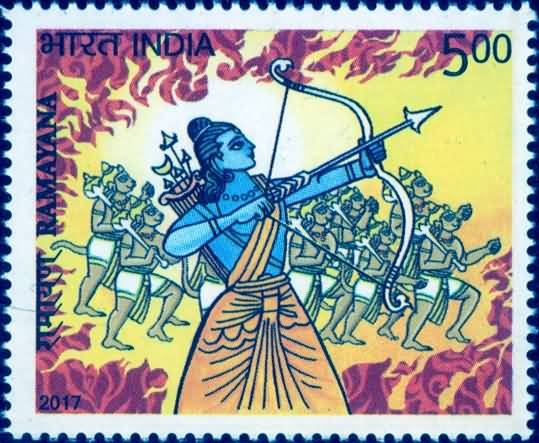
Ram kills Ravan
Technical Data
| Date of Issue | September 22, 2017 |
|---|---|
| Denomination | Rs. 5 |
| Perforation | 13 x 13¾ |
| Printer | Security Printing Press, Hyderabad |
| Printing Process | Wet Offset |
| Watermark | No Watermark |
| Colors | Multicolor |
| Credit (Designed By) | Sh. Sankha Samanta Smt. Alka Sharma |
| Catalog Codes |
Michel IN 3211A Yvert et Tellier IN 2902 |
| Themes | Literature |
Triumph of Dharma over Adharma
One of the most powerful and defining moments in the Ramayana, the ancient Sanskrit epic composed by Maharshi Valmiki, is the battle between Lord Ram and Ravana, the king of Lanka. This climactic episode symbolizes the eternal victory of righteousness (dharma) over evil (adharma), and continues to inspire millions across the world.
The Abduction of Sita
The chain of events leading to the great war began when Ravana deceitfully abducted Sita, the devoted wife of Lord Ram, and took her to Lanka. Despite the valiant attempt of the noble bird Jatayu to rescue her, Ravana overpowered him and carried Sita away to Ashok Vatika.
Determined to rescue Sita and uphold justice, Ram, accompanied by his loyal brother Lakshman and devoted follower Hanuman, set out towards Lanka. With the support of Sugriva and the Vanara (monkey) army, a bridge was constructed across the ocean to reach Ravana’s kingdom.
The Great Battle of Lanka
The war between Ram and Ravana was fierce and prolonged. Ravana, a mighty warrior and scholar, possessed immense strength and divine boons. His army of rakshasas (demons) clashed with the Vanara sena in an epic battle that tested courage, loyalty, and determination.
Many heroic warriors fought bravely on both sides. Lakshman defeated Indrajit, Ravana’s powerful son, while Hanuman displayed extraordinary valor throughout the war. The battlefield became a symbol of the cosmic struggle between good and evil.
The Final Duel
At last, the decisive moment arrived when Lord Ram confronted Ravana directly. Ravana appeared formidable with his ten heads and unmatched combat skills. Yet Ram, calm and composed, invoked powerful celestial weapons taught to him by sages like Vishwamitra.
Following divine guidance, Ram aimed a sacred arrow at Ravana’s vulnerable point. The arrow, charged with divine energy, pierced Ravana’s heart. The mighty king of Lanka fell, marking the end of tyranny and the restoration of righteousness.
Symbolic Significance
The killing of Ravana is not merely the defeat of a villain; it represents:
- The victory of truth over falsehood
- The triumph of virtue over arrogance
- The restoration of moral order
- The power of patience, courage, and faith
Ravana, despite his knowledge and strength, was consumed by ego and desire. Ram’s victory teaches that true greatness lies in humility, self-control, and adherence to dharma.
Return to Ayodhya and Ram Rajya
After conquering Lanka and rescuing Sita, Lord Ram returned to Ayodhya, where he was welcomed with immense joy. His coronation marked the beginning of Ram Rajya, an era of justice, prosperity, and harmony.
The episode of Ram killing Ravana is commemorated annually through the festival of Dussehra, when effigies of Ravana are burnt to symbolize the destruction of evil.
Commemorative Postage Stamps
The Department of Posts has issued a Commemorative Postage Stamp depicting the dramatic scene of Ram killing Ravana as part of the Ramayana series.
The stamp captures the intensity of the final battle, portraying Lord Ram aiming his divine arrow at Ravana amidst the battlefield of Lanka. The powerful imagery reflects courage, determination, and the ultimate triumph of righteousness. Through this philatelic tribute, the timeless message of moral victory and justice continues to inspire generations.
The story of Ram’s victory over Ravana remains one of the most enduring symbols of hope and righteousness, reminding humanity that truth and virtue ultimately prevail over evil.
First Day Cover

Leave a Comment
You must be logged in to post a comment.