
The Court of Ram
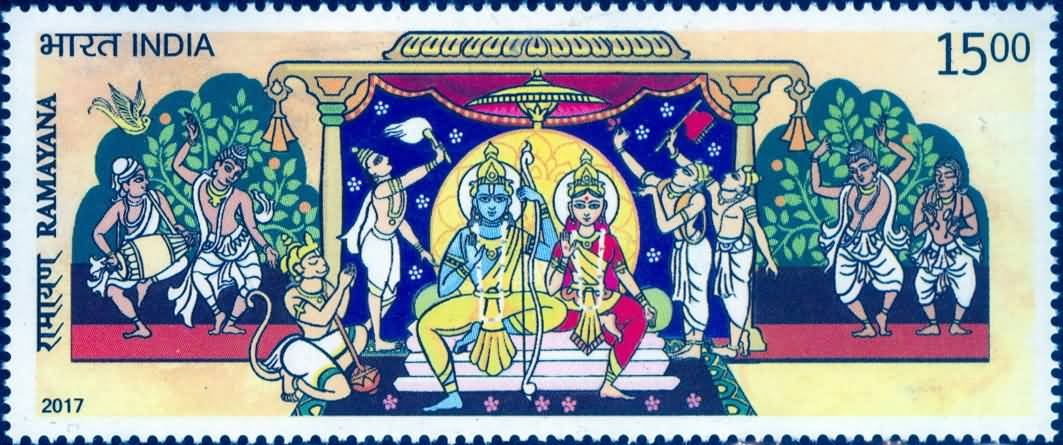
Technical Data
| Date of Issue | September 22, 2017 |
|---|---|
| Denomination | Rs. 15 |
| Perforation | 13 x 13¾ |
| Printer | Security Printing Press, Hyderabad |
| Printing Process | Wet Offset |
| Watermark | No Watermark |
| Colors | Multicolor |
| Credit (Designed By) | Sh. Sankha Samanta Smt. Alka Sharma |
| Catalog Codes |
Michel IN 3212A Yvert et Tellier IN 2903 |
| Themes | Literature |
The Ideal Kingdom of Ram Rajya
The Court of Ram represents the highest expression of righteous governance, justice, and moral authority. Rooted in the timeless epic Ramayana composed by Maharshi Valmiki, the image of Lord Ram seated in his royal court symbolizes Ram Rajya — an era of peace, prosperity, and ethical rule that continues to inspire generations.
Ram as Maryada Purushottam
Lord Ram, revered as Maryada Purushottam (the supreme upholder of moral values), embodied the ideal qualities of a ruler. His life was defined by duty (dharma), compassion, courage, and unwavering commitment to truth. Whether as a devoted son accepting exile, a loving husband searching for Sita, or a valiant warrior defeating Ravana, Ram always placed righteousness above personal comfort.
When he returned to Ayodhya after fourteen years of exile and victorious conquest of Lanka, he ascended the throne not merely as a king, but as a symbol of justice and equality.
The Vision of Ram Rajya
During Ram’s reign, Ayodhya flourished in every aspect. The kingdom witnessed harmony, prosperity, and social balance. It is said that:
- There was no sorrow or injustice.
- People were healthy and content.
- Governance was impartial and fair.
- Moral and social values were upheld.
Ram listened carefully to the concerns of his subjects and ensured that every decision reflected the principles of dharma. His court was a place where wisdom, compassion, and justice prevailed.
Members of the Royal Court
The Court of Ram traditionally depicts Lord Ram seated on the throne, often accompanied by:
- Sita, symbolizing purity, strength, and devotion
- Lakshman, representing loyalty and dedication
- Bharat and Shatrughna, exemplifying brotherhood and sacrifice
- Hanuman, the embodiment of devotion and service
Together, they reflect the unity of family, duty, and devotion that defined Ram’s rule.
Symbolism and Cultural Significance
The image of Ram’s court is not merely royal imagery; it represents an ideal society governed by righteousness. It conveys:
- The supremacy of ethical leadership
- The harmony between ruler and subjects
- The triumph of good over evil
- The importance of justice tempered with compassion
The concept of Ram Rajya has become synonymous with ideal governance in Indian thought and philosophy.
Commemorative Postage Stamp
The Department of Posts issued a Commemorative Postage Stamp as part of the Ramayana series depicting The Court of Ram.
The stamp artistically portrays Lord Ram seated majestically on the throne of Ayodhya, radiating serenity and authority. The royal assembly, adorned in traditional attire, reflects the grandeur and spiritual dignity of Ram Rajya. The design captures the essence of ideal kingship and the cultural richness of the epic tradition.
This commemorative postage stamp serves as a philatelic tribute to the timeless concept of just governance and moral leadership embodied by Lord Ram.
The Court of Ram continues to inspire generations as the embodiment of ethical rule and social harmony. Ram Rajya remains an enduring ideal in Indian thought — a vision of a society governed by righteousness, compassion, and justice.
First Day Cover

Leave a Comment
You must be logged in to post a comment.