
Kalamkari
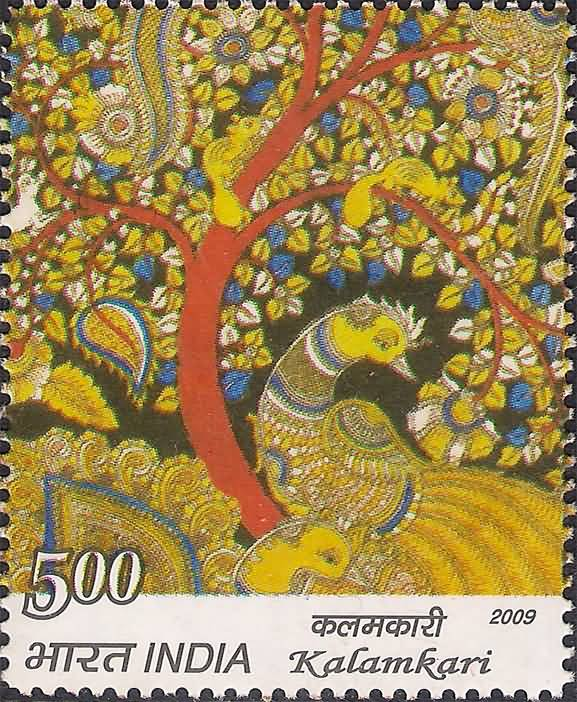
Technical Data
| Date of Issue | December 10, 2009 |
|---|---|
| Denomination | Rs. 5 |
| Quantity | 800,000 |
| Perforation | 13 |
| Printer | India Security Press, Nasik |
| Printing Process | Wet Offset |
| Watermark | No Watermark |
| Colors | Multicolor |
| Credit (Designed By) | Sh. Sankha Samanta |
| Catalog Codes |
Michel IN 2445 Stamp Number IN 2383 Stanley Gibbons IN 2671 WADP Numbering System - WNS IN098.2009 |
| Themes | Textile |
The Timeless Art of Hand-Painted Indian Textiles
Kalamkari is one of the most celebrated traditions of Indian handloom textiles, renowned for its intricate hand-painted and block-printed designs. The term Kalamkari literally means “pen work,” derived from kalam (pen) and kari (craftsmanship). This exquisite textile art flourishes in Andhra Pradesh and reflects centuries of cultural exchange, religious storytelling, and artistic mastery.
Recognized for its narrative richness and natural dye techniques, Kalamkari stands as a living symbol of India’s textile heritage.
Two Distinct Schools of Kalamkari
Kalamkari developed into two major stylistic traditions:
1. Masulipatnam Style
Patronized by Muslim rulers, the Masulipatnam school reflects strong Persian influences and Islamic aesthetic principles. Artisans often use carved wooden blocks for repetitive patterns, creating decorative textiles marked by floral motifs, arabesques, and intricate borders.
2. Sri Kalahasti Style
Associated with Hindu temples, the Sri Kalahasti tradition remains predominantly hand-drawn using the kalam. This style is known for depicting episodes from the Ramayana, Mahabharata, and other mythological narratives. The freehand drawing technique gives each piece a distinctive individuality and expressive depth.
Technique and Craftsmanship
Kalamkari textiles are traditionally created using natural dyes extracted from plants, roots, bark, and minerals. The process is labor-intensive and involves multiple stages:
- Preparing and treating the cotton fabric
- Sketching the design with a kalam
- Repeated dyeing and washing cycles
- Detailed hand painting or block printing
The skill required to balance colour, narrative detail, and design precision makes Kalamkari a highly respected craft within Indian textiles.
Cultural and Ritual Significance
Beyond its aesthetic appeal, Kalamkari plays an important role in rural religious life and ceremonial traditions in Andhra Pradesh. Temple hangings, narrative panels, and ritual textiles often depict mythological stories, serving both decorative and didactic purposes.
Over centuries, Kalamkari has demonstrated remarkable adaptability—responding to changing patronage, market demands, and global appreciation—while retaining its traditional essence.
Support for the Handloom Sector
The Government of India has introduced several initiatives to strengthen the handloom sector, including skill development, welfare coverage, marketing support, yarn supply schemes, and design innovation programs. These efforts help sustain traditional crafts like Kalamkari while enabling artisans to adapt to modern markets.
Commemorative Postage Stamp on Kalamkari
Celebrating India’s rich textile legacy, India Post has issued a commemorative postage stamp as part of the Indian Textiles series, featuring Kalamkari.
This philatelic tribute honours:
- The centuries-old pen-painted textile tradition of Andhra Pradesh
- The fusion of Persian and indigenous artistic influences
- The narrative richness of mythological storytelling
- India’s enduring commitment to preserving handloom heritage
Through this commemorative stamp issue, Kalamkari is recognized not merely as a decorative textile, but as a vibrant canvas of India’s artistic imagination and cultural continuity.
First Day Cover

Leave a Comment
You must be logged in to post a comment.