
Apa Tani Weaves
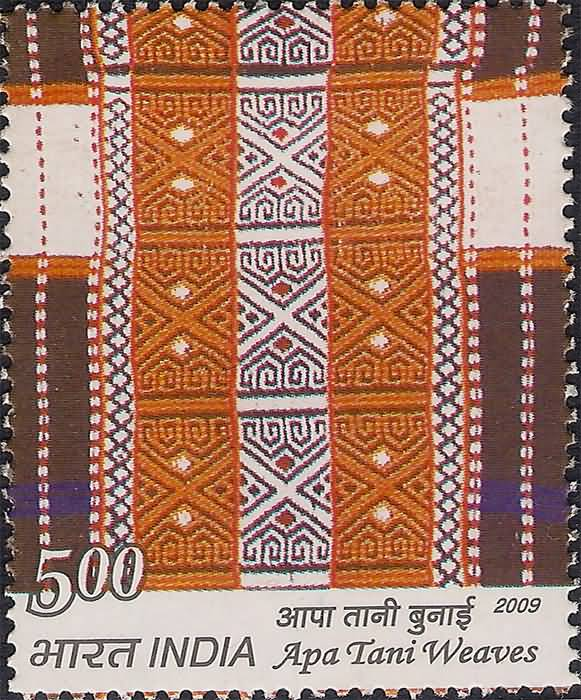
Technical Data
| Date of Issue | December 10, 2009 |
|---|---|
| Denomination | Rs. 5 |
| Quantity | 800,000 |
| Perforation | 13 |
| Printer | India Security Press, Nasik |
| Printing Process | Wet Offset |
| Watermark | No Watermark |
| Colors | Multicolor |
| Credit (Designed By) | Sh. Sankha Samanta |
| Catalog Codes |
Michel IN 2446 Stamp Number IN 2384 Stanley Gibbons IN 2672 WADP Numbering System - WNS IN099.2009 |
| Themes | Textile |
A Living Tradition of Tribal Handloom Art
Apa Tani Weaves represent one of the most distinctive traditions within Indian handloom textiles, reflecting the cultural identity and self-reliant lifestyle of the Apa Tani community of Arunachal Pradesh. The Apa Tani people inhabit the Lower Subansiri district in Northeast India, where weaving is not merely a craft but an integral part of domestic and social life.
Rooted in tradition and passed down through generations, Apa Tani weaving showcases simplicity, sustainability, and refined geometric aesthetics.
A Household Tradition Led by Women
In Apa Tani society, weaving is traditionally practiced by women and transmitted from mother to daughter. Almost every household possesses one or two looms, making textile production a deeply embedded family tradition.
The loom used is a simple, portable loin loom with a single heddle and no reed. Compact and easy to operate, it is considered a family heirloom inherited exclusively by women. This intimate and domestic setting ensures that weaving knowledge, skills, and motifs are preserved across generations.
Weaving Techniques and Design
Apa Tani textiles are primarily woven in plain weave (tabby), with decorative patterns created using the extra weft technique. This method allows artisans to introduce intricate geometric motifs into the fabric without disrupting its structural integrity.
Key features of Apa Tani Weaves include:
- Broad stripes alternating with narrow bands
- A rich variety of geometric patterns
- Balanced and symmetrical compositions
- Strong visual contrast
Traditionally, the dominant colours were red, green, and yellow, derived from natural dyes made from leaves, roots, creepers, and tree bark. While modern dyed yarns are now available in a wider palette, the characteristic striped patterns and geometric motifs continue to define the identity of Apa Tani textiles.
Cultural and Social Significance
Apa Tani textiles are woven primarily for household use rather than commercial production. Garments and fabrics play an important role in daily wear, ceremonies, and community gatherings, reinforcing social identity and continuity.
The weaving tradition embodies sustainable practices—local materials, natural dyes, and handmade techniques—demonstrating harmony with the region’s ecological environment. Through their textiles, the Apa Tani community expresses both aesthetic sensibility and cultural pride.
Support for the Handloom Sector
Recognizing the importance of traditional weaving communities like the Apa Tani, the Government of India has implemented various initiatives for the development and promotion of the handloom sector. These include schemes for skill upgradation, welfare coverage, marketing support, yarn supply at fair prices, and design development. Such measures aim to strengthen rural livelihoods while preserving India’s diverse textile heritage.
Commemorative Postage Stamp on Apa Tani Weaves
To celebrate the richness of India’s textile traditions, India Post has issued a commemorative postage stamp as part of the Indian Textiles series, featuring Apa Tani Weaves.
This philatelic tribute honours:
- The indigenous weaving tradition of Arunachal Pradesh
- The skill and artistry of Apa Tani women
- The preservation of tribal textile heritage
- India’s commitment to sustaining its handloom legacy
Through this commemorative stamp issue, Apa Tani Weaves are recognized as a vibrant expression of cultural continuity—where every thread reflects tradition, identity, and craftsmanship passed down through generations.
First Day Cover

Leave a Comment
You must be logged in to post a comment.