
UNESCO World Heritage Sites in India-III

Technical Data
| Date of Issue | August 15, 2020 |
|---|---|
| Denomination | Rs. 25 |
| Quantity | 110,000 |
| Printer | Security Printing Press, Hyderabad |
| Printing Process | Wet Offset |
| Watermark | No Watermark |
| Colors | Multicolor |
| Credit (Designed By) | Ms. Nenu Gupta Sh. Pallab Bose |
| Catalog Codes |
Michel IN BL231 Stamp Number IN 3235a Yvert et Tellier IN BF215 Stanley Gibbons IN MS3763 Michel IN Phila-India IN 3730 |
| Themes | Architecture | Churches-Cathedrals-Basilicas-Chapels | Mosques | Sculptures | Temples | Towers | UNESCO World Heritage Sites |
Stamps in this Miniature Sheet


Stamp Design Competition by Department of Posts
National-Level Stamp Design Initiative
The Department of Posts has been conducting Stamp Design Competitions at the national level since 2015 to commemorate important national occasions such as Independence Day, Republic Day, and Children’s Day. Based on the prize-winning entries, commemorative postage stamps are designed and released to mark these occasions.
Continuing this initiative, the Department of Posts conducted a nationwide Photography Contest for Stamp Design this year on the theme “UNESCO World Heritage Sites in India (Cultural)”.
Winners of the Photography Contest
The first three prize winners of the competition are:
- Ms Sanya Khandale
- Ms Madhu Tripathi
- Ms Poonam Amol Bhosale
The five consolation prize winners are:
- Sr Jousse
- Mr Saksham Saxena
- Mr Hardik Kansara
- Ms Arishna Kamran
- Mr Atul Padia
India is home to 38 UNESCO World Heritage Sites, comprising 30 Cultural Sites, 7 Natural Sites, and 1 Mixed Site.
Featured UNESCO World Heritage Sites
Sarkhej Roza, Ahmedabad
One of the prominent landmarks of the Historic City of Ahmedabad, a UNESCO World Heritage Site, Sarkhej Roza is renowned for its rich history and architectural significance. The complex was designed by Azam and Muazzam Khan, two Persian brothers buried in a tomb near Vasna, Ahmedabad.
Sarkhej Roza represents an early example of Indo-Saracenic architecture, blending Islamic architectural influences from Persia with Indian Hindu and Jain elements, creating a unique composite architectural style.
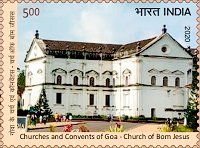
Church of Bom Jesus, Goa
The Church of Bom Jesus is a Roman Catholic Basilica located in Goa and forms part of the Churches and Convents of Goa, a UNESCO World Heritage Site. The church houses the mortal remains of St. Francis Xavier.
Construction began in 1594, and the church was consecrated in May 1605 by Archbishop Dom Fr. Aleixo de Menezes. One of the oldest churches in India, the basilica features marble flooring inlaid with precious stones. While its gilded altars are elaborate, the overall interior remains simple and austere.
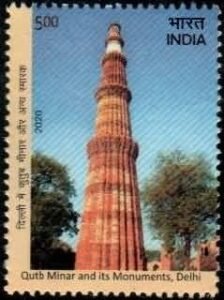
Qutb Minar, Delhi
The Qutb Minar, part of the Qutb Minar and its Monuments in Delhi, is a UNESCO World Heritage Site and one of India’s most iconic architectural landmarks. Construction of its first storey began in 1199 under Qutbuddin Aibak, founder of the Delhi Sultanate.
Standing at a height of 72.5 metres, it is the tallest brick minaret in the world. The tower consists of five superposed storeys, adorned with intricate inscriptions and geometric patterns. A spiral staircase of 379 steps runs through the structure.
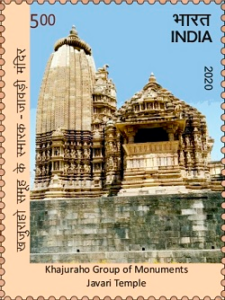
Javari Temple, Khajuraho
Located in Madhya Pradesh, the Khajuraho Group of Monuments is celebrated for its Hindu and Jain temples built in the Nagara style. Among them, the Javari Temple, constructed between 975 and 1100 AD, is one of the most prominent.
Dedicated to Lord Vishnu, the temple features a sanctum, vestibule, mandapa, and portico. Architectural highlights include a Makara Torana (Capricorn Arch), a well-defined shikhara, and three bands of carved sculptures on the outer walls. Sculptures of the nava-graha, along with deities Brahma, Vishnu, and Shiva, adorn the entrance.
Group of Monuments at Pattadakal
The Group of Monuments at Pattadakal is a UNESCO World Heritage Site located on the banks of the Malaprabha River in Bagalakote district, Karnataka. Dating from the 7th and 8th centuries AD, the site comprises Hindu and Jain temples associated with the Chalukya dynasty.
The temples are primarily dedicated to Shiva, with influences of Vaishnavism and Shaktism. Temple friezes depict episodes from the Ramayana, Mahabharata, and Bhagavata Purana, as well as motifs from texts like the Panchatantra and Kirātārjunīya. The lone Jain temple is dedicated to a single Jina, and several inscriptions in old Kannada have been discovered at the site.
Philatelic Issue
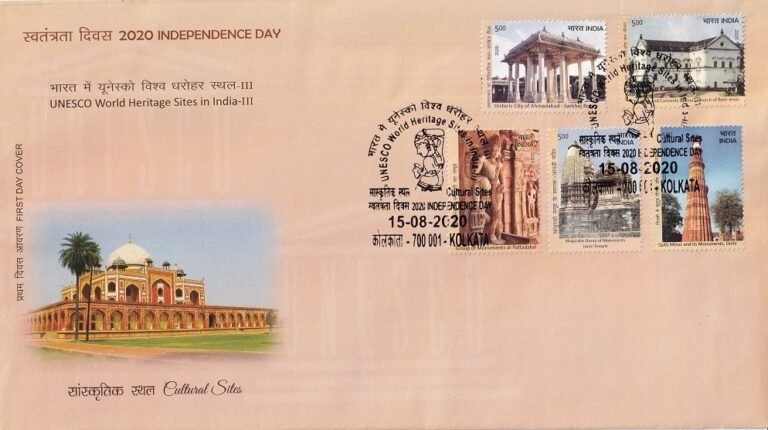
The Department of Posts is pleased to issue a set of five Commemorative Postage Stamps and a Miniature Sheet on UNESCO World Heritage Sites in India – III. The stamps have been designed using photographs from the prize-winning entries, celebrating India’s rich cultural heritage through philately.
First Day Cover
Leave a Comment
You must be logged in to post a comment.