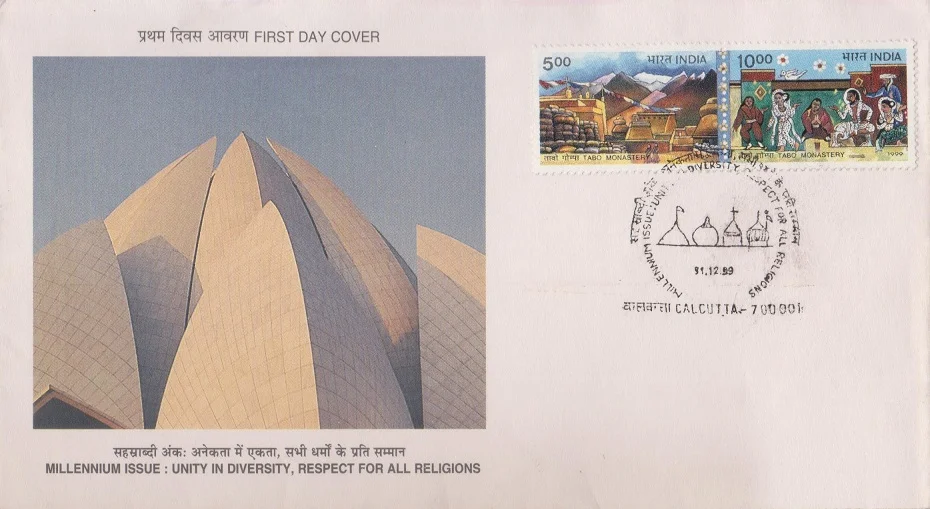
Traditional Scene -Unity in Diversity
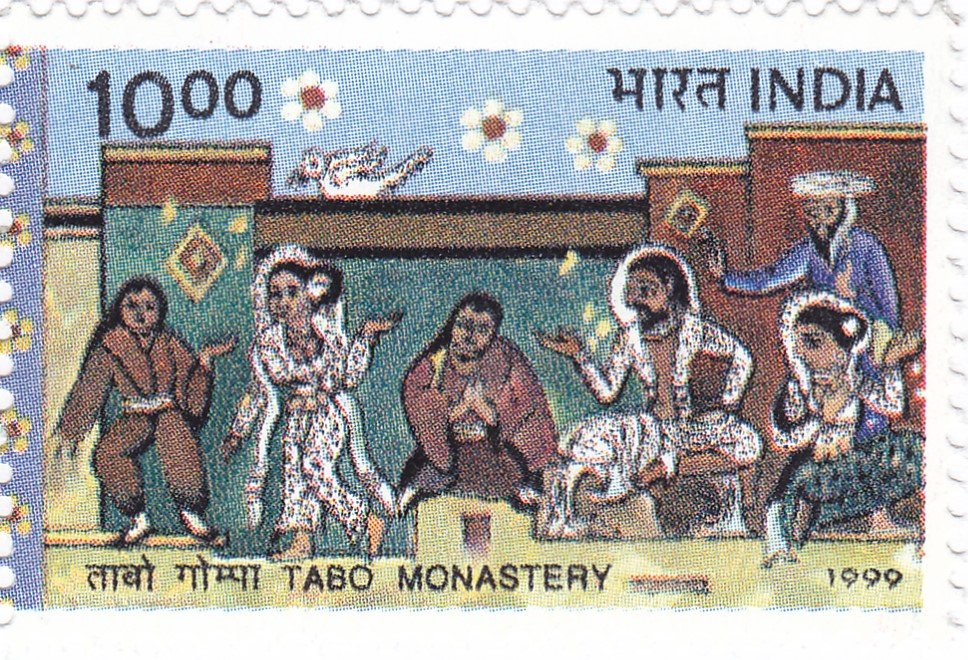
Technical Data
| Date of Issue | December 31, 1999 |
|---|---|
| Denomination | Rs. 10 |
| Quantity | 700,000 |
| Perforation | comb 13 x 13¼ |
| Printer | Security Printing Press, Nashik |
| Printing Process | Photogravure |
| Watermark | No Watermark |
| Colors | Multicolor |
| Credit (Designed By) | R. N. Pasricha |
| Catalog Codes |
Michel IN 1732 Stamp Number IN 1793 Yvert et Tellier IN 1498 Stanley Gibbons IN 1895 |
| Themes | Millennium |
Introduction
The second stamp of the Millennium Issue titled “Unity in Diversity, Respect for All Religions” depicts an ancient Buddhist wall painting from Tabo Monastery. This painting forms part of the rich artistic heritage of the monastery and reflects the spiritual traditions of Buddhism in India.
Source of the Painting
The stamp reproduces a section of the painted frieze found on the southern wall of the main hall of Tabo Monastery. The monastery, more than one thousand years old, is famous for its magnificent wall paintings, which narrate stories from Buddhist literature and philosophy.
The Story of Sudhana
The painting shown on the stamp belongs to a continuous narrative based on the spiritual journey of Sudhana.
In the scene, Sudhana stands before a lady dressed in white. She directs him to the Brahmin Sivaragra, who is seated on an elaborate seat in the centre of the composition.
Sudhana is then shown kneeling before Sivaragra, seeking his guidance and wisdom as part of his quest for ultimate realization.
Artistic Features
The painting is notable for its complex narrative style. To show the movement of the story, the artist repeats the figure of Sudhana in different parts of the composition. This technique allows several stages of the story to be shown within a single painting.
The artwork also employs symbolic hand gestures, known as mudras, to convey spiritual ideas and emotions. The use of these gestures adds deeper meaning to the narrative.
Religious and Cultural Significance
The wall painting illustrates the Buddhist belief that enlightenment is achieved through learning from many spiritual teachers and through inner understanding.
By depicting Sudhana’s search for wisdom, the stamp highlights values such as humility, devotion, and the pursuit of truth.
Importance of the Stamp
The Ancient Buddhist Wall Painting stamp was issued to celebrate the artistic and spiritual heritage of Tabo Monastery. It also reflects India’s tradition of respecting all religions and preserving the cultural expressions of different faiths.
Conclusion
The stamp depicting the ancient Buddhist wall painting is a tribute to the beauty and depth of India’s Buddhist art. Through the story of Sudhana and Sivaragra, it conveys the timeless message of the search for wisdom and enlightenment.
First Day Cover