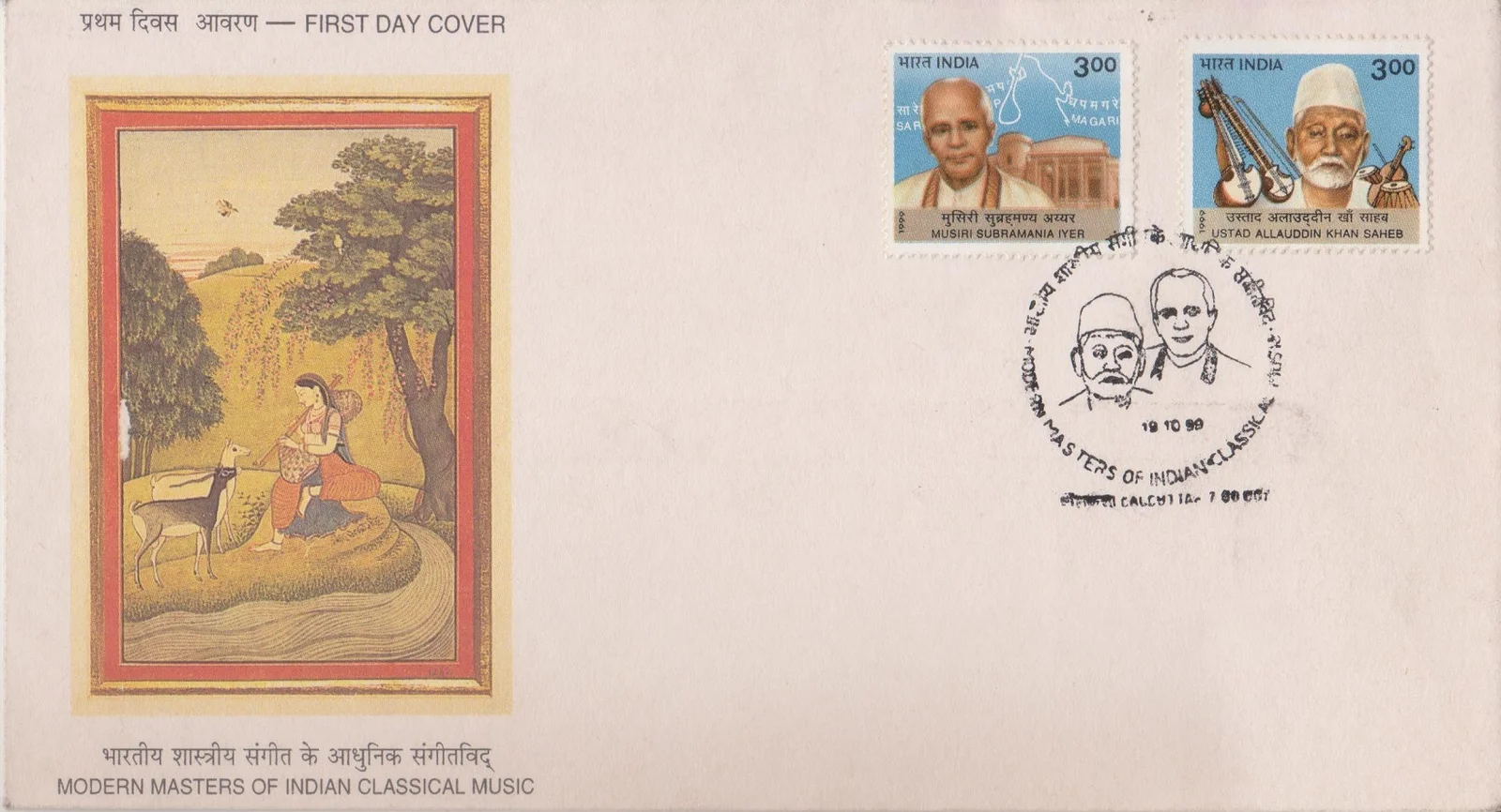
Ustad Allauddin Khan Saheb
Technical Data
| Stamp Set | Modern Masters of Indian Classical Music |
|---|---|
| Date of Issue | October 19, 1999 |
| Denomination | Rs. 3 |
| Quantity | 400,000 |
| Perforation | comb 13½ x 14 |
| Printer | Security Printing Press, Nashik |
| Printing Process | Photogravure |
| Watermark | No Watermark |
| Colors | Multicolor |
| Credit (Designed By) | |
| Catalog Codes |
Michel IN 1717 Stamp Number IN 1778 Yvert et Tellier IN 1484 Stanley Gibbons IN 1880 |
| Themes | Famous people | Men | Music | Singers |
Legendary Sarod Maestro and Pioneer of Indian Classical Music
Ustad Allauddin Khan (1870–1972), also known as Baba Allauddin Khan, was one of the greatest sarod players in the history of Indian classical music. His immense contribution to the Hindustani music tradition earned him global recognition as a master musician, teacher, and innovator.
Mastery in Music and Instruments
Although the sarod was his primary instrument, Ustad Allauddin Khan was a versatile genius who could proficiently play over 18 musical instruments. He was also an accomplished vocalist, specializing in classical forms such as Dhrupad and Hori.
He belonged to the renowned Senia Gharana, associated with the legendary Tansen. His deep understanding of melody and rhythm allowed him to create mesmerizing performances that often captivated audiences for hours.
Contribution to Indian Classical Music
Ustad Allauddin Khan was a staunch traditionalist who upheld the purity of classical music while also contributing to its evolution. Some of his key contributions include:
- Introducing a notation system in Hindustani classical music
- Promoting rigorous training methods for students
- Expanding the reach of Indian classical music globally
He was among the first Indian musicians to gain international recognition when he accompanied Uday Shankar on a cultural tour of Europe in 1935, bringing Indian music to Western audiences.
Teacher and Mentor
Ustad Allauddin Khan was not only a performer but also a legendary teacher. He mentored several distinguished musicians who later became icons in Indian classical music, contributing to the continuation of his musical legacy.
Awards and Recognition
In recognition of his immense contribution to music, Ustad Allauddin Khan received several prestigious awards, including:
- Padma Vibhushan (1958)
- Sangeet Natak Akademi Award (1952)
He was among the first musicians in India to be honored with the Padma Vibhushan.
Indian Classical Music: Unity in Diversity
Indian music has a rich and continuous tradition dating back to the Vedic period. Over time, it evolved from folk traditions into classical forms. Despite regional diversity, there is a deep unity in Indian music.
The two main systems are:
- Hindustani classical music (North India)
- Carnatic classical music (South India)
These are complemented by folk music, bhajans, and kirtans, reflecting India’s cultural diversity.
Commemoration and Legacy
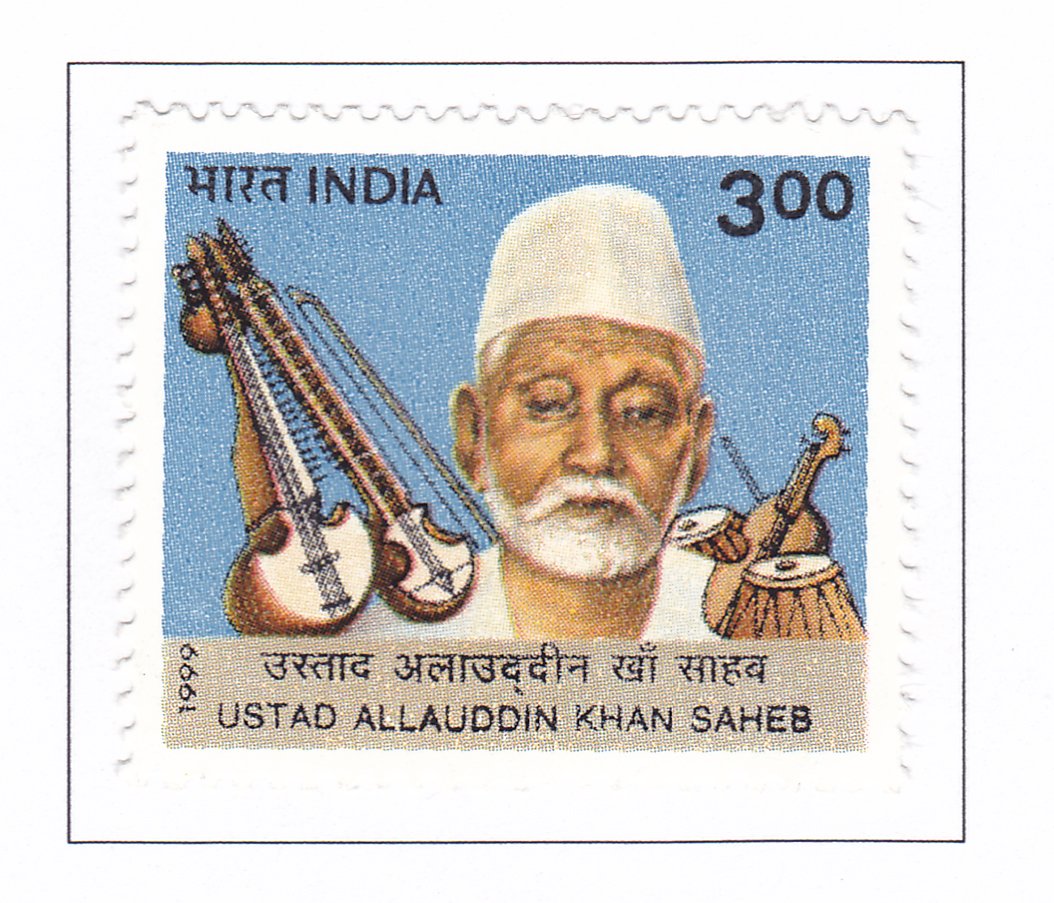
To honor his legacy, India Post issued a commemorative postage stamp featuring Ustad Allauddin Khan as part of the series “Modern Masters of Indian Classical Music.”
This series celebrates the unity and richness of Indian music by recognizing great masters from both Hindustani and Carnatic traditions.
Conclusion
Ustad Allauddin Khan remains a towering figure in Indian classical music. His unmatched mastery, dedication to tradition, and contributions as a teacher have left an enduring legacy. His life and work continue to inspire musicians and music lovers across the world.
First Day Cover