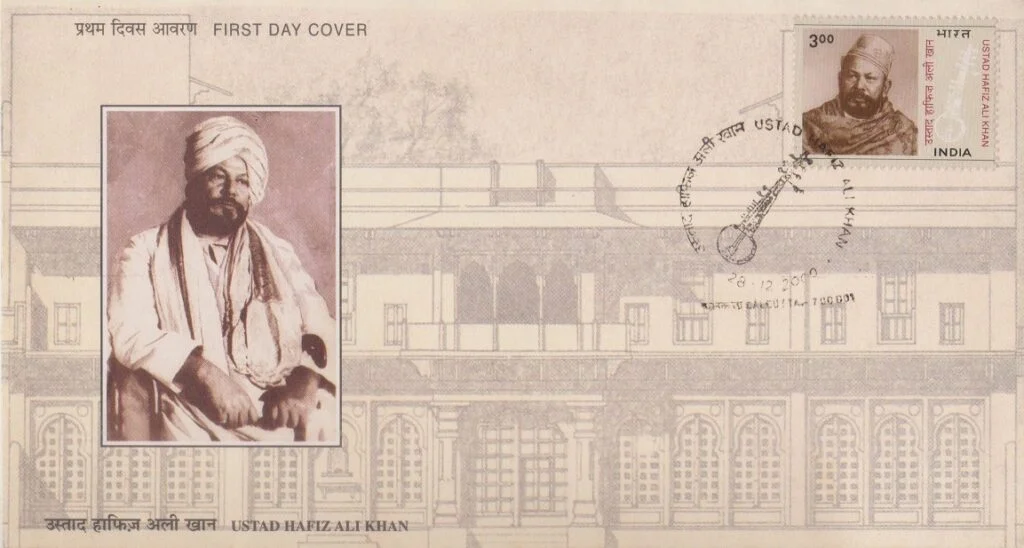
Ustad Hafiz Ali Khan (1918-1995)
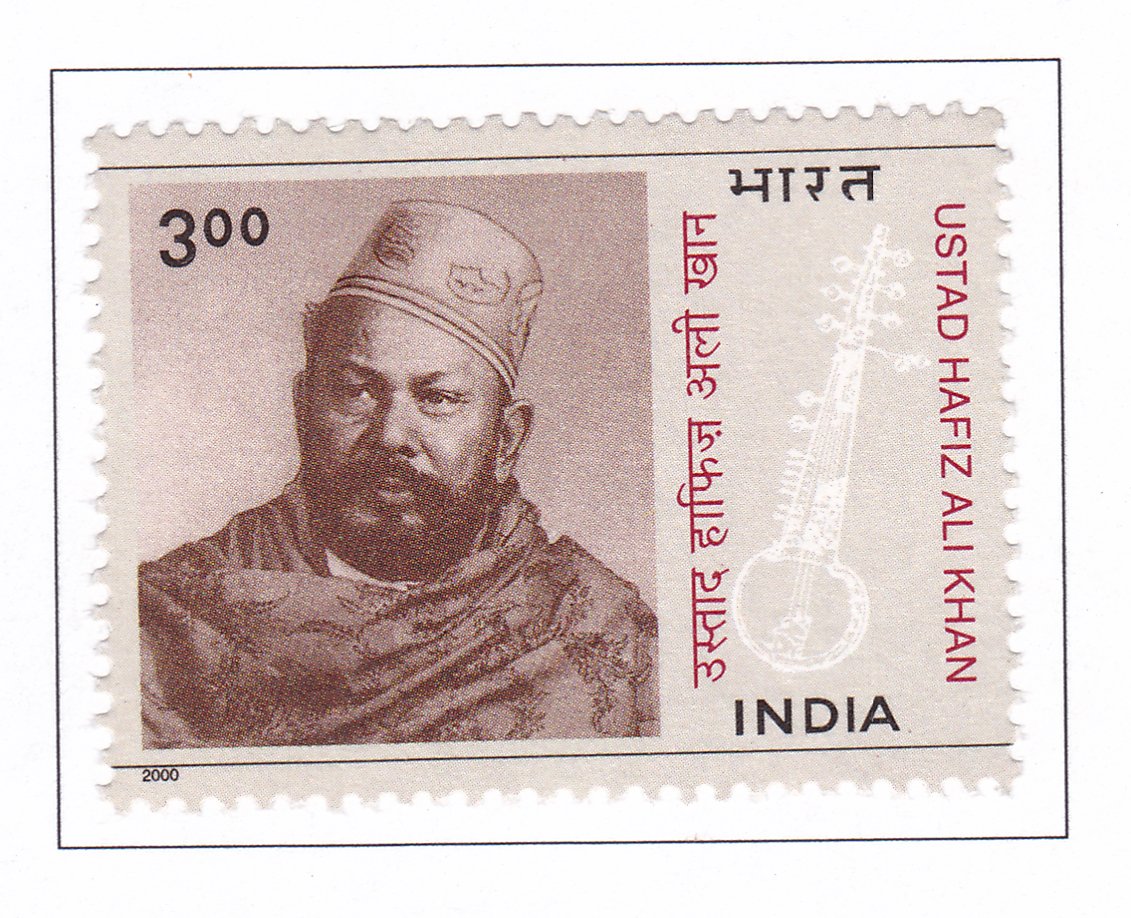
Technical Data
| Date of Issue | December 28, 2000 |
|---|---|
| Denomination | Rs. 3 |
| Quantity | 400,000 |
| Perforation | comb 13 |
| Printer | Calcutta Security Printers Ltd |
| Printing Process | Offset Lithography |
| Watermark | No Watermark |
| Colors | Multicolor |
| Credit (Designed By) | Smt. Alka Sharma |
| Catalog Codes |
Michel IN 1806 Stamp Number IN 1865 Yvert et Tellier IN 1572 Stanley Gibbons IN 1974 |
| Themes | Famous people | Headgear | Men | Musical Instruments | Musicians |
Master of the Sarod and Torchbearer of Gwalior’s Musical Legacy
Ustad Hafiz Ali Khan (1888–1972) was one of the greatest exponents of the sarod and a key figure in preserving India’s rich classical music tradition. He carried forward the glorious musical heritage of Gwalior, the land of legendary musicians like Tansen.
Evolution of the Sarod
The sarod, one of the most popular string instruments in Indian classical music today, evolved from the ancient rabab. It was introduced to India by Afghan musicians who migrated from Kabul and settled in northern regions.
Through refinement and innovation, the sarod became a central instrument in Hindustani classical music, with maestros like Hafiz Ali Khan playing a crucial role in its development and popularity.
Early Life and Musical Training
Born into a distinguished family of musicians, Ustad Hafiz Ali Khan inherited a rich legacy of sarod playing. He began his musical training at the age of six under the guidance of his father, Ustad Nanhe Khan, and continued rigorous practice for over a decade.
After his father’s demise, he dedicated himself to intense practice and soon earned the title “Aftab-e-Sarod” for his exceptional mastery.
Learning from Great Masters
A lifelong learner, Hafiz Ali Khan expanded his musical knowledge by training under renowned maestros:
- Chukkalal and Ganeshilal of Brindavan (Dhrupad and Dhamar styles)
- Ganpatrao Bhaiya Saheb of Gwalior (Thumri style)
- Ustad Wazir Khan (Been and Sarod)
This diverse training enriched his performances with depth and versatility.
Musical Career and Achievements
After completing his training, Hafiz Ali Khan returned to Gwalior and became the court musician of Maharaja Madhav Rao Scindia. He performed at numerous music conferences and gained widespread acclaim.
He also spent nearly a decade in Kolkata, where he continued to perform and further establish his reputation as a leading sarod player.
Style and Contribution to Indian Classical Music
Ustad Hafiz Ali Khan was known for his deep respect for tradition. His music reflected:
- Strong grounding in Dhrupad and Dhamar styles
- Melodious and expressive renditions
- Preference for pakhawaj accompaniment over tabla
- Commitment to preserving the purity of classical ragas
Although he himself avoided experimental trends, he encouraged his disciples, including his son Amjad Ali Khan, to explore new musical ideas.
Legacy and Recognition
Hafiz Ali Khan played a vital role in popularizing the traditional sarod style and trained several disciples who carried forward his legacy.
He was honored with the prestigious Padma Bhushan in 1960 for his immense contribution to Indian classical music.
Sarod Ghar: A Living Tribute
His residence in Gwalior has been transformed into Sarod Ghar, a museum dedicated to preserving musical heritage.
Managed by the Ustad Hafiz Ali Khan Trust, it promotes music education, nurtures young talent, and strengthens the traditional Guru-Shishya (teacher-disciple) system.
Commemoration
Ustad Hafiz Ali Khan is remembered as a legend who enriched Indian classical music with his mastery and dedication. In recognition of his contributions, the Department of Posts issued a commemorative postage stamp in his honor.
First Day Cover