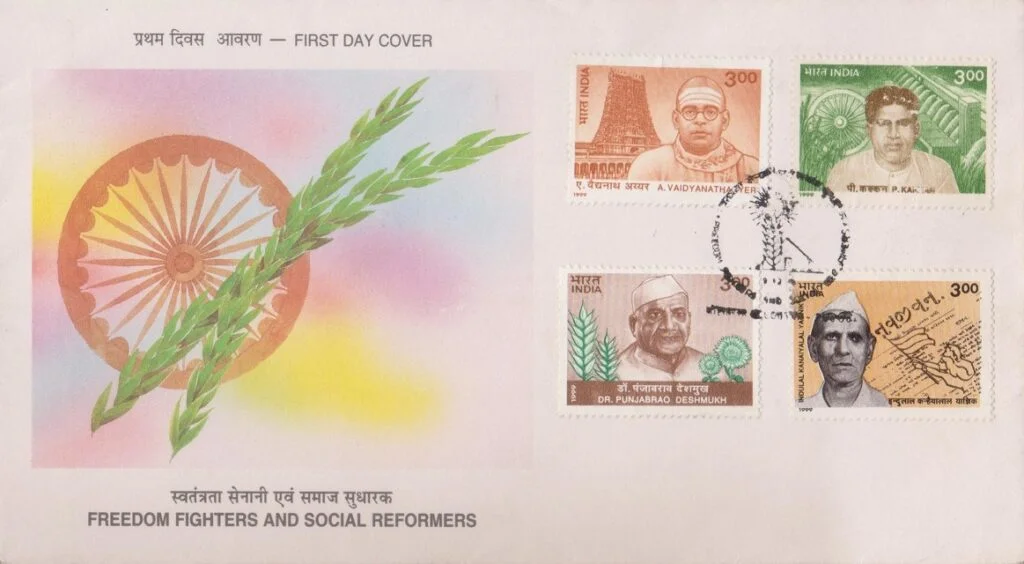
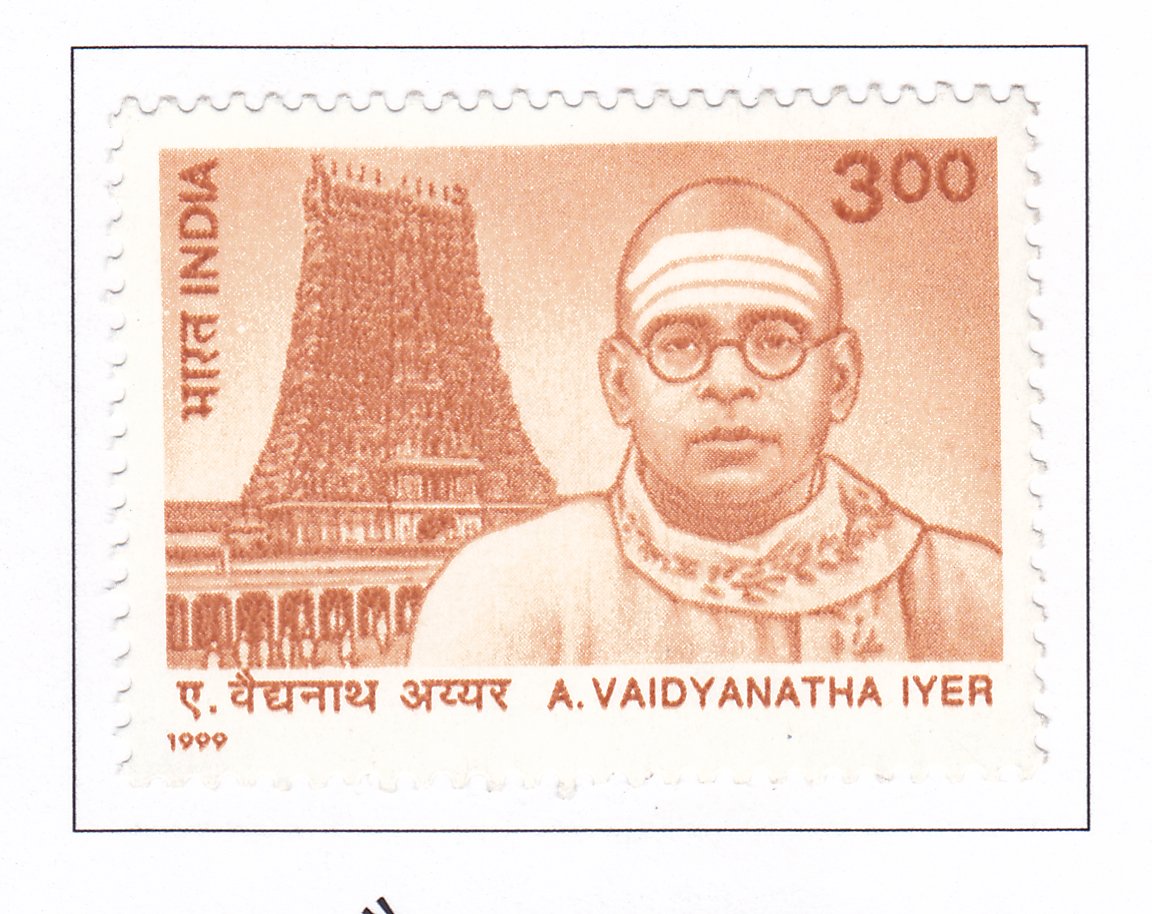
A. Vaidyanatha Iyer
Technical Data
| Stamp Set | India's Struggle for Freedom |
|---|---|
| Date of Issue | December 9, 1999 |
| Denomination | Rs. 3 |
| Quantity | 700,000 |
| Perforation | comb 13½ x 13¼ |
| Printer | Security Printing Press, Nashik |
| Printing Process | Photogravure |
| Watermark | No Watermark |
| Colors | Blackish red orange |
| Credit (Designed By) | |
| Catalog Codes |
Michel IN 1723 Stamp Number IN 1785 Yvert et Tellier IN 1490 Stanley Gibbons IN 1886 |
| Themes | Famous people | Freedom Fighters | Men | Optical Instruments | Politicians | Temples |
A. Vaidyanatha Iyer (1890–1955) was a noted freedom fighter, social reformer, and Gandhian leader who dedicated his life to the upliftment of society. He is best remembered for leading the historic temple entry movement in Madurai, which helped end untouchability and opened temple doors to oppressed communities.
To honor his remarkable contribution, the Department of Posts issued a commemorative postage stamp on A. Vaidyanatha Iyer as part of the “Freedom Fighters and Social Reformers” series.
Early Life and Inspiration from Mahatma Gandhi
A. Vaidyanatha Iyer was born in 1890 in Tamil Nadu. Deeply influenced by Mahatma Gandhi, he joined the Indian freedom struggle in 1922. Inspired by Gandhian ideals of truth, equality, and non-violence, he devoted himself to the service of the nation.
He believed that political freedom was incomplete without social equality. Therefore, alongside the struggle against British rule, he worked continuously to remove social discrimination and injustice.
A. Vaidyanatha Iyer in the Freedom Struggle
A. Vaidyanatha Iyer actively participated in several important movements during India’s struggle for independence.
He played a major role in the Vedaranyam Salt Satyagraha of 1930, which was organized in Tamil Nadu as part of Mahatma Gandhi’s Salt Movement. He also took part in the Quit India Movement of 1942 and many other campaigns against British rule.
Because of his active involvement in the national movement, A. Vaidyanatha Iyer spent several years in prison. Despite repeated arrests and hardships, he remained committed to the cause of Indian independence.
Contribution to Khadi and Village Industries
Apart from participating in the freedom movement, A. Vaidyanatha Iyer worked tirelessly for the development of Khadi and village industries.
He encouraged people to use hand-spun and hand-woven cloth as a symbol of self-reliance and national pride. He also supported the growth of rural industries to improve the lives of people living in villages.
His efforts reflected Gandhian principles of economic independence and rural development.
Social Reforms and Campaign Against Untouchability
A. Vaidyanatha Iyer was a passionate social reformer. He campaigned for:
- Removal of untouchability
- Women’s welfare
- Prohibition
- Equal rights for all sections of society
He believed that every individual deserved dignity and equal treatment, regardless of caste.
The greatest achievement of A. Vaidyanatha Iyer was his campaign against untouchability and discrimination in temples.
The Historic Madurai Temple Entry Movement
In 1939, A. Vaidyanatha Iyer led a group of people from the depressed classes into the famous Meenakshi Temple in Madurai.
For centuries, these communities had been denied entry into Hindu temples. By leading them into the Meenakshi Temple to offer prayers, A. Vaidyanatha Iyer challenged an unjust social practice.
This historic event became one of the most important milestones in the temple entry movement in India.
The temple entry at Madurai immediately influenced the government to pass legislation allowing Harijans and other oppressed communities to enter temples.
The event marked a turning point in the fight against untouchability and caste discrimination.
Mahatma Gandhi’s Praise for A. Vaidyanatha Iyer
Mahatma Gandhi appreciated the work of A. Vaidyanatha Iyer and his fellow reformers.
Writing in the journal Harijan in July 1939, Gandhi described the Madurai temple entry as:
“A great event in the campaign against untouchability.”
He also praised A. Vaidyanatha Iyer and his co-workers for their continuous efforts in educating the public and promoting social reform.
Gandhi’s words reflected the national importance of A. Vaidyanatha Iyer’s work.
Simple Life and Public Service
A. Vaidyanatha Iyer led a simple and austere life. Although he earned the respect of the people, he never sought power, position, or political office.
His life was dedicated entirely to the service of the nation and the welfare of the oppressed.
Even after independence, he continued to work for social equality and reform.
A. Vaidyanatha Iyer Commemorative Stamp
The commemorative postage stamp on A. Vaidyanatha Iyer was issued by the Department of Posts as part of a special set of four stamps dedicated to freedom fighters and social reformers.
The series also honored:
- Indulal Kanaiyalal Yagnik
- Dr. Punjabrao Deshmukh
- P. Kakkan
The First Day Cover design symbolizes both India’s freedom movement and the larger struggle for social reform.
The stamp recognizes A. Vaidyanatha Iyer’s historic contribution to the temple entry movement, social equality, and India’s independence.
Legacy of A. Vaidyanatha Iyer
A. Vaidyanatha Iyer remains one of the most respected figures in the history of social reform in India. His courage in fighting untouchability and opening temple doors to marginalized communities changed the course of history.
Today, he is remembered as a freedom fighter, a Gandhian leader, and a pioneer of the temple entry movement in Tamil Nadu. His life continues to inspire those who work for equality, justice, and social change.
First Day Cover