
Vaikom Muhammad Basheer
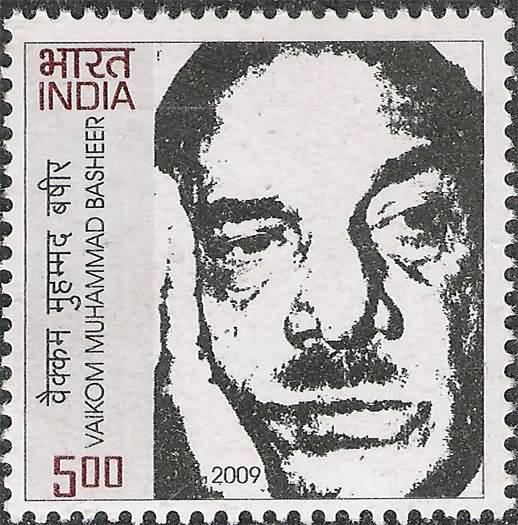
Technical Data
| Date of Issue | January 21, 2009 |
|---|---|
| Denomination | Rs. 5 |
| Quantity | 400,000 |
| Perforation | 13 |
| Printer | Security Printing Press, Hyderabad |
| Printing Process | Wet Offset |
| Watermark | No Watermark |
| Colors | Multicolor |
| Credit (Designed By) | Smt. Alka Sharma |
| Catalog Codes |
Michel IN 2340 Stamp Number IN 2306 Stanley Gibbons IN 2564 WADP Numbering System - WNS IN002.2009 |
| Themes | Anniversaries and Jubilees | Authors | Famous people | Freedom Fighters | Humanists | Literary People (Poets and Writers) | Literature | Men |
The Beypore Sultan of Malayalam Literature
Vaikom Muhammad Basheer (21 January 1908 – 5 July 1994) was one of the most celebrated writers in Malayalam literature. Fondly known as the Beypore Sultan, Basheer’s life was as extraordinary as his writings. His works reflected deep human emotions, humor, suffering, and social realities—often written in the language of common people rather than formal literary Malayalam.
India Post honored his literary legacy by issuing a commemorative postage stamp in his memory.
Early Life and Education
Vaikom Muhammad Basheer was born on 21 January 1908 in Thalayolapparampu, near Vaikom in northern Travancore (present-day Kerala). He was the eldest child in a large family. His father, a timber contractor, struggled financially, and the family did not enjoy material comforts.
Basheer began his education in a Malayalam-medium school before moving to an English-medium school in Vaikom, located five miles away. During his school years, he was deeply influenced by Mahatma Gandhi and adopted the Swadeshi ideals, wearing khadi as a symbol of nationalism.
Role in the Indian Freedom Movement
Determined to fight for India’s independence, Basheer left school while in the fifth form. Since there was no active independence movement in the princely states of Travancore and Kochi, he traveled to Kozhikode to participate in the Salt Satyagraha of 1930.
He was arrested and imprisoned in Kanpur, where he drew inspiration from the revolutionary stories of Bhagat Singh, Sukhdev Thapar, and Shivaram Rajguru. Following the Gandhi–Irwin Pact of March 1931, he was released along with hundreds of political prisoners.
After his release, Basheer edited the revolutionary journal Ujjivanam (“Uprising”) and organized anti-British activities. A warrant was issued for his arrest, forcing him to leave Kerala.
Seven Years of Wanderings Across India
Basheer then embarked on a remarkable seven-year journey across India and parts of Asia and Africa. During this period, he took on numerous jobs to survive—working as a loom fitter, cook, fortune teller, newspaper vendor, fruit seller, sports goods agent, accountant, watchman, shepherd, and hotel manager.
For over five years, he lived as an ascetic among Hindu saints and Sufi mystics in the Himalayas and along the Ganga basin, adopting their customs and practices. He endured extreme hardship, sometimes facing starvation and dehydration.
These rich life experiences later became the foundation of his deeply human and realistic storytelling.
Return to Kerala and Beginning of Literary Career
Basheer returned to Kerala around 1936–37, only to find his family bankrupt. After struggling in various jobs, he eventually wrote his first short story, “Ente Thankam”, for the newspaper Jayakesari. The story, later included in Vishappu, was inspired by a woman he used to see daily at a public water pipe.
This marked the beginning of his journey as a full-time writer.
Despite poverty and near-starvation, Basheer continued writing prolifically—short stories, poems, and political essays—often without receiving payment. Some of his works, including Hathabhaagyayaaya ente naadu and the one-act play Pattahinte Pekkinaavu, were banned in Travancore.
During this time, he associated with literary figures such as M.P. Paul and participated in writers’ gatherings, where he read the draft of his famous novel Baalyakaalasakhi.
Imprisonment and Major Works
Between 1941 and 1942, Basheer was arrested and imprisoned in Thiruvananthapuram Central Jail. His prison experiences inspired many of his later works.
While in prison, he wrote Premalekhanam (1943). After his release, Baalyakaalasakhi was published in 1944 with an introduction by M.P. Paul. The novel went on to become a classic of Malayalam literature.
He later self-published and personally sold his books, running bookstalls in Ernakulam—Circle Book House and Basheer’s Bookstall.
Personal Struggles and Pathumma’s Goat
After India’s independence, Basheer withdrew from active politics and focused entirely on writing.
He faced periods of mental illness and was admitted twice to sanatoriums. During treatment in a hospital in Thrissur, he wrote one of his most beloved works, Pathummayude Aadu (Pathumma’s Goat). Despite personal struggles, he recovered and continued writing with renewed vigor.
Literary Style and Contribution
Vaikom Muhammad Basheer revolutionized Malayalam literature with his unconventional writing style. He rejected rigid grammatical rules and embraced the spoken language of ordinary people. His publishers initially attempted to “standardize” his language, but Basheer insisted on preserving the originality and freshness of his prose.
His works span:
- Short stories
- Novels
- One-act plays
- Essays and reminiscences
Basheer’s fiction blends humor and pathos, realism and the supernatural, simplicity and profound emotional depth. Beneath his seemingly simple language lies remarkable subtlety and philosophical insight.
Though his works have been translated into English and 18 Indian languages, much of the original charm lies in his unique Malayalam expression.
Awards and Recognition
In recognition of his immense contribution to Indian literature, the Government of India honored him with the Padma Shri in 1982.
Affectionately called the Beypore Sultan, Basheer spent his later years in Beypore, Kerala.
Death and Legacy
Vaikom Muhammad Basheer passed away on 5 July 1994 in Beypore. His legacy continues to inspire generations of readers and writers.
His life—marked by struggle, adventure, imprisonment, love, and resilience—remains a testament to the transformative power of literature.
Commemorative Postage Stamp on Vaikom Muhammad Basheer
To honor his literary legacy, India Post issued a Commemorative Postage Stamp on Vaikom Muhammad Basheer.
The stamp celebrates Basheer’s invaluable contribution to Malayalam literature and Indian cultural heritage. By issuing this commemorative stamp, India Post paid tribute to a writer whose works continue to inspire readers across generations.
Such commemorative stamps not only recognize national icons but also preserve their memory in philatelic history, allowing collectors and admirers to remember Basheer’s enduring literary impact.
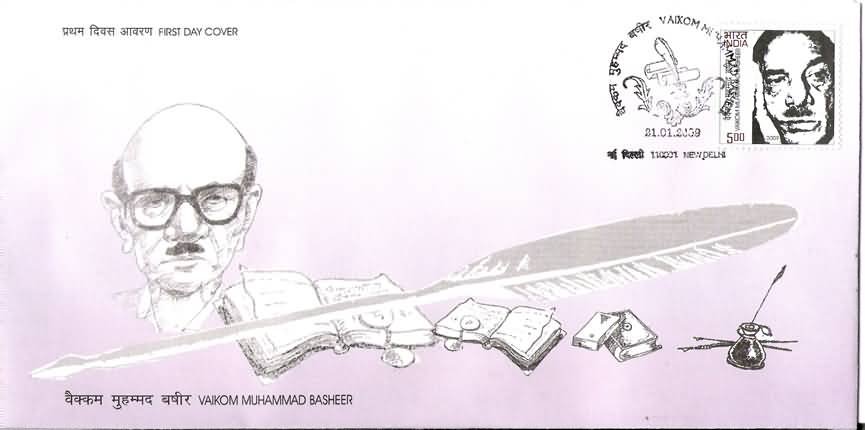
First Day Cover
Leave a Comment
You must be logged in to post a comment.