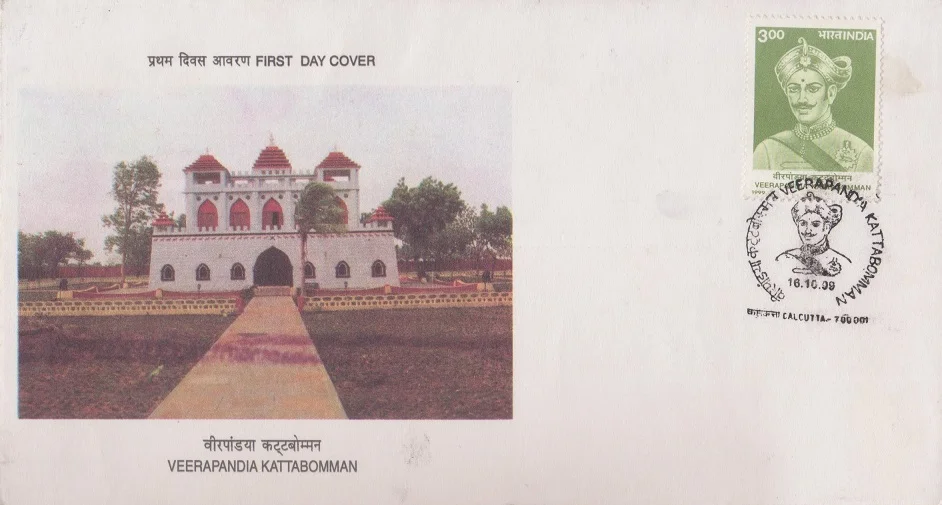
Veerapandia Kattabomman
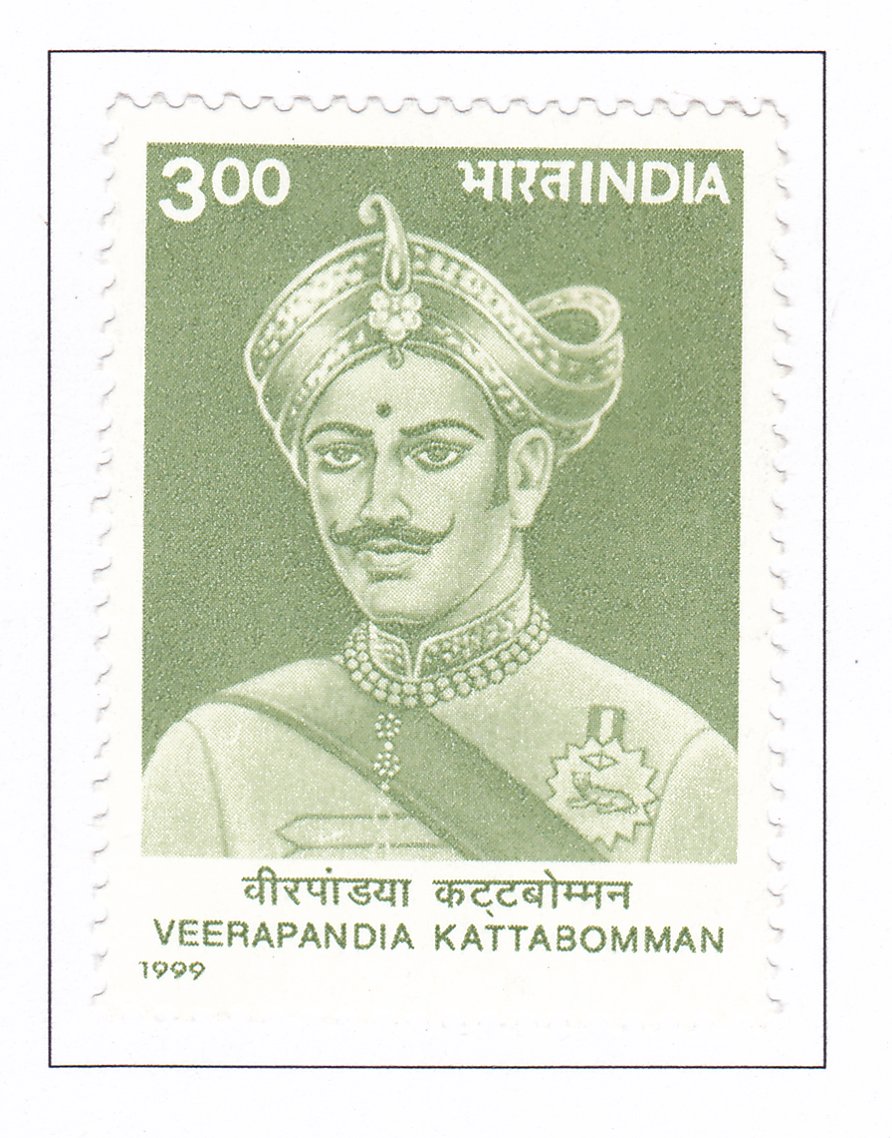
Technical Data
| Date of Issue | October 16, 1999 |
|---|---|
| Denomination | Rs. 3 |
| Quantity | 400,000 |
| Perforation | comb 13 x 13½ |
| Printer | Security Printing Press, Nashik |
| Printing Process | Photogravure |
| Watermark | No Watermark |
| Colors | Yellow green |
| Credit (Designed By) | |
| Catalog Codes |
Michel IN 1716 Stamp Number IN 1777 Yvert et Tellier IN 1483 Stanley Gibbons IN 1879 |
| Themes | Anniversaries and Jubilees | Famous people | Headgear | Men |
Early Freedom Fighter and Martyr of Tamil Nadu
Veerapandia Kattabomman (1760–1799) was one of the earliest freedom fighters of India and a symbol of resistance against British colonial rule. A brave ruler of Panchalankuruchi in Tamil Nadu, he is remembered as a great patriot who sacrificed his life for the nation.
Early Life and Rise to Power
Veerapandia Kattabomman became the ruler of Panchalankuruchi in 1790 at the age of thirty. During this period, much of South India was under the control of the Nawab of Arcot, who had transferred tax collection rights to the East India Company in 1792.
Resistance Against British Rule
Unlike many local rulers who submitted to British authority, Veerapandia Kattabomman strongly opposed the exploitative revenue policies of the East India Company. He refused to accept their unjust taxation system and openly defied their authority.
Repeated attempts by the British to capture the fort of Panchalankuruchi failed. Even an attempt by Collector W.C. Jackson to arrest him at Ramanathapuram did not succeed.
Formation of a Rebel Alliance
During the Fourth Mysore War, Veerapandia Kattabomman seized the opportunity to organize resistance against the British. He formed a powerful alliance of local chieftains (Poligars), including rulers from regions like:
- Nagalapuram
- Kulathur
- Kadalkudi
- Kollarpatti
- Sivaganga and Ramanathapuram
Together, they refused to pay tribute and challenged British authority.
Battle of Panchalankuruchi
Determined to crush the rebellion, Lord Wellesley ordered military action. British forces under Major John Bannerman attacked the fort of Panchalankuruchi on 5th September 1799.
Despite fierce resistance and heavy losses on both sides, the rebels were eventually forced to evacuate the fort after days of intense fighting.
Capture and Martyrdom
Veerapandia Kattabomman was later captured near Pudukottai and handed over to the British. On 16th October 1799, he was brought before an assembly at Kayathar and sentenced to death after a mock trial.
Displaying extraordinary courage, he chose to face death on his own terms. According to popular accounts, he hanged himself from a tamarind tree, becoming one of the earliest martyrs in India’s freedom struggle.
Commemoration and Legacy
To honor his sacrifice, India Post issued a commemorative postage stamp on the occasion of his 200th death anniversary in 1999.
Veerapandia Kattabomman is remembered for:
- His fearless resistance against colonial rule
- His refusal to submit to injustice
- His role as one of India’s earliest freedom fighters
Conclusion
Veerapandia Kattabomman remains a legendary figure in Indian history. His bravery and sacrifice laid the foundation for future resistance against British rule. Even today, he stands as a symbol of courage, patriotism, and unwavering determination.
First Day Cover